Castillo San Felipe del Morro: A Spanish Fortress at San Juan Bay
Site at a Glance
- Rating
- 4.8
- Popularity
- High
- Country
- United States
- Primary era
- Early Modern
- External website
- Open
- Eras represented
- Early Modern, Modern
- Civilizations
- Spanish
- Site type
- Military
- Remains
- Citadel
On this page14 sections
History
Castillo San Felipe del Morro is a Spanish fortress and citadel in Puerto Rico, United States, at San Juan, developed from harbor defenses authorized in 1539 and rebuilt as a major military work during the sixteenth century. Built to control the entrance to San Juan Bay, it protected the port and city of San Juan as part of the Spanish defensive system of Old San Juan. The Spanish Crown regarded San Juan as a strategically vital “Key to the Indies” during the period of long-distance maritime expansion known as the Age of Discovery and Sail.
Origins and Early Construction
King Charles V of Spain authorized the harbor defenses at El Morro and La Fortaleza in 1539. The initial work began as a small tower or proto-fortress under the direction of the conquistador Diego Ramos de Orozco. This early installation allowed the harbor to be defended while the larger fortress was being developed. An earlier battery on the promontory had four embrasures, or openings for guns, together with a three-gun water battery. By 1555, El Morro mounted eight bronze cannons.
In 1587, Field Marshal Juan de Tejeda and Bautista Antonelli, an Italian military engineer in Spanish service, prepared the principal design according to contemporary Spanish military principles. Construction of the redesigned fortress began in March 1589 under Governor Diego Menéndez de Valdés, after Tejeda and Antonelli had left San Juan. Captain Pedro de Salazar later assumed responsibility for the work. Skilled stonecutters, masons, smiths, a cooper, a metal founder, and an overseer worked alongside approximately 150 enslaved laborers.
Portuguese soldiers sent from Lisbon by order of Philip II formed the fortress’s first recorded garrison in 1593. El Morro’s name commemorates Philip II, the Spanish king who succeeded Charles V and supported the fortress’s early development. The fort’s landward defenses were developed with a hornwork, two half-bastions, a curtain wall, a moat, a drawbridge, a ravelin, a gate, a guardhouse, and batteries facing the sea.
Attacks and the Expansion of San Juan’s Defenses
El Morro defended San Juan during repeated attacks by foreign forces. In 1595, artillery from the fort struck the flagship of Sir Francis Drake, an English privateer and naval commander, and Drake’s fleet was repelled. George Clifford, Earl of Cumberland, captured the fort during an English land attack in 1598, but English forces later withdrew after a dysentery epidemic. Dutch forces commanded by Boudewijn Hendricksz attacked in 1625. El Morro resisted, although the city was sacked and burned.
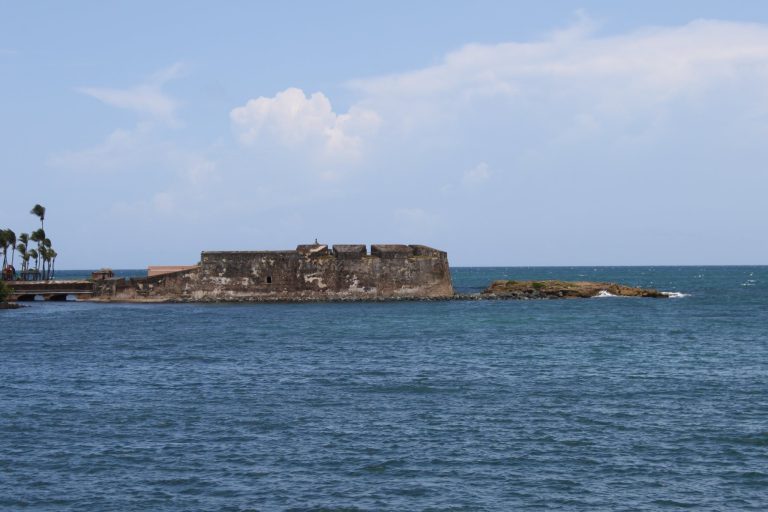
The defensive network around the fortress expanded over the following decades. Governor Enrique Enríquez de Sotomayor began the city walls in the 1630s, and by the late seventeenth century they substantially enclosed San Juan. Natural cliffs protected the Atlantic side, while the walls, coastal works, La Fortaleza, San Cristóbal, and El Cañuelo, also known as Fort San Juan de la Cruz, supported the defense of the harbor and city.
After the British capture of Havana during the Seven Years’ War, King Charles III appointed Field Marshal Alejandro O’Reilly and Colonel Tomás O’Daly in 1765 to reorganize San Juan’s defenses and garrison. Their work transformed San Juan into a Spanish “Defense of the First Order,” a military designation for a heavily fortified plaza of the highest defensive category. El Morro reached its present form in 1787.
British forces made another major attempt to take San Juan in 1797. General Ralph Abercromby and Admiral Henry Harvey led a force of approximately 7,000 to 13,000 men, but Spanish defenders under Captain General Ramón de Castro and local militia officers repelled the attack. In 1825, the Puerto Rican privateer Roberto Cofresí was imprisoned and later executed within the castle.
Transfer to the United States and Preservation
A United States naval force bombarded San Juan on 12 May 1898 during the Spanish-American War. The attack damaged El Morro’s lighthouse and fortifications. Spain ceded Puerto Rico to the United States under the Treaty of Paris, and San Juan’s defenses were formally transferred to the United States Army in October 1898.
During the early twentieth century, El Morro became part of the United States Army post known as Fort Brooke. In 1915, Lieutenant Teófilo Marxuach fired on the German merchant ship Odenwald when it attempted to leave San Juan without authorization. The action is widely regarded as the first United States shot associated with the country’s participation in the First World War.
During the Second World War, the United States Army added concrete observation posts and an underground bunker as part of the harbor-defense system and to monitor possible German submarine activity in the Caribbean. The Army withdrew from El Morro in 1961, after which the fortress passed to the National Park Service for preservation as part of San Juan National Historic Site.
Castillo San Felipe del Morro and the fortifications of Old San Juan form part of La Fortaleza and San Juan National Historic Site, which UNESCO designated a World Heritage Site in 1983. El Morro was also included in the United States National Register of Historic Places in 1966. In 1992, the exterior esplanade was restored to an open field-of-fire appearance through the removal of Army-era palm trees, roads, and parking areas. The lighthouse was repaired and restored during the same broad period of preservation.
Remains
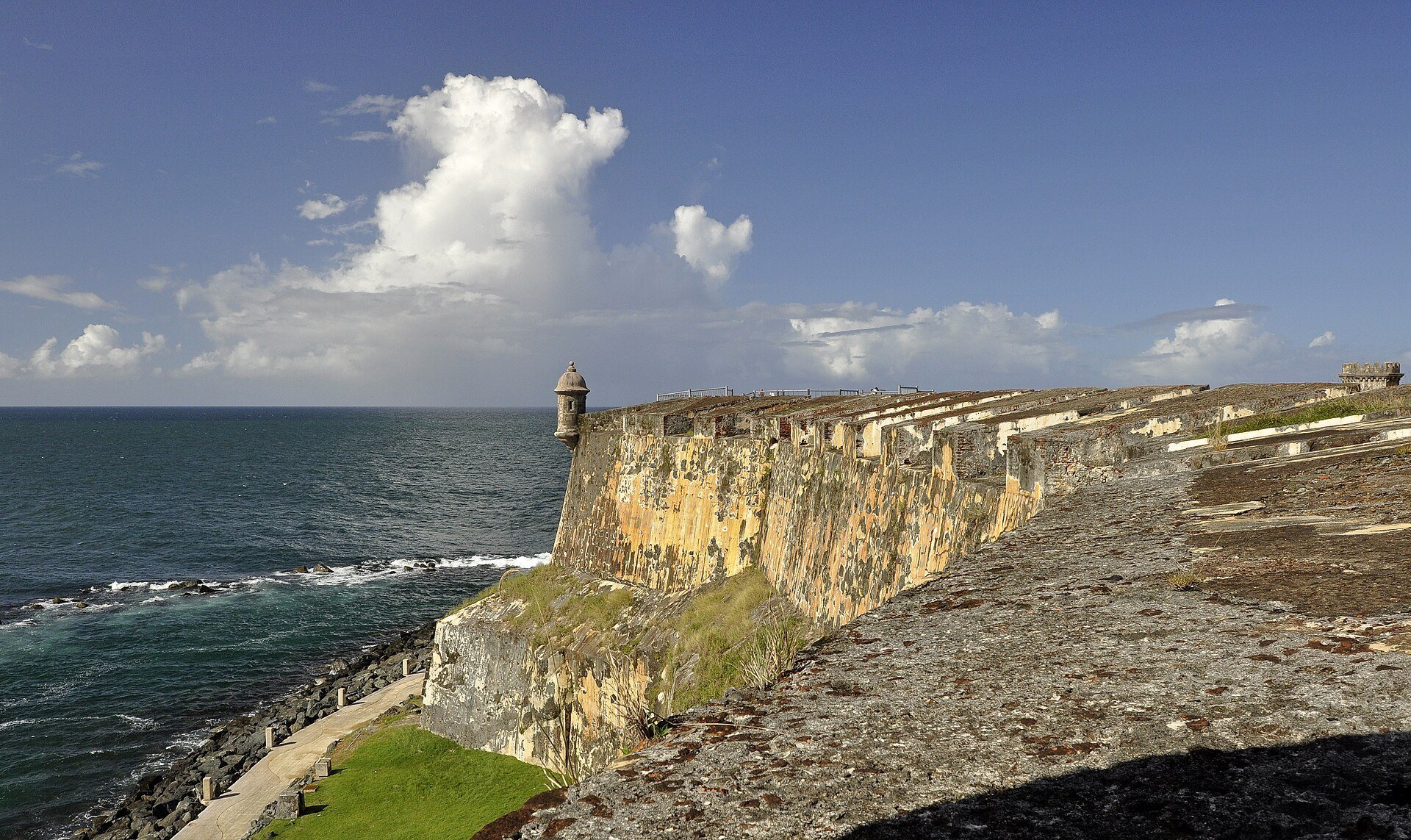
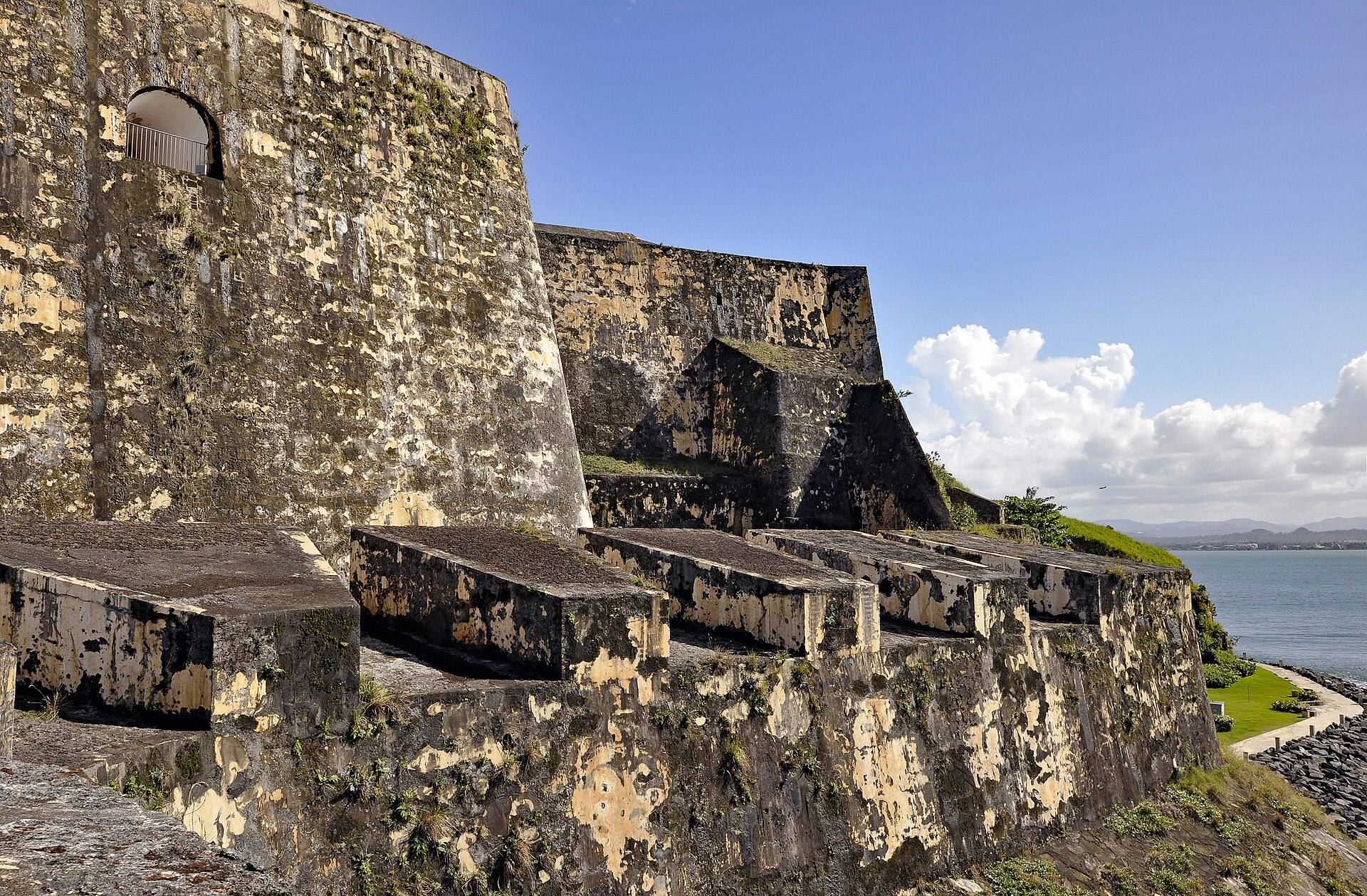
El Morro occupies a steep, rocky promontory at the northwestern end of San Juan Islet, overlooking the Atlantic and guarding the entrance to San Juan Bay. The fortress rises approximately 43 to 44 metres above sea level and extends across about 28 hectares, including the outer esplanade. Its six levels form a large citadel and promontory fort, a stronghold that uses a projecting headland and its steep sides as part of its defensive system.
Landward Defenses
Hornwork and Entrance
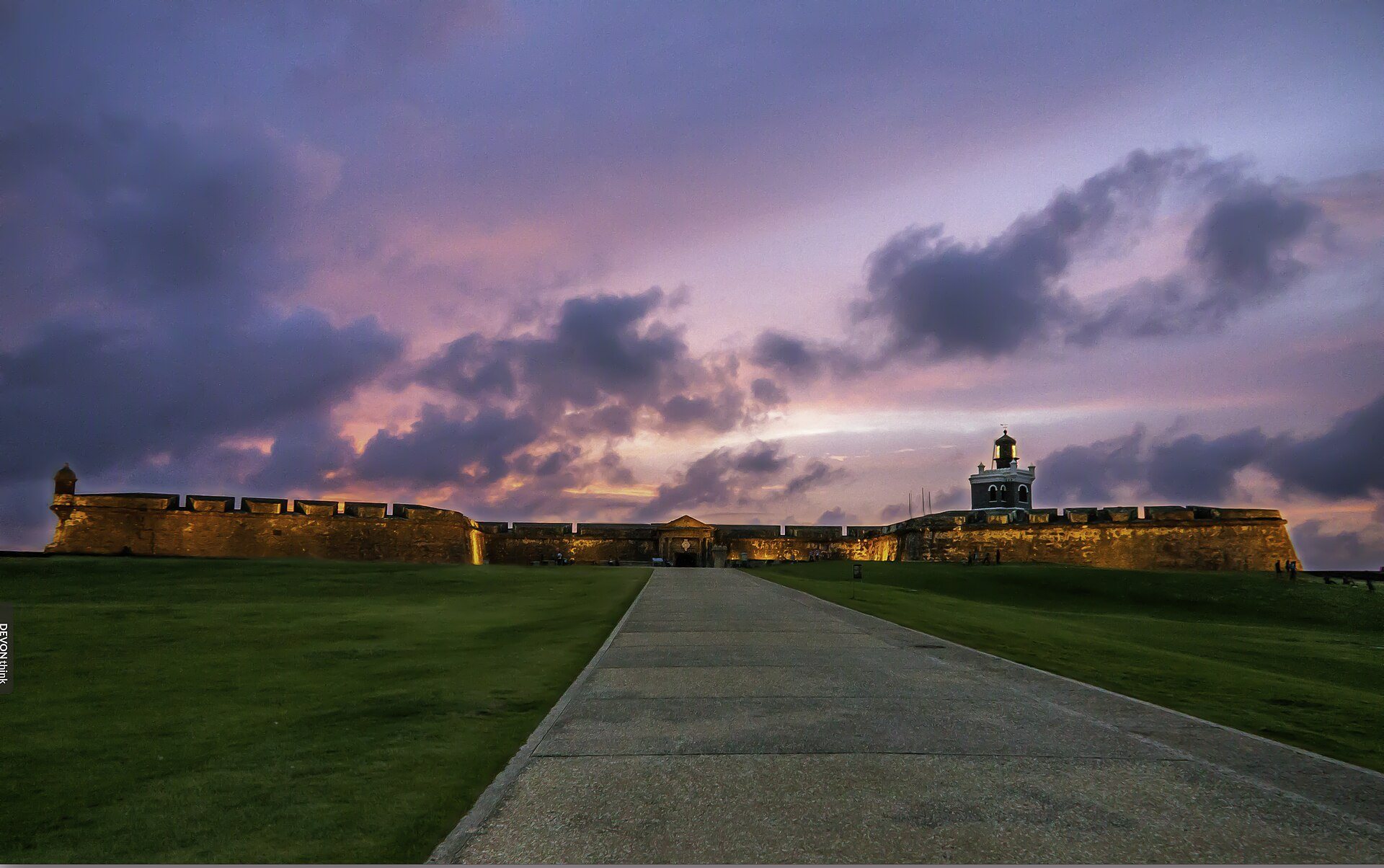
The landward hornwork, a projecting fortified outwork, crosses the headland in front of the earlier tower and water battery. It consists of the Atlantic-side Tejeda Bastion and harbor-side Austria Bastion, two half-bastions joined by a curtain wall. Outside the curtain wall lies a dry moat. A drawbridge leads to a gate protected by a ravelin, a detached triangular defense placed before a gate or curtain wall, while a guardhouse stood immediately inside the entrance.
Walls and Open Defensive Ground
The fortress is built principally from sandstone, limestone, brick, sand, clay, and rubble. Its walls are generally about 5.5 to 7.6 metres thick, while strengthened sections reach approximately 12.2 metres. Earlier outer walls were about 1.8 metres thick before later enlargement. Inner and outer courtyards, ramps, battlements, sentry boxes, guardhouses, the dry moat, and the glacis form a multilevel defensive complex. The glacis, a gently sloping area outside a fortification, and the esplanade were kept open as a field of fire for the cannon.
Batteries and Water Supply
Santa Bárbara Battery
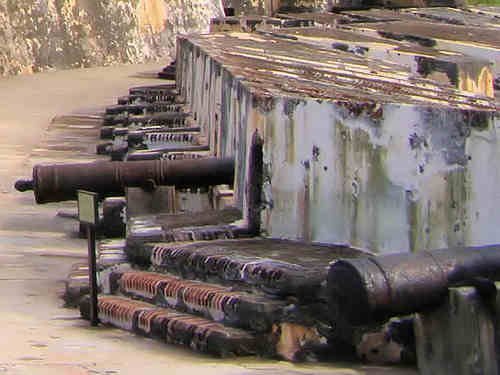
El Morro retains sea- and harbor-facing batteries, including two batteries positioned behind the hornwork. The Santa Bárbara Battery became the principal battery after the eighteenth-century improvements. It held 37 cannons, lower-level guns in fortified chambers called casemates, and additional casemates in the upper great wall.
Cisterns
Three cisterns beneath the main plaza were added during the improvements carried out between 1765 and 1787. Together they could hold approximately 820,000 litres of rainwater, providing a substantial water reserve within the fortress.
Lighthouse and Later Military Features
Lighthouse
A lighthouse was built atop El Morro in 1843. The original structure was destroyed during the 1898 bombardment. A replacement erected in 1899 as an octagonal reinforced-concrete tower developed a crack and was demolished. The present lighthouse was built by the United States in 1908 and rises approximately 55 metres above sea level.
Garitas and Second World War Installations
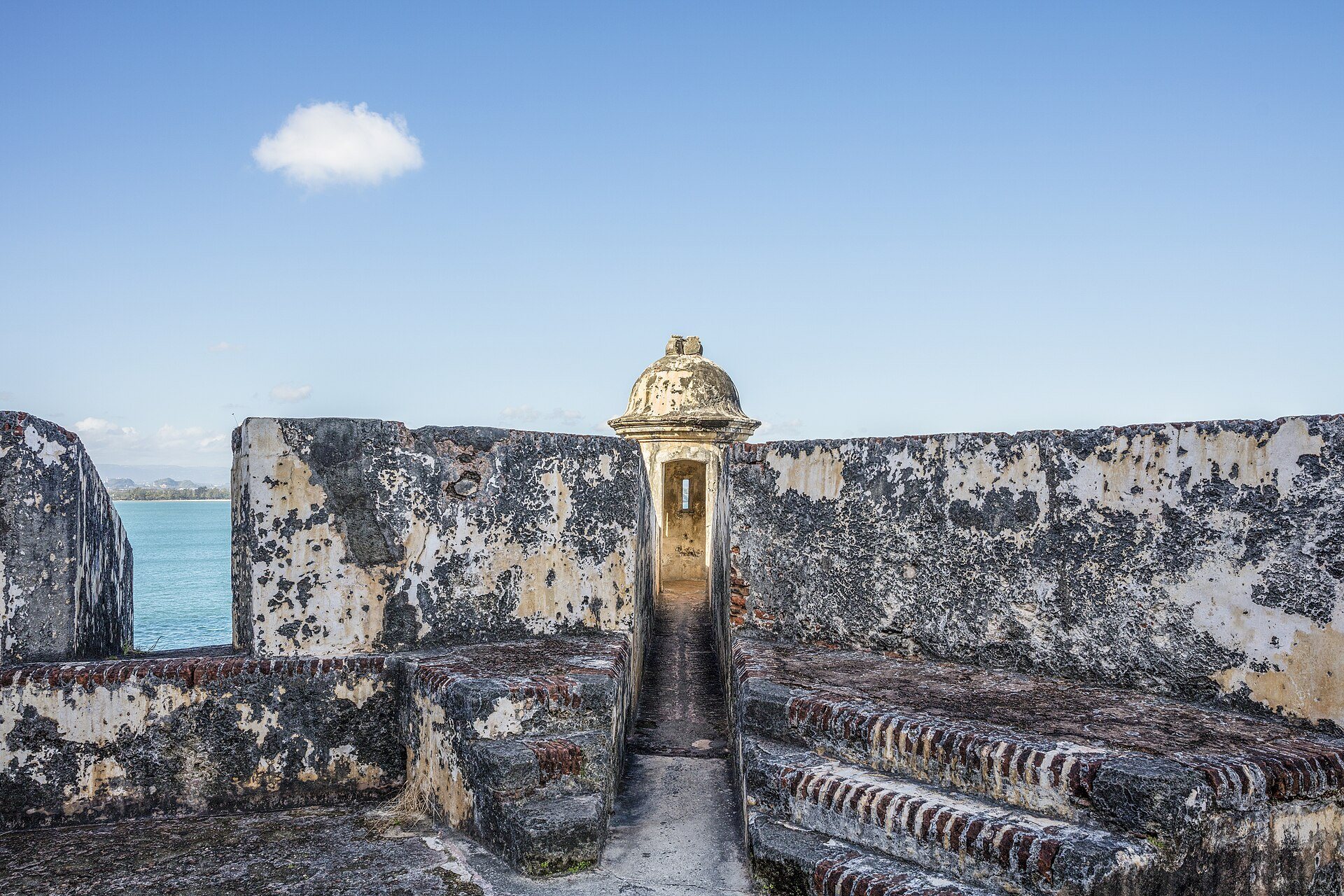
Small domed sentry boxes, known as garitas, project from the walls and have become a distinctive cultural symbol of Puerto Rico. The fortress also retains reinforced-concrete observation posts and an underground bunker added by the United States Army during the Second World War. Across the bay, El Cañuelo complemented El Morro’s defense of the harbor entrance, while San Cristóbal, the city walls, and other coastal works formed part of the wider defensive network.
The 1992 clearance of the esplanade removed later palm plantings, paved roads, and parking areas. This work restored the open appearance associated with the fortress’s colonial defensive setting and returned the outer ground to a form suited to its original artillery function.