Fortín de San Gerónimo: A Spanish Colonial Coastal Fort in San Juan
Site at a Glance
- Rating
- 4.6
- Popularity
- Low
- Country
- United States
- Primary era
- Early Modern
- Eras represented
- Early Modern
- Civilizations
- Spanish
- Site type
- Military
- Remains
- Fort
On this page11 sections
History
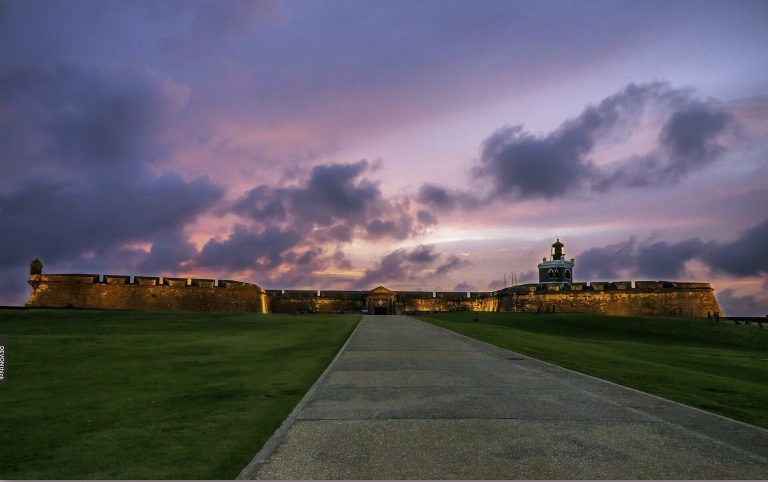
Fortín de San Gerónimo is a Spanish colonial fort in Puerto Rico, United States, at the mouth of the Condado Lagoon in San Juan. Built to replace an earlier artillery battery, it formed part of the defenses protecting the city and its harbor, and its present form largely reflects reconstruction during the late eighteenth century.
Origins and Early Reconstruction
The fort replaced the smaller El Boquerón battery at the eastern end of San Juan Islet. That battery helped defend San Juan during Sir Francis Drake’s attack in 1595, but it was destroyed three years later during the assault led by George Clifford, third Earl of Cumberland. In 1609, Governor Gabriel de Rojas restored the fort and established the location and dimensions that shaped its later development.
Further substantial changes took place in 1646 and 1664. During this period the fort also served as a prison, adding a custodial function to its role as a coastal defense position.
Late-Eighteenth-Century Expansion
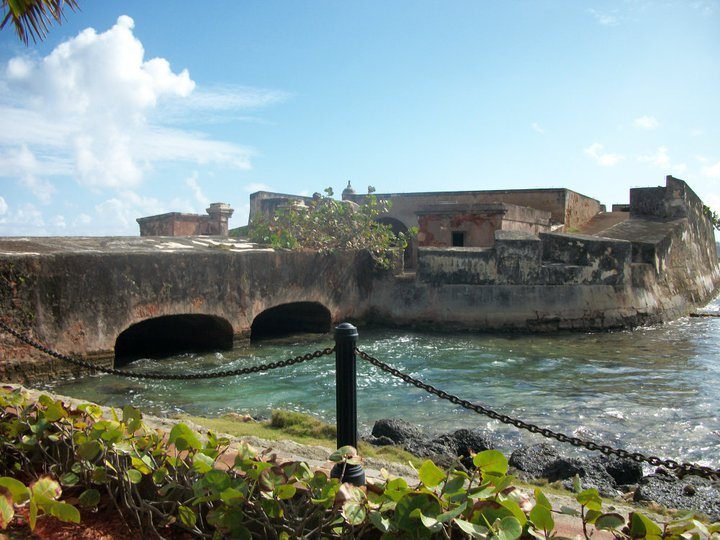
Major rebuilding and enlargement began in 1791. The reconstruction is attributed to Juan Francisco Mestre, a military architect associated with the project, and the work was completed in 1796. It raised the fort’s artillery platform, added larger rooms for soldiers and ammunition, and improved access during high tide by raising the two-arched stone bridge.
The reconstruction incorporated San Gerónimo into San Juan’s first defensive line, together with Fortín San Antonio and Escambrón Fort. Castillo San Cristóbal formed the final defensive line protecting the city’s principal entrance.
The British Invasion of 1797
San Gerónimo and San Antonio played a central role in resisting the British invasion commanded by Admiral Henry Harvey and Sir Ralph Abercromby. Harvey was a senior Royal Navy officer, while Abercromby was a British army commander. British troops landed at Cangrejos on April 17, 1797, as Harvey blockaded San Juan Harbor and Abercromby tried to capture the Martín Peña Bridge and advance from Miramar across the San Antonio Bridge.
Governor and Field Marshal Ramón de Castro y Gutiérrez, a Spanish colonial governor and senior military commander, prevented the capture of San Juan. British forces withdrew from Puerto Rico on April 30. During the approximately two-week siege, heavy bombardment badly damaged San Gerónimo and Fortín San Antonio. Their defenders reportedly fired muskets and cannon from behind sandbags after the fortifications were damaged, and both forts were later rebuilt and enlarged.
Ownership and Preservation
After the Spanish-American War, the fort passed to the United States Army. In 1921 it was transferred to Colonel Baker for use as a residence under a 999-year arrangement. The Institute of Puerto Rican Culture later became the property’s owner, and the Hilton managed it for a period.
Fortín de San Gerónimo was added to the U.S. National Register of Historic Places on October 11, 1983. It is also a contributing property of the Línea Avanzada historic district and is protected under Puerto Rico’s historic-sites system, although it is not part of San Juan National Historic Site. In 2004-2006, the Institute of Puerto Rican Culture and the U.S. Army Corps of Engineers pursued plans for a breakwater to reduce water-related deterioration. Federal legislation in 2009 directed the Secretary of the Interior to study whether the fort should become part of San Juan National Historic Site.
After roughly two decades of closure, the Asociación Amigos del Fortín de San Jerónimo was founded in 2018 as a nonprofit organization dedicated to preservation, restoration, maintenance, and eventual reopening. The Institute of Puerto Rican Culture later closed the fort for proposed renovation work. In 2023, the U.S. House of Representatives passed a bill that would make the fort an affiliated area of the National Park Service.
Remains
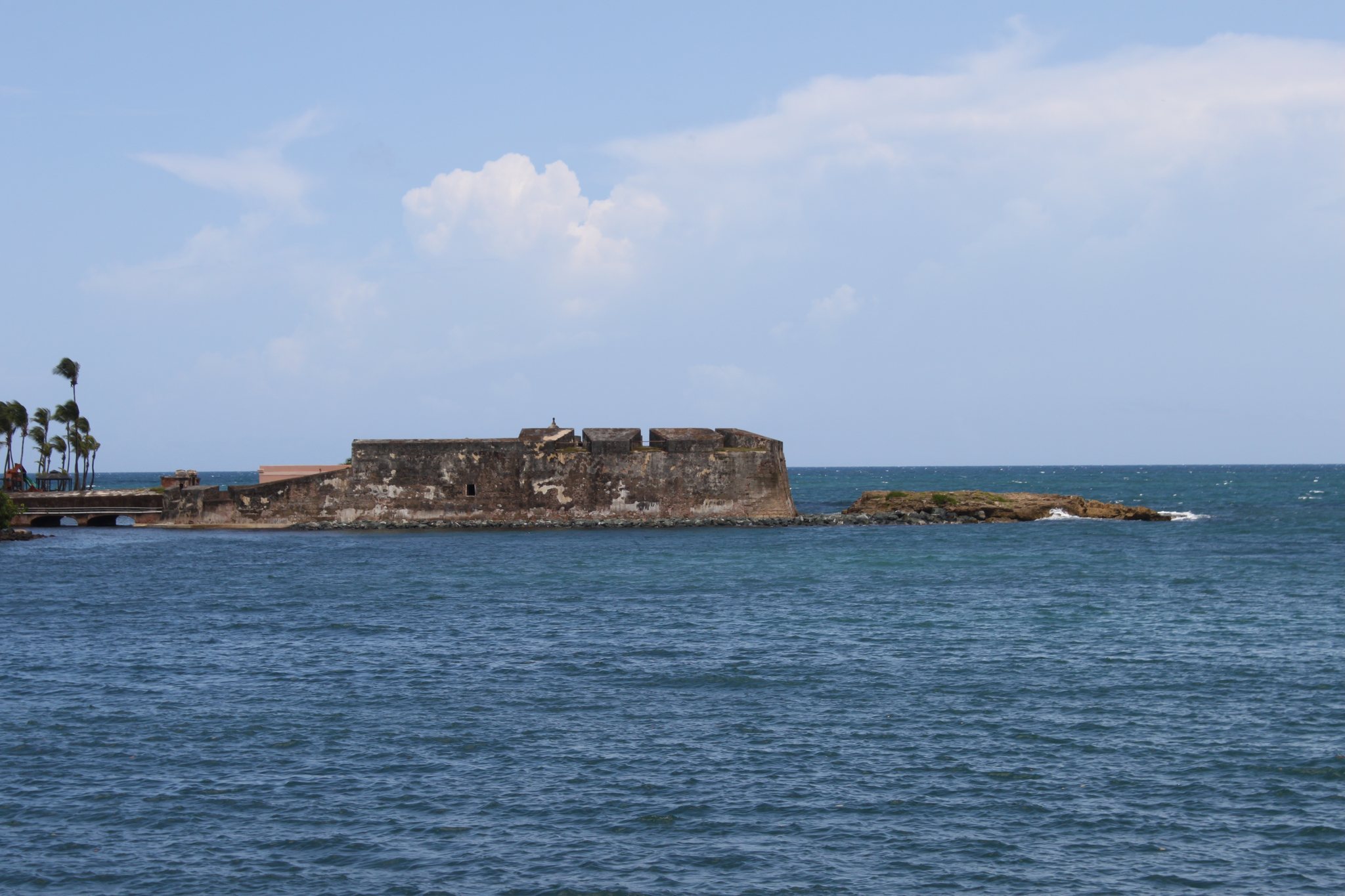
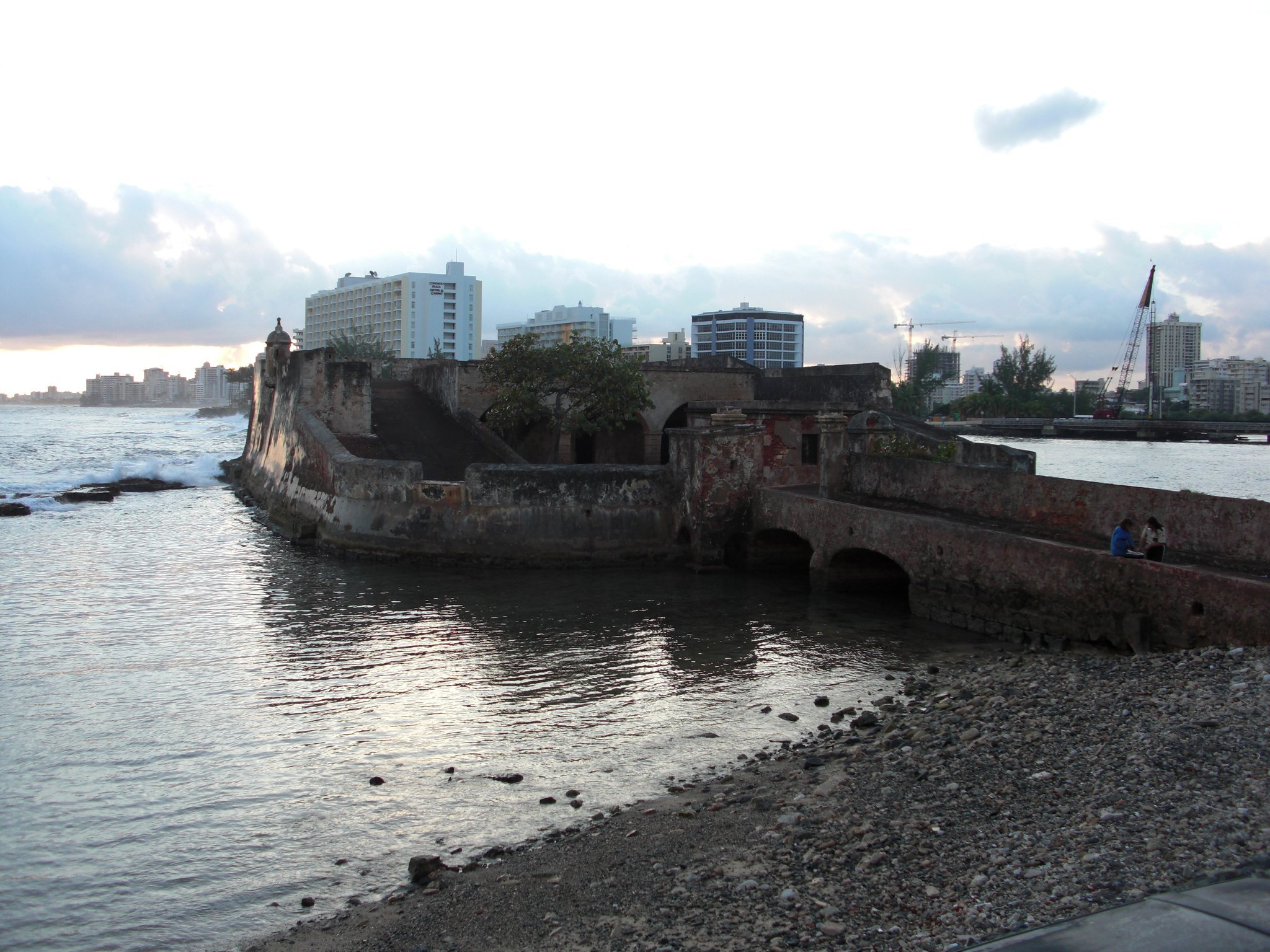
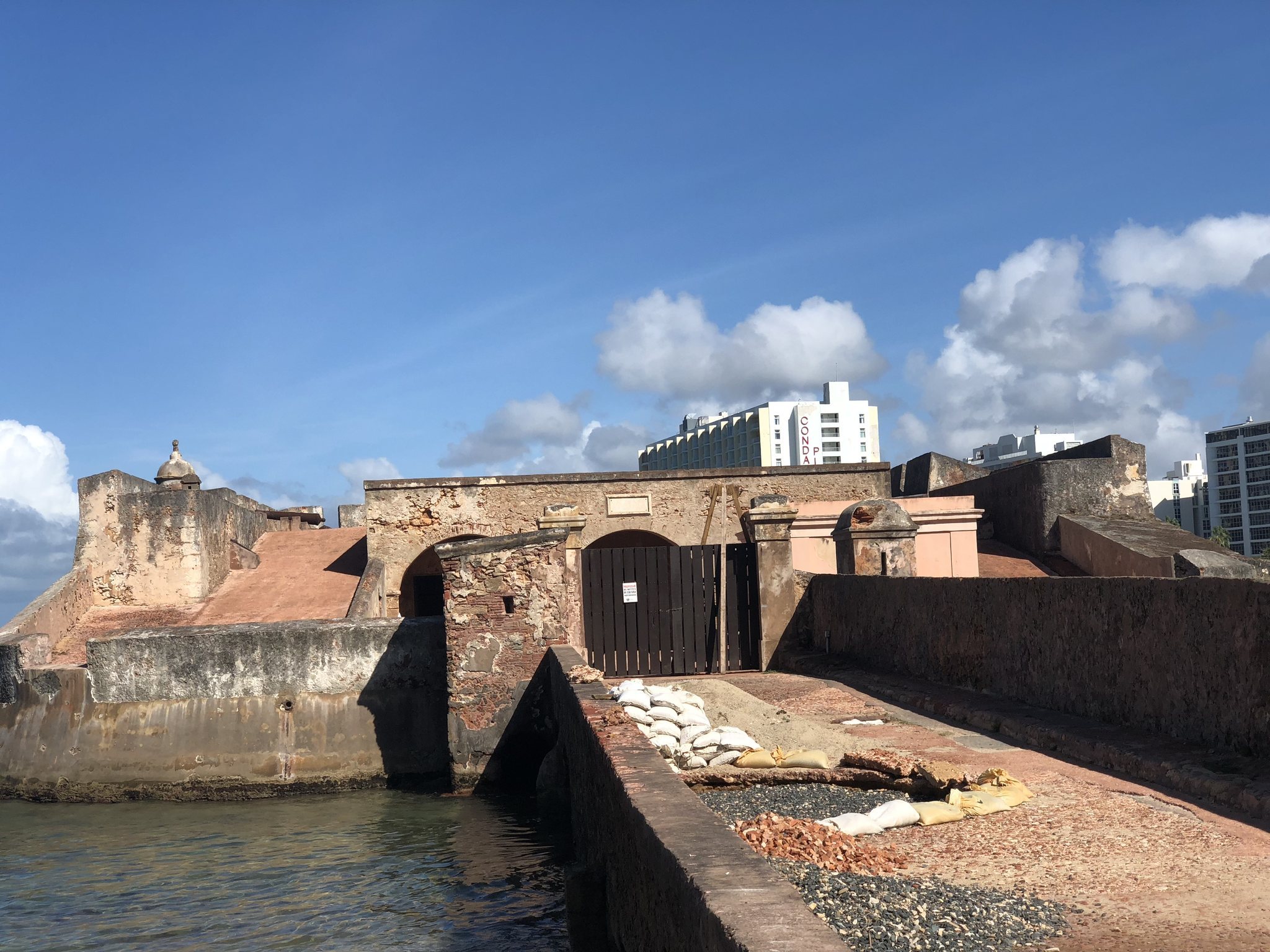
Fortín de San Gerónimo occupies a small rocky plateau beside the grounds of the Caribe Hilton Hotel, at the mouth of the Condado Lagoon. The plateau is submerged at high tide and connected to San Juan Islet by a bridge. The fort is a compact rectangle with rounded corners, measuring approximately 31 meters across and 53 meters in length, with its highest point about 9 meters above sea level.
Fort Structure and Defenses
Form and Access
The entrance opens into a small courtyard containing the powder store and soldiers’ barracks. Ramps on both sides allowed cannon to be moved up to the roof platform. The two-arched stone bridge was raised during the 1791-1796 rebuilding to improve access when high tide covered the surrounding plateau.
Guns and Lookout
Nine gun embrasures, openings through which cannon could fire, were arranged around the fort. Approximately half covered the narrow passage toward the bay. The north wall carries the fort’s projecting lookout turret, which gave a sentry some protection while observing approaching enemies.
Water Storage and Later Damage
Two water cisterns survive within the fort. Its walls also bear the physical consequences of the 1797 bombardment and later rebuilding and enlargement. Water erosion subsequently threatened the masonry, leading to proposed breakwater and preservation measures. The fort has been used as a museum and has contained an exhibit on San Juan’s history, while also accommodating occasional private activities.
Polvorín de San Gerónimo
The Polvorín de San Gerónimo is a separate gunpowder house built in 1769, approximately 700 meters away in Luis Muñoz Rivera Park. It supplied the fort with gunpowder and formed part of the logistical system supporting San Gerónimo’s artillery defenses.