Chiesa Madre: The Principal Catholic Church of San Cataldo
Site at a Glance
- Rating
- 4.6
- Popularity
- Low
- Country
- Italy
- Primary era
- Early Modern
- External website
- Open
- Eras represented
- Early Modern, Modern
- Civilizations
- Italian, Kingdom of Sicily, Kingdom of the Two Sicilies, Spanish
- Site type
- Religious
- Remains
- Church
On this page20 sections
History
Chiesa Madre is the principal Catholic church of San Cataldo, Italy, founded by the Galletti family and dedicated to the Immaculate Conception. Construction began in 1633 during a period of population growth, and the church became an important religious centre in the settlement. Its design is associated with Baroque architecture and the post-Tridentine reforms, the Catholic reforms that sought to make worship and religious instruction more effective for large congregations. The church is also classified in architectural descriptions as Romanesque.
Foundation and seventeenth-century rebuilding
The church was first dedicated to the Nativity of Mary. In 1632, Baron Vincenzo Galletti asked the Bishop of Agrigento for permission to construct a larger church and establish an archpriesthood, a prominent parish led by an archpriest. He assigned an annual income of 40 onze to support its opening for worship and reserved the right to appoint the archpriest.
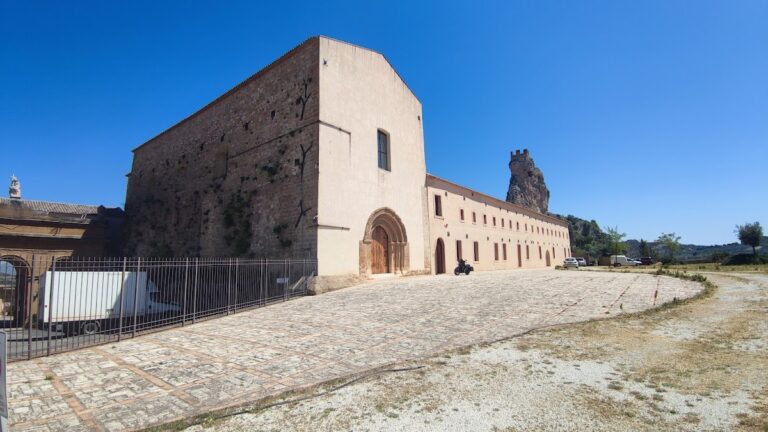
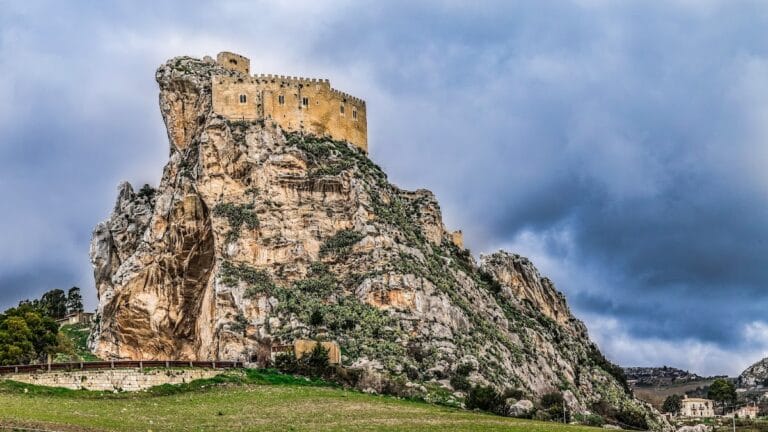
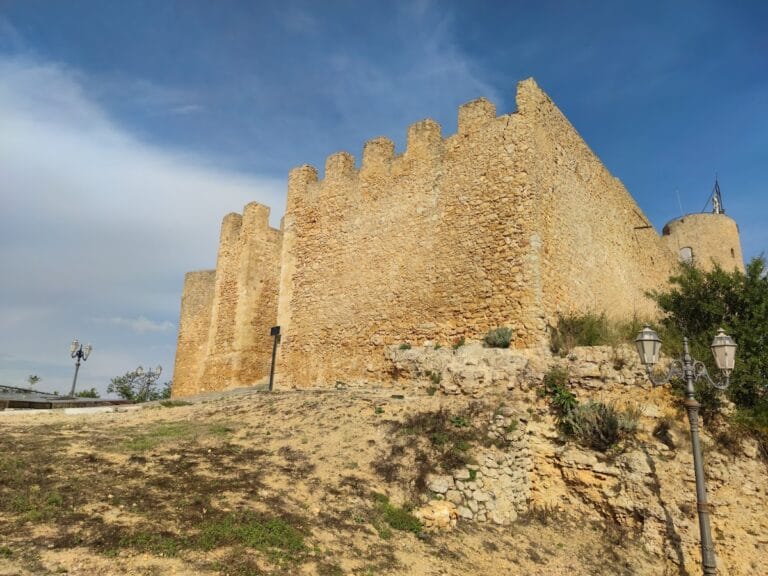
The new building was placed in the upper part of San Cataldo, on a rocky outcrop near the castle. It replaced the small Augustinian church in the lower part of present-day Via San Nicola, which could no longer accommodate the growing population. The Galletti family, who founded San Cataldo, retained patronage rights and continued to finance improvements to the church.
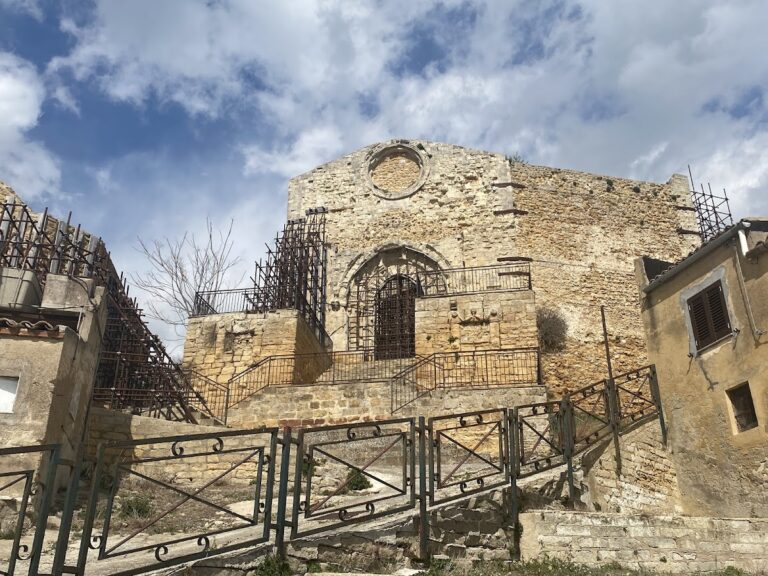
During the seventeenth century, sections of the chapels of the Crucifix and San Cataldo collapsed. The community responded by rebuilding and enlarging the church. A landslide then damaged the foundations in 1698. Prince Galletti arranged for repairs, and the interior was almost completely transformed to improve the building’s stability.
Completion and eighteenth-century development
The author of the design is unknown. Its architectural language has been linked to the circle of builders and collaborators associated with Giovanni Battista Vaccarini, the eighteenth-century Sicilian architect known especially for his work in the rebuilding of Catania after the 1693 earthquake. This is an attribution to Vaccarini’s circle rather than confirmed authorship by Vaccarini himself.
Chiesa Madre was solemnly consecrated on 9 May 1739 by Pietro Galletti, Bishop of Catania and brother of Prince Giuseppe Galletti, under the protection of the Immaculate Virgin. A pastoral visitation by Lorenzo Gioeni, Bishop of Agrigento, in 1745 described the church’s internal organization, including seven side altars in each nave, the chapel of the Blessed Sacrament, and the chapel of Saint Cataldo.
In 1768, Giuseppe Caruso, a member of a Catanian family of master builders, was commissioned to work on the facade and floor and to install the funerary monument to Giuseppe Galletti. The church’s association with the Galletti family therefore continued through both its religious patronage and its physical development.
Nineteenth-century alterations
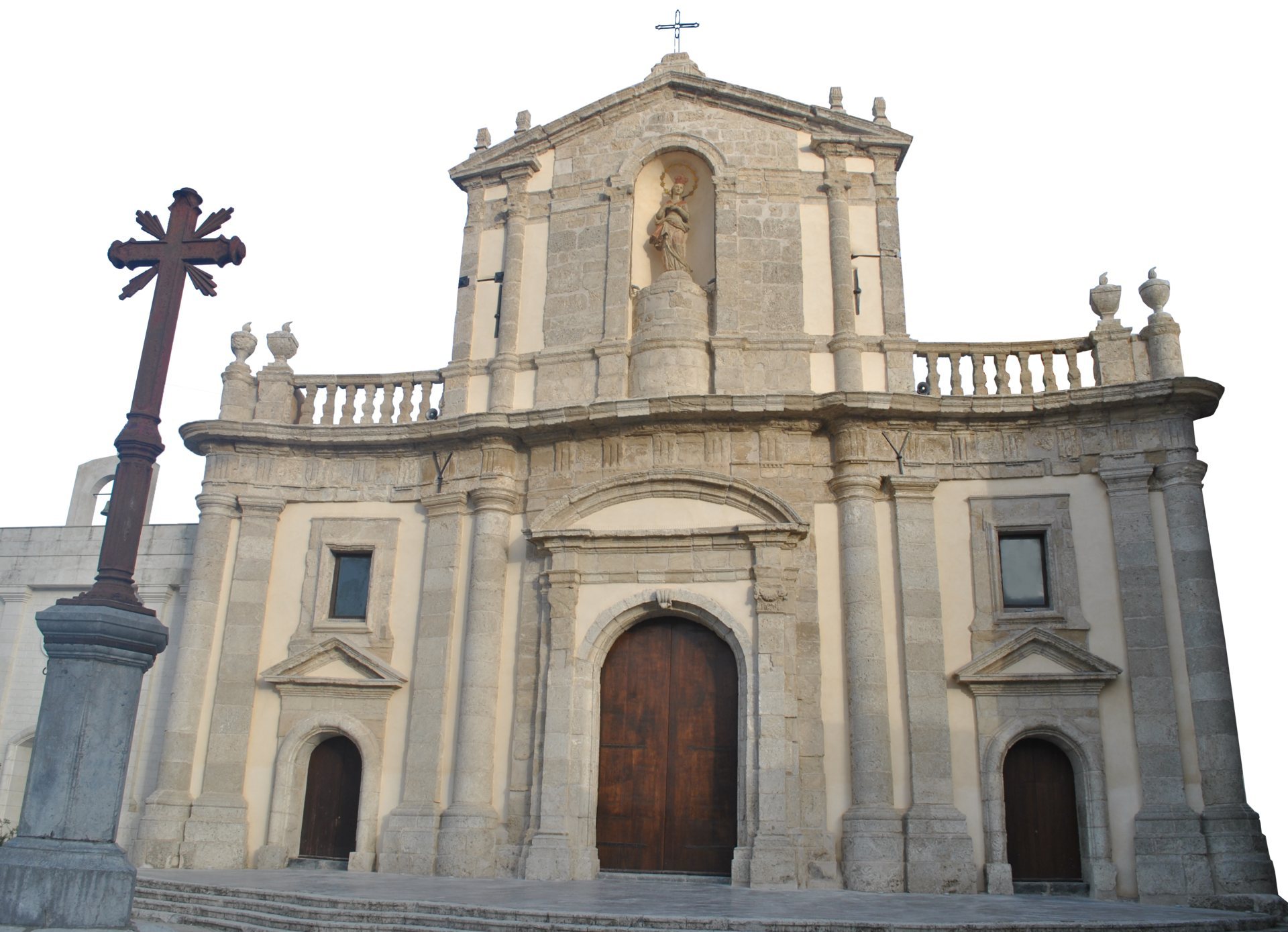
Archpriest Antonino Amico Roxas began a new carved-stone facade in 1820, using a Tuscan-Spanish architectural design. Work stopped after his death in 1822 and was later resumed by Don Calogero Giamporcaro. The facade was completed under the direction of the Palermo architect Emanuele Di Bartolo. Some of the stones had originally been prepared for an unfinished Greek-cross church dedicated to Saint Anthony Abbot.
Archpriest Luigi Giamporcaro commissioned extensive restoration from the master builder Vasano and the stonecarvers Nicola and Antonio Perricone. Their work continued until 1845. In 1879, Archpriest Raimondo Maira ordered new marble paving and the restoration of the chapels of the Immaculate Conception, the Crucifix, and the Blessed Sacrament. These works were completed in 1889.
Archpriest Arcangelo Salomone devoted 26 years of his archpriestly income to worship and improvements. During his tenure, the paving of the Blessed Sacrament chapel was completed in 1892, the statue of the Immaculate Conception was gilded by Alfio Villani in Catania in 1893, and the choir was paved in 1894. He also commissioned a new pipe organ.
Twentieth-century religious and civic importance
A funerary monument to Giovanni Guttadauro, the second Bishop of Caltanissetta, was inaugurated beside the altar of the Immaculate Conception on 29 June 1904. A second monument commemorates Prince Giuseppe Galletti in the Crucifix chapel. The central barrel vault was decorated by the local painter Salvatore Naro during the first half of the twentieth century.
Chiesa Madre has remained the principal setting for San Cataldo’s major religious celebrations. These include the anniversary of the dedication on 9 May, the feast of Saint Cataldo on 10 May, the October feast of the Most Holy Crucifix, the feast of the Immaculate Conception on 8 December, Holy Week processions, and the procession of the Nativity of Mary on 8 September. The feast of the Assumption has not been held since August 2019.
The church is also associated with the Mercedarian church through the traditional movement of the Immaculate Conception statue. During the octave of the feast, the statue spends eight days at the Mercedarian church before returning to Chiesa Madre. Local tradition says that bad weather would cause it to remain there permanently, although ecclesiastical authorities deny that any such contract or agreement exists.
The church contains the remains of Archbishop Cataldo Naro, Archbishop Alberto Vassallo di Torregrossa, and Marianna Amico Roxas. Giacomo Cusmano preached there, and Angelo Giuseppe Roncalli visited before becoming Pope John XXIII. The parish community has also produced several bishops and archbishops, including Luigi Giamporcaro, Luigi Cammarata, Alberto Vassallo di Torregrossa, Cataldo Naro, Francesco Lomanto, Giuseppe La Placa, and Salvatore Rumeo.
Closure, restoration, and Lateran affiliation
On 26 April 1965, Mayor Ferdinando Maiorana ordered the church closed for worship after the municipal technical office declared it unsafe because of the landslide. Local residents protested, including through an occupation of the church. A citizens’ committee led by Giuseppe Alessi raised funds for urgent rehabilitation, and proposals to demolish the building were abandoned.
The Immaculate Conception returned to Chiesa Madre on 8 December 1979, after the church had been closed for fourteen years. Bishop Alfredo Maria Garsia and Archpriest Gabriele Nicosia celebrated the first Mass after the reopening. Further restoration between 1 October 2015 and 15 February 2016 repaired the facade and upgraded the electrical system. Bishop Mario Russotto reopened the church after the works on 27 February 2016.
A special year marking the 280th anniversary of the dedication ran from 8 December 2018 to 8 December 2019. The anniversary was celebrated on 9 May 2019 with a solemn concelebration presided over by Salvatore Gristina, Archbishop of Catania. On 8 December 2019, Chiesa Madre was affiliated by a particular bond with the Lateran Archbasilica, the cathedral church of the Bishop of Rome. A decree of the Apostolic Penitentiary issued on 10 October 2019 granted perpetual plenary indulgences, the remission of the temporal effects of sin under prescribed conditions, to properly prepared faithful visiting the church on specified feast days and during an annual collective pilgrimage.
Remains
Plan, facade, and interior
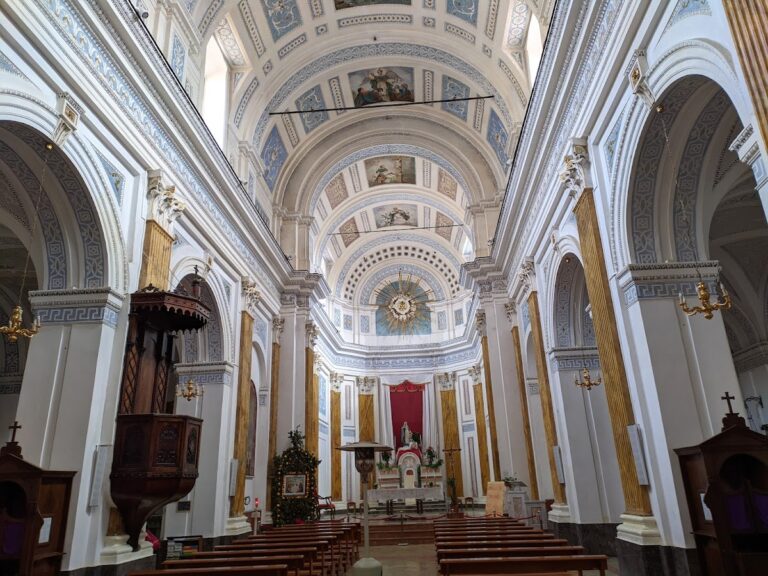
Chiesa Madre occupies the highest and most central point of San Cataldo, on a rocky outcrop near the former castle. Its basilical plan has a central nave flanked by side aisles, a Latin-cross layout with a shorter transept, a central dome, and a large choir chapel. The arrangement reflects the church’s role as a principal parish space and its connection with post-Tridentine religious practice.
Facade and vault
The facade is built of carved stone and follows a Tuscan-Spanish design. Some of its stones were reused from the unfinished Church of Saint Anthony Abbot. Inside, the central barrel vault, a continuous curved ceiling formed by extending an arch along the length of the church, was decorated by Salvatore Naro. Marble paving extends through the church, including the choir and the chapel of the Blessed Sacrament.
Altars, paintings, and sculptures
The 1745 description records seven side altars in each nave, together with chapels dedicated to the Blessed Sacrament and Saint Cataldo. The high altar holds Carmelo Riggi’s 1781 painting of the Nativity of Mary. The church also preserves an anonymous eighteenth-century painting of the Adoration of the Shepherds, a painting of the Sacred Heart of Jesus by Riggi, and sculptures of an ivory Crucifix, Saint Michael the Archangel, the Immaculate Conception, and Saint Cataldo. The dates and makers of the sculptures differ, and several are unknown.
A Roman ivory Crucifix almost 75 centimetres high has stood on the high altar since 2013. Other preserved objects include the jeweled crown of the Immaculate Conception, the body of Saint Clement the Martyr pending restoration, the gold pectoral cross of Luigi Cammarata, a silver monstrance used to display the consecrated Eucharistic host, and a statue of the Annunciation by Cardella of Agrigento.
Crucifix reliquary
A reliquary associated with the Crucifix contains numerous relics of saints and martyrs. It is opened once a year during the feast of the Crucifix, linking the object to one of the church’s principal devotional celebrations.
Music and bells
Pipe organ
The pipe organ commissioned by Archpriest Arcangelo Salomone was contracted on 9 April 1904 with Pacifico Inzoli of Crema. It replaced a smaller instrument made in 1745 by the Palermo organ builder Michele Andronico. The later organ has mechanical transmission with some pneumatic elements, two hand-operated keyboards, a 27-note pedalboard, and 16 stops that control its sounds.
The organ was dismantled and stored while the church was closed. Francesco Oliveri of Acicatena restored it, and it was reassembled behind the high altar in August 2000.
Bell tower
The bell tower rises beside the cathedral’s side staircase. Three bells were installed when the church was founded, and three additional large bells were added for the consecration on 9 May 1739. The largest bell was originally cast in 1779 at the expense of Prince Nicolò Galletti. After it was damaged in 1887 and lost a section weighing about two quintals, or approximately 200 kilograms, in 1889, it was recast in 1898 by Vincenzo Benedetti of Rieti under the direction of Arcangelo Salomone.
The recast bell, together with another weighing about five quintals, produced an instrument of approximately 30 quintals. It was dedicated to the Most Holy Crucifix and the Immaculate Conception and blessed by Bishop Ignazio Zuccaro on 14 February 1898. The tower now contains six bells. One inscription is on the exterior and cannot currently be read. Another bell commemorates the 250th anniversary of the dedication with the date 9 May 1989, while a further bell records wartime removal between 1940 and 1945 and restoration in 1950. The smallest bell was recast in 1989.
Associated religious buildings
Oratory of the Blessed Sacrament
The Oratory of the Blessed Sacrament is attached to Chiesa Madre. Ignazio Amico founded it with its confraternity, a voluntary religious association of laypeople formed around shared devotional or charitable activities, in 1645. The oratory contains a statue of the Christ Child by Bagnasco, a Crucifix used during Holy Week, and a painting by Roxas depicting the Passion of Christ. It was restored in the 1970s and again in 2009.
Church of San Giuseppe
The Church of San Giuseppe stands on the site of the former oratory of Saint Francis and is adjacent to the clergy house. Archpriest Baldassare Amico established it in 1708, and it was rebuilt during the nineteenth century.
Church of Saint Anthony Abbot
The Church of Saint Anthony Abbot, later associated with Our Lady of Mount Carmel, originated in an unfinished Greek-cross project begun in 1740 by Archpriest Isidoro Amico. Its carved stones were reused for the facade of Chiesa Madre in 1818. The later church has a single nave and was rebuilt between 1900 and 1905.
Church of the Lord of the Mysteries
The Church of the Lord of the Mysteries was founded at the beginning of the nineteenth century near the monumental Calvary and its Stations of the Cross. Structural danger led to its closure in 1870, and the building was reconstructed between 1898 and 1899.
Church of Madonna della Catena
The Church of Madonna della Catena forms part of the group of institutions associated with Chiesa Madre and the religious life of San Cataldo.