Jinbayama Kofun: An Early Keyhole-Shaped Burial Mound in Japan
Site at a Glance
- Rating
- 3.7
- Popularity
- Very Low
- Country
- Japan
- Primary era
- Classical
- External website
- Open
- Eras represented
- Classical
- Civilizations
- Unclassified
- Site type
- Burial
- Remains
- Burial Mound
On this page7 sections
History
Jinbayama Kofun is a keyhole-shaped burial mound in Shimonoseki, Japan, built around the latter half of the fourth century during the early Kofun period. The Kofun period, conventionally dated from approximately the third to the sixth centuries, was an era of large burial mounds for members of the elite. Jinbayama is regarded as one of the earliest kofun in the western Yamaguchi region and ranks second in size among the burial mounds of the Nagato region.
Early Kofun-period foundation
The mound stands near the mouth of the Ayaragi Plain, an area where many kofun were distributed. Its occupant is unknown. One interpretation connects the burial with a family associated with the Anato regional chieftaincy, a local governing institution whose leaders are understood as regional chieftains of ancient western Yamaguchi. The nearby Wakamiya Kofun, within the Ayaragi-go Site, belongs to the same wider funerary landscape.
Recognition and investigation
In 1902, Jinbayama was reported as a gourd-shaped tumulus, a description that reflected the relatively undeveloped form of its front section. A survey followed in 1973. Between 2005 and 2008, the Shimonoseki City Board of Education carried out four archaeological investigations, with the results published in 2010. These investigations found the burial facility substantially intact, although excavation ended before the clay enclosure around the coffin was opened.
The kofun precinct was designated a National Historic Site on May 15, 1991. The protected area also includes Uematsu Kofun, approximately 70 meters northeast of Jinbayama. Uematsu is identified as the only square burial mound in the Nagato region.
Remains
The main tumulus
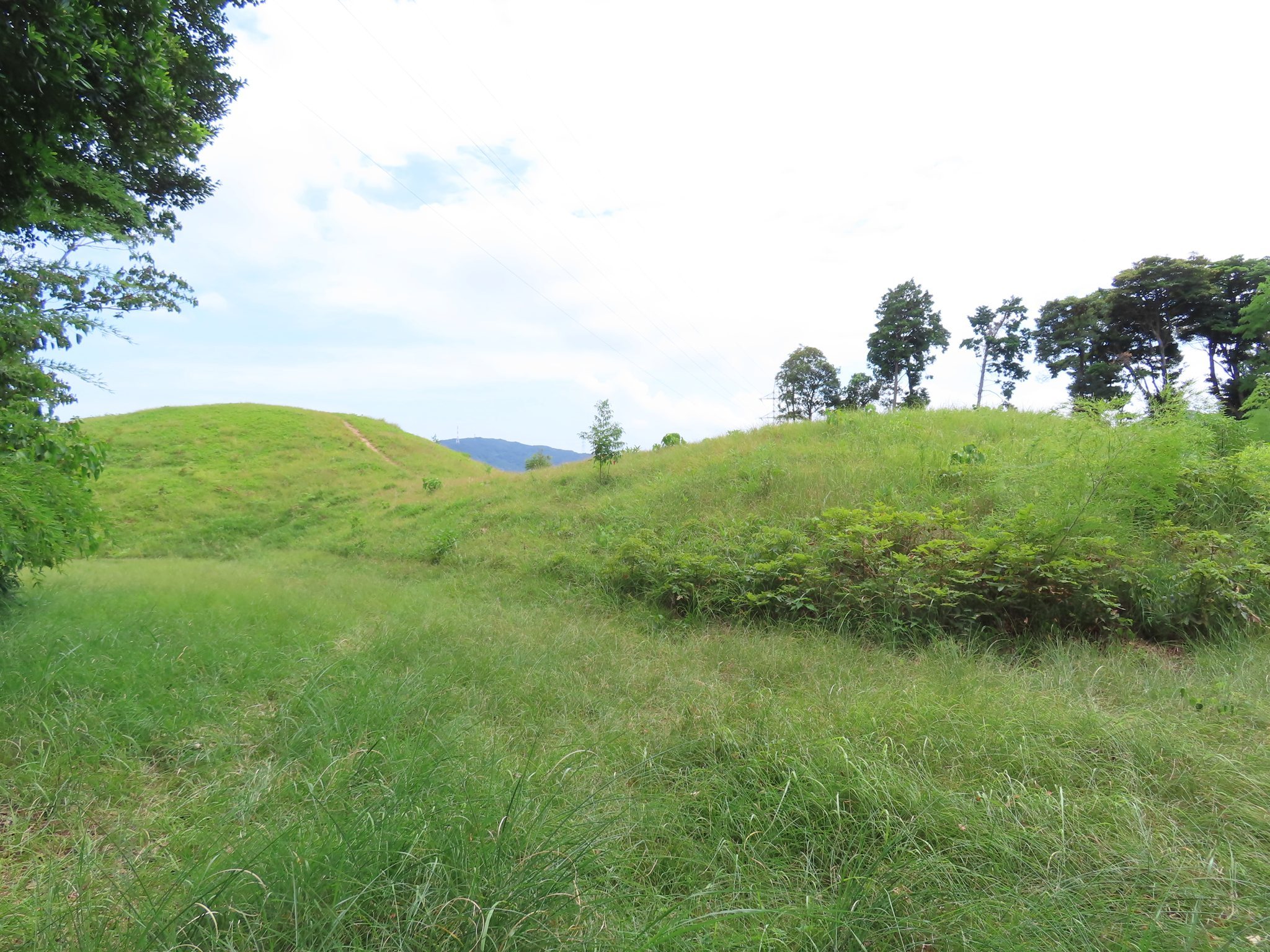
Jinbayama Kofun occupies the eastern edge and slope of a plateau on the north bank of the Ayaragi River. Its plan combines a circular rear section with a roughly square front section, the characteristic keyhole form of an elite Kofun-period tomb. The front points west-northwest and is relatively undeveloped. The mound is about 75 meters long. Its rear section is approximately 47 meters across and 8 meters high, while the front is about 26 meters wide, roughly half the rear section’s diameter.
Only the circular rear section has three construction tiers. The mound as a whole is exceptionally well preserved. Fragments of haniwa, clay objects placed on and around burial mounds, were found on the outer surface. They indicate that hollow cylindrical haniwa may have stood in rows on some or all of the tiers. The mound’s surface has produced no identified stone revetment.
Burial facility
The burial facility is a chamber covered with packed clay and contains a wooden coffin shaped like a lengthwise section of bamboo. The coffin is unusually large, measuring approximately 1 meter in diameter and about 6 to 6.2 meters long. Its clay covering and substantial dimensions form the central surviving evidence for the tomb’s funerary installation, while the chamber itself remains unopened.
Associated mounds and setting
Two small round mounds, called the Jinbayama North Tumulus and Jinbayama South Tumulus, lie near the principal mound. They are considered possible associated satellite mounds, smaller burial mounds constructed in connection with a larger tomb. The north mound has also been interpreted as a remnant left during the cultivation of farmland. Trees around the tumulus have been felled, leaving Jinbayama visible from the plains to the south.