Koizumi Kuon-ji Temple: A Nichiren Buddhist Head Temple in Japan

Site at a Glance
- Rating
- 4
- Popularity
- Very Low
- Country
- Japan
- Primary era
- Modern
- Eras represented
- Early Modern, Modern
- Civilizations
- Japanese, Tokugawa
- Site type
- Religious
On this page11 sections
History
Koizumi Kuon-ji Temple is a Nichiren Buddhist head temple in Japan, located in Fujinomiya, Shizuoka Prefecture. Formally called Fuji-san Kuon-ji and also known as Renzobo, it was founded in 1334 and belongs to the Fuji lineage, which continues the doctrinal tradition of Nikko, one of Nichiren’s principal disciples. The temple is one of the Fuji Five Head Temples and one of the Eight Head Temples of the Kōmon school. Its principal object of worship is the Three Treasures, meaning the Buddha, the Buddhist teaching, and the community or lineage that preserves it.
Foundation and early Fuji-lineage history
Nichiren, the thirteenth-century Japanese Buddhist reformer who founded Nichiren Buddhism, is venerated at Koizumi Kuon-ji as the founder. Nikko is honored as the second patriarch, Nichimoku as the third, and Nichigo as the fourth. Nichigo, a leading disciple of Nikko, established the Koizumi Renzobo in the first month of 1334. This early religious center is identified with the later Koizumi Kuon-ji.
The temple remained connected with important figures in the Fuji lineage during the fourteenth and fifteenth centuries. In 1341, Nichiei, a disciple of Nichigo, visited the Koizumi Renzobo. On December 12, 1344, Hota Nichigo went there with Satsuma Nichiei, who began his return journey from Kyoto to the Renzobo on March 18, 1345. In April 1402, Nichiji of Taiseki-ji transcribed the principal image and presented it to the Koizumi lay association affiliated with Taiseki-ji.
On April 8, 1416, Hota Nichiden transferred the Koizumi religious center, identified with Kuon-ji, first to Enjo-bo Nissen and then to Hosen-bo Nishu. In 1443, Koizumi Nichian went to Jozen-ji in Hyuga and altered its principal image. In 1468, Hota Nichian founded Kuon-ji at Koizumi in Suruga.
Disputes, destruction, and rebuilding
Relations among the Fuji-lineage institutions were not always peaceful. A dispute arose in September 1482 among followers associated with Taiseki-ji, Omosu, Hota, and Koizumi. In 1537, military fire completely destroyed the temple.
Reconstruction followed political and religious support. In 1545, Hyobu-a Nichigi became a deputy official. On September 29, 1546, Asahina Chikanori and Hota Niga requested the revival of Koizumi Kuon-ji. The temple was then exempted from various duties, and rebuilding took place in spring 1547. In 1549, during the tenure of the fourteenth abbot, Niga, Imagawa Ujizane granted the temple a vermilion-seal charter, a formally authenticated document issued under a ruler’s seal. On November 6, Niga established regulations for Koizumi Kuon-ji. Ujizane again exempted the temple from various duties on August 28, 1560.
The temple’s relationships with other centers continued to develop in the late sixteenth century. On November 15, 1588, Hota Nikan wrote to the abbot Nichichin and Koizumi Kuon-ji’s lay supporters about arrangements for shared use between Koizumi and Minobu, urging them to preserve their unity. On December 26, 1593, Nikan transferred Myohon-ji to Koizumi Nichichin and arranged for Kuon-ji to be inherited by the academic head, Nissei.
Early modern rebuilding and institutional change
A Founder’s Hall was built in 1622. In 1648, Hota Nichizen asked Koizumi Kuon-ji and its clerical and lay supporters to provide a successor for Hota Myohon-ji. The temple was completely burned again around 1680, and a private house within its estate burned in 1785. In 1789, during the rule of the eleventh shogun, the temple was ordered through Matsudaira Kii-no-kami to conduct prayers for the peace and security of the country.
Fire repeatedly altered the complex. The Main Hall, Study, and subsidiary temple buildings were completely destroyed in 1835. In April 1868, another fire destroyed five buildings, including the Guest Hall, Study, Main Kitchen, Long Gate, and entrance hall. The Main Kitchen was rebuilt in June of that year. The Main Hall burned again on November 9, 1880, in a fire caused by fireworks celebrating the opening of an elementary school. In 1884, the Main Hall of Toko-ji at Ueno was transferred to Koizumi Kuon-ji for use as a temporary Main Hall.
Modern Nichiren Buddhist organizations
Koizumi Kuon-ji joined four affiliated temples in 1876 to form the unified Fuji-lineage organization Nichiren Kōmon-ha. The organization was renamed Nichiren Honmon-shu, or Honmon-shu, in 1899. In 1941, Honmon-shu joined the Itchi branch of Nichiren Buddhism and the Shōretsu-lineage Kempon Hokke sect in a three-group merger that formed Nichiren Buddhism.
The same 1941 reorganization dissolved the former head-temple and branch-temple system within Nichiren Buddhism. Institutions that had been connected through that structure are therefore described as former head temples or former branch temples. Koizumi Kuon-ji’s Guest Hall was completed in 1952.
Remains
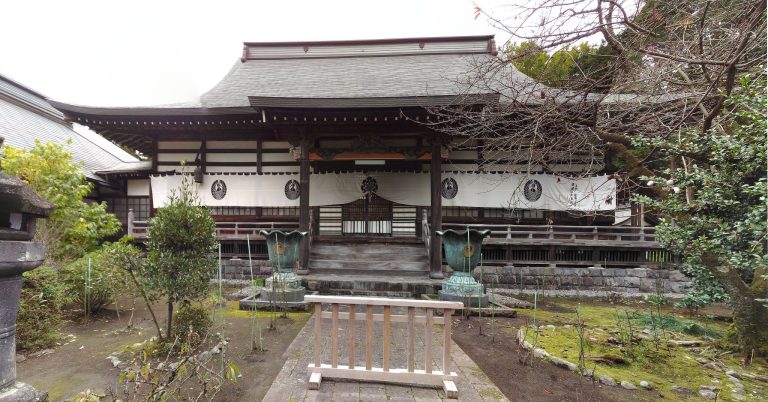
The temple complex at Koizumi 1649 in Fujinomiya includes a Main Hall and several buildings associated with its religious functions and successive rebuilding phases. Its physical history is shaped by repeated fires, including the destruction of the complex in 1537 and around 1680, the loss of major buildings in 1835, and further damage in 1868 and 1880.
Principal buildings
Main Hall
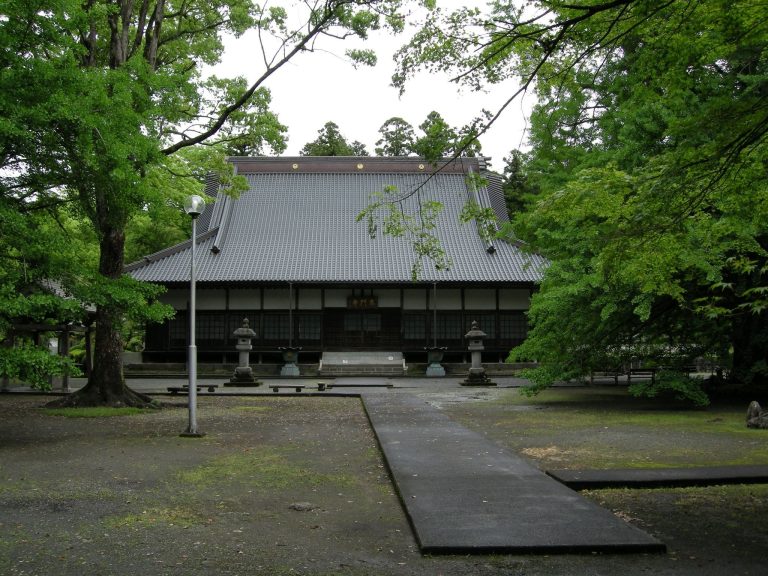
The Main Hall forms part of the temple complex. Fire destroyed it in 1835, and it burned again on November 9, 1880, when fireworks celebrating the opening of an elementary school caused a fire. In 1884, the Main Hall of Toko-ji at Ueno was brought to Koizumi Kuon-ji and used as a temporary Main Hall.
Founder’s Hall
The Founder’s Hall was built in 1622. It belongs to the group of structures associated with the temple’s veneration of its founding figures, including Nichiren, Nikko, Nichimoku, and Nichigo.
Guest Hall and Study
The Guest Hall and Study were among the buildings destroyed by fire in 1835. Both were again included among the structures lost in the April 1868 fire. The Guest Hall was completed in 1952, while the Study is associated with the earlier phases of the complex that were repeatedly altered by fire.
Main Kitchen, Long Gate, and entrance hall
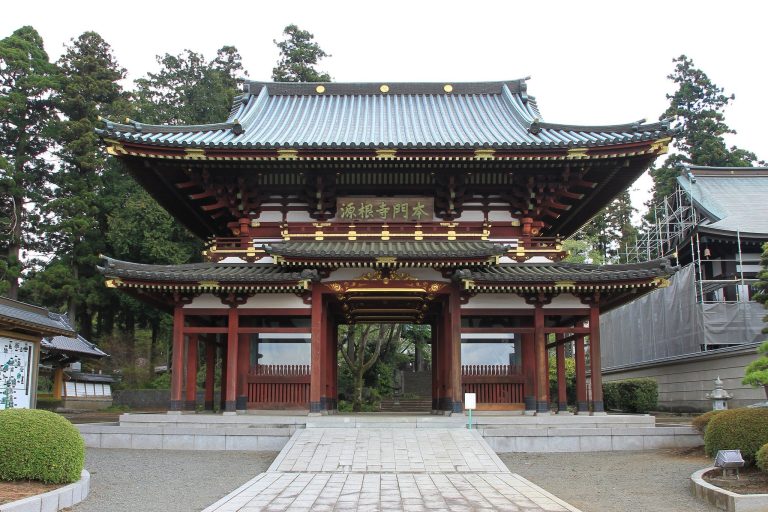
The Main Kitchen, Long Gate, and entrance hall were among five buildings destroyed in April 1868. The Main Kitchen was rebuilt in June of the same year, preserving a physical element of the temple’s nineteenth-century rebuilding history.
િ