Inome Cave: An Archaeological and Religious Site in Japan


Site at a Glance
- Rating
- 4
- Popularity
- Low
- Country
- Japan
- Primary era
- Unclassified
- Eras represented
- Unclassified
- Civilizations
- Unclassified
- Site type
- Religious
- Remains
- Sanctuary
On this page8 sections
History
Inome Cave is an archaeological and religious site in Izumo, Japan, associated with occupation and use from the Jomon period through the Kofun period. The Jomon period comprised prehistoric hunter-gatherer and early settled communities, while the later Yayoi period brought wet-rice agriculture, metal use, and increasing social differences. The Kofun period, named for large burial mounds, saw the emergence of powerful regional authorities and early states.
Discovery and excavation
The cave came to attention in October 1948 during restoration work at Inome fishing port. Pottery and human bones were found among sand and gravel accumulated on the cave floor. Many artifacts had already been removed before members of the Taisha Archaeological Society arrived, after which an excavation continued for about one month. The finds included Jomon and Yayoi pottery, Kaisen and Haji ware, Sue ware, wooden objects, human remains, and natural remains.
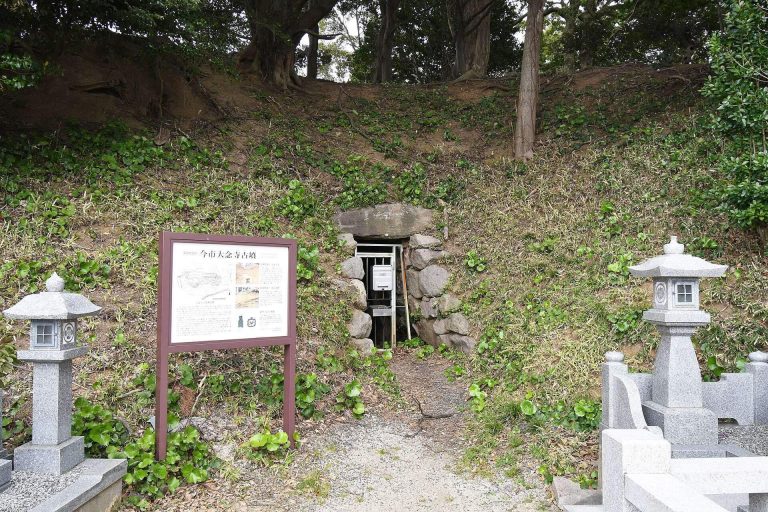
The excavated artifacts are designated Tangible Cultural Properties of Shimane Prefecture and are kept at the neighboring Inome Cave Artifact-Bearing Layer Museum. Inome Cave was designated a National Historic Site of Japan in 1986.
Burial and community
Human remains represent at least 20 individuals, including one Yayoi-period adult, at least 14 adults traditionally assigned to the Kofun period, one infant, and four young children. Sixteen individuals, numbered 1 through 16, have confirmed information about their excavated layers. Later dating research showed that some materials assigned to the Kofun period did not belong to that period, and the chronology of some other bones may also be uncertain.
Analysis indicates that the Inome population brought together people with local Jomon-related ancestry and immigrant-related ancestry. The degree of admixture was less advanced than among modern mainland Japanese populations. Long-term burial of a population connected through maternal descent has also been inferred.
Yomi no Ana and religious tradition
Inome Cave has been linked with Yomi no Ana, meaning “Cave of the Underworld,” described in the eighth-century Izumo no Kuni Fudoki. This record of Izumo Province combines geography with accounts of places, traditions, and religious associations. Yomi was understood as the realm of the dead in early Japanese mythology, so Yomi no Ana was regarded as a cave or opening connected with the afterlife.
The large number of human remains and the cave’s use as a burial place shortly before the compilation of the Fudoki have made the identification influential, although the physical correspondence remains disputed. Goto Kurashiro proposed the identification before the 1948 excavation, associating the nearby headland of Genzaga-hana with the rocky place described in the text and citing its pine grove as supporting evidence.
Mizutare Cave, also called Nagara Cave, near Sagiura in Taisha, Izumo, has been proposed as an alternative. Its dimensions and shape are considered more consistent with the Fudoki description. Inome Cave lies on a beach rather than a rocky shore and does not correspond as closely in form. The location of Yomi no Ana therefore remains unsettled, partly because the historical boundary of Uga district is uncertain.
A shrine inside Inome Cave venerates the cave as the place of Okuninushi’s death. Okuninushi is a major kami, or divine or sacred being, in Japanese religious traditions, particularly those associated with Izumo and the formation and governance of the land. Inome has consequently been understood as a sea-cave religious space centered on funerary commemoration, with a proposed continuity between its religious use and evidence for burial and memorial practice.
Remains
Cave formation and layout
Inome Cave is a large sea-erosion cave at the western end of Inome Bay on the Sea of Japan, with an opening facing east. Waves formed the cavity by wearing away the surrounding geological formations. Measurements made in 2012 with a laser rangefinder give the entrance a width of 33.0 meters, a height of 10.0 meters at the shrine, and a depth of 50.0 meters. The passage narrows progressively toward the interior.
The cave lies in the Neogene Ushikiri Formation, whose principal rocks include tuff, andesite, dacite lava, and rhyolite lava. Much of the ceiling consists of green tuff, volcanic ash and rock debris altered after deposition by heat and mineral-rich fluids. Near the ceiling is a layer of comparatively unaltered rhyolite volcanic breccia, a rock formed from cemented angular volcanic fragments. Chemical analyses classify the rhyolite as alkaline rhyolite belonging to the medium-potassium and tholeiitic rock series. A shrine stands within the cave.
Burials and objects
One supine adult male burial, with the body lying on its back, was associated with late Yayoi pottery. Six shell rings lay on the right arm. The wider assemblage includes Jomon and Yayoi pottery, Kaisen ware, Haji ware, an unglazed ancient earthenware, and Sue ware, a high-fired ceramic associated with the Kofun period and later periods.
Wooden finds include a short bow, a shield, wooden clogs, a sword-like object, a digging tool, a head-shaped object, a cup-shaped vessel, a bowl, a knife handle, chopsticks, and fragments interpreted as parts of either a dugout canoe or a wooden coffin. A Kofun-period dugout canoe has been interpreted as a possible burial object. Stone artifacts include small knife-like tools and fragments. Iron finds include nails, a fishhook, a burnt awl-like object, and fragments.
Six shell bracelets, bone and antler implements, and lumps of red pigment were also recovered. The bracelets were made from goliath conch using the Tateiwa-type manufacturing technique associated with the latter half of the Middle Yayoi period. They are interpreted as having been finished locally by polishing material obtained for Tateiwa-type bracelets. Goliath-conch bracelets were generally worn by men.
Natural remains
The cave preserved freshwater clam shells, bones of deer, rabbit, and mole, bird and fish bones, insects, seaweed, nuts, rice husks, wheat, wood fragments, and leaves. Some of these materials survived in good condition, adding evidence of the food, plant, animal, and environmental materials present in the cave’s archaeological deposits.