Gokuraku-ji Temple: A Shingon Ritsu Buddhist Temple in Kamakura, Japan


Site at a Glance
- Rating
- 4.1
- Popularity
- Low
- Country
- Japan
- Primary era
- Modern
- Eras represented
- Medieval, Early Modern, Modern
- Civilizations
- Japanese, Kamakura shogunate, Tokugawa
- Site type
- Religious
- Remains
- Monastery
On this page19 sections
History
Gokuraku-ji Temple is a Buddhist temple of the Shingon Ritsu tradition in Kamakura, Japan, near the Gokurakuji-zaka cut-through. Its formal name is Reishūzan Kanno-in Gokuraku Ritsu-ji, and its principal image is Shaka Nyorai, the historical Buddha. Shingon Ritsu combines esoteric Buddhist practice with strict monastic discipline based on Buddhist rules. The temple’s earliest history is uncertain, but it became an important religious, medical, and welfare institution in medieval eastern Japan.
Origins and the Hōjō patrons
The 1561 Gokuraku-ji Engi states that an earlier Pure Land Buddhist temple founded by a monk named Shōei was moved from Fukazawa in western Kamakura to the present site in 1259. At that time, the area was known as Jigokudani. A different temple tradition attributes the foundation to the monk Shōkaku during 1113 to 1118, leaving the original date and circumstances unresolved.
Hōjō Shigetoki became the temple’s founder and principal patron. The third son of Hōjō Yoshitoki and younger brother of Hōjō Yasutoki, he served for 17 years as the Rokuhara Tandai, Kyoto’s senior military and administrative office. After returning to Kamakura, he became a co-signer of the shogunate government from 1247. In 1256 he entered Buddhist religious life under the name Kankaku.
The Azuma Kagami records Shigetoki’s close association with the site. In 1261 he invited Prince Munetaka, the shogun, to his newly built mountain residence at Gokuraku-ji and held a mounted archery event there. Shigetoki died later that year. His sons, Hōjō Nagatoki and Hōjō Naritoki, continued his plans and expanded the temple buildings.
Ninshō and the medieval institution
Ninshō entered Gokuraku-ji in 1267 and is regarded as the temple’s practical founder. Under his leadership, the temple probably changed from its earlier Pure Land affiliation to Shingon Ritsu, although a ritual bell dated 1255 and inscribed with “Gokuraku Ritsu-ji” indicates that the temple may already have followed that tradition before Ninshō arrived.
Gokuraku-ji served purposes that extended beyond worship. Its medieval compound included a dispensary, a hospital, and a facility for medicinal baths. The temple provided assistance to sick and poor people, including those suffering from leprosy. Ninshō continued his religious, building, and healing work there until his death in 1303.
Fire repeatedly interrupted the temple’s development. Gokuraku-ji burned in 1275 and was rebuilt under Ninshō. It suffered another fire in 1308. Around 1315, a trading vessel authorized by the shogunate sailed to Yuan China to help obtain funds for repairs, accompanied by the monk Enrin.
In 1333, Emperor Go-Daigo confirmed the temple’s land holdings through an imperial decree. The warfare surrounding the fall of the Kamakura shogunate in 1333 and 1334 damaged Gokuraku-ji, after which the temple went through repeated cycles of destruction and rebuilding. Its former subsidiary temple Buppō-ji was also drawn into the attack on Kamakura in 1333.
Later rebuilding and decline
Further fires struck in 1425 and 1571. Before the latter destruction, the abbot Shōzen led a reconstruction during the Eiroku era, from 1558 to 1570. In 1591, Tokugawa Ieyasu, founder of the Tokugawa shogunate, granted Gokuraku-ji nine kan and 500 mon in land marked by a vermilion seal.
By the beginning of the Edo period, the temple had fallen into serious disrepair. When the Zen monk and writer Takuan Sōhō visited in 1633, he described collapsed walls, damaged roofs, and sagging ridge beams. The abbot Eishō began another revival in 1656. An eighteenth-century request from parishioners and Shōmyō-ji for the appointment of a new abbot indicates that Gokuraku-ji was then without a resident head.
At its medieval height, Gokuraku-ji comprised seven principal buildings and 49 subsidiary temples. It became one of the principal centers of Shingon Ritsu Buddhism in eastern Japan, alongside Saidai-ji in Nara, and held the status of a government-sponsored prayer temple for national peace and stability.
Modern damage and heritage recognition
The Great Kantō Earthquake of 1923 caused extensive damage, including the collapse of the main hall. Most of the present complex belongs to the rebuilding that followed, while the main gate survived from an earlier period and dates from 1863.
The former Buppō-ji was one of Gokuraku-ji’s 49 subsidiary temples. Founded by Ninshō, it stood on Mount Reizan, a coastal promontory associated with Reizan-zaki. Tradition places a rainmaking contest between Ninshō and Nichiren there. Its elevated position overlooking Sagami Bay also gave it a fortress-like role on Kamakura’s western defensive line. After involvement in Nitta Yoshisada’s attack on Kamakura in 1333, the site recovered before being abandoned as a temple around the seventeenth century.
Archaeological work at Buppō-ji in 2002 uncovered a cut-stone foundation platform, building foundations, and a pond, together with evidence of yagura, rock-cut medieval funerary or memorial chambers characteristic of Kamakura, at the foot of the hill. The excavated area was reburied for preservation. Buppō-ji was designated a national historic site in 2006. In 2008, the historic-site designation for Gokuraku-ji was expanded to include the central area of the former medieval compound and renamed “Gokuraku-ji Precinct and Ninshō’s Tomb.” The temple was included in Japan Heritage in 2016.
Gokuraku-ji remains connected with several pilgrimage traditions. It is the 22nd place in the Bandō Thirty-Three Kannon Pilgrimage, the 20th and 21st places in the Kamakura Twenty-Four Jizō Pilgrimage, and the 12th place in the Kamakura Thirteen Buddhas pilgrimage.
Remains
The surviving precinct lies in a valley near the Gokurakuji-zaka cut-through. Edo-period drawings show that the former compound extended across the valley now occupied by the temple and Inamuragasaki Elementary School. The valley along the Gokurakuji River is believed to have contained facilities for treating and assisting sick and poor people. Within the present grounds, a paved approach of roughly 100 meters runs from the mountain gate to the main hall and is lined with cherry trees.
Gate and main hall
Sanmon
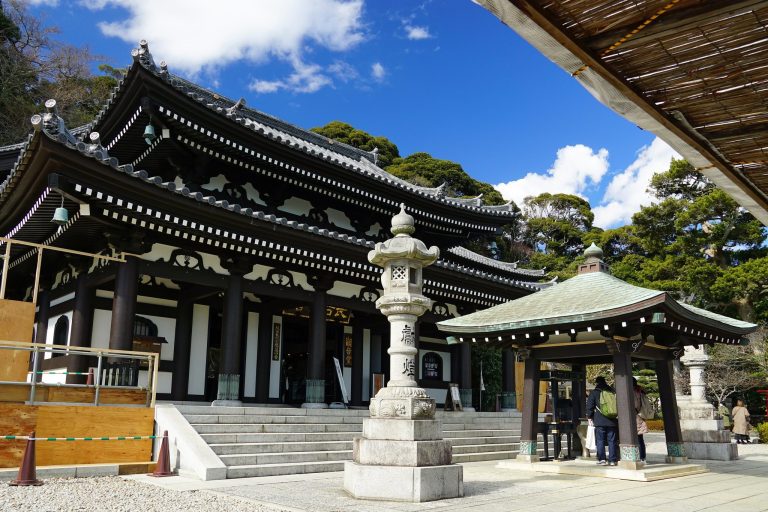
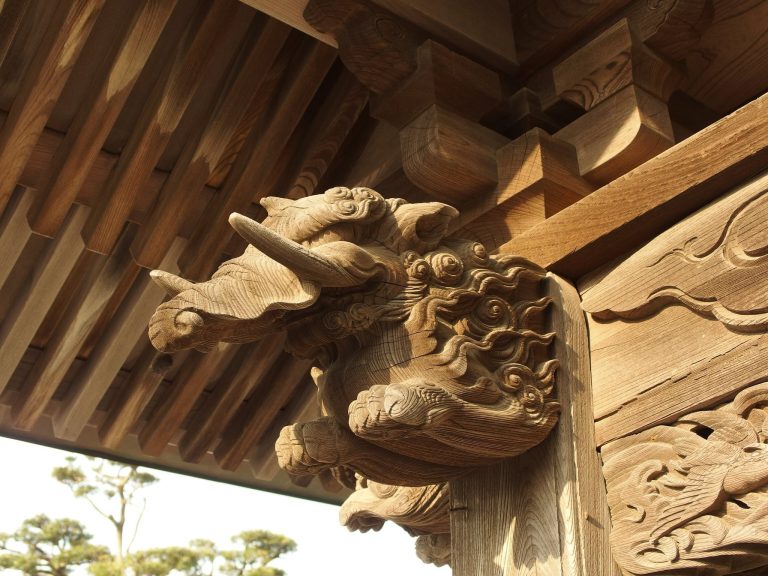
The thatched Sanmon, or mountain gate, was built in 1863. It forms the entrance to the surviving precinct and begins the approach leading toward the main hall. Its date places it among the older surviving elements of the modern temple complex.
Main hall images
The main hall’s altar places a seated Fudō Myōō at the center, with Yakushi Nyorai, the Buddha associated with healing, on the right and Monju Bosatsu, the bodhisattva of wisdom, on the left. Images of Ninshō and Kōshō Bosatsu, the monk Eison, stand at the rear. The Monju image is a work of the Kamakura period.
The hall also houses a wooden seated Fudō Myōō from the late Heian period. Approximately 98 centimeters high, the figure holds a sword and a rope. It was transferred to Gokuraku-ji in 1916 from Shōtatsu-ji in Shimane Prefecture and was not originally made for this temple.
Several wooden images represent temple leaders. The 86.5-centimeter image of Ninshō dates from the Muromachi period. The image of Eison is 84.5 centimeters high and was carved in 1306, although all but its head was destroyed in the fire of 1425. An image of Eishin, 73.5 centimeters high, also dates from the Muromachi period. The 60.6-centimeter image of Eshō was carved in 1663, when Eshō was 70 years old.
Shaka Nyorai images
The principal image is a wooden standing Shaka Nyorai dated by an inscription inside its pedestal to 1297. It follows the Seiryōji style, with rope-like hair, robes rising to the neck, and concentric folds in the garment. Treated as a hidden Buddhist image, it is opened for viewing only from April 7 to 9.
A separate wooden seated Shaka Nyorai from the Kamakura period raises both hands before the chest in the tenbōrin-in, a Buddhist teaching gesture symbolizing the turning of the wheel of Buddhist doctrine. Its varied drapery and intelligent expression are characteristic of Kamakura-period sculpture. Early-modern records attribute the work to the sculptor Zenkei, while differences in style and chronology have led to an alternative attribution to Zenkei’s son.
Approach buildings and ritual objects
Tenborin-den
The Tenborin-den was built in 1968 on the right side of the approach. It functions as a small museum for Buddhist statues and ritual equipment. Its collection includes a wooden Shaka Nyorai approximately 91 centimeters high and dating from the thirteenth century, together with ten wooden standing images of the Buddha’s major disciples. Some of the disciple figures were carved before 1269, and each is approximately 83 to 87 centimeters high.
Daishi-dō
The Daishi-dō stands on the left side of the approach and is dedicated to Kūkai, also called Kōbō Daishi, who established the wider Shingon tradition from which Shingon Ritsu developed. The building contains an image of Nyoirin Kannon, associated with the 22nd place in the Bandō Kannon pilgrimage, as well as a lacquered image of Kūkai and Shingon ritual implements from the Kamakura period.
Ritual implements and medicinal equipment
The temple’s cultural-property collection includes ten wooden standing images of the Buddha’s major disciples bearing a date inscription from 1268. Its Shingon ritual implements include a five-pronged bell, a five-pronged vajra, and a single-pronged vajra. The five-pronged bell bears an inscription dated 1255. Near the main hall, a large stone mortar and pestle is associated with the grinding and preparation of medicinal herbs.
Cemetery monuments
Ninshō Tower
The Ninshō Tower stands in the cemetery of the western inner sanctuary. It is a large stone gorintō, a five-element pagoda whose forms represent elements in Buddhist cosmology, and is approximately 356 centimeters high. The tower itself has no inscription, but objects deposited inside indicate that it was constructed around 1303.
Memorial towers
A second stone gorintō stands to the right of the Ninshō Tower. It was formerly identified as Hōjō Shigetoki’s tomb tower, but fell during torrential rain in 1961. Objects found inside during restoration established that it is a memorial tower for the temple’s third abbot and a nun.
Another gorintō, 193 centimeters high and inscribed with the date August 1310, stands near the Ninshō Tower. The cemetery also contains a hōkyōintō, another type of Buddhist memorial pagoda, traditionally identified as Hōjō Shigetoki’s tomb tower. It is approximately 310 centimeters high and was carved from tuff thought to have been brought from the Izu Peninsula.
Deposited objects
Materials placed inside the memorial towers include bronze and gilt-bronze reliquaries, a gilt-bronze five-element pagoda, and small brown- and yellow-glazed jars. One reliquary bears an inscription naming the temple elder. The gilt-bronze pagoda carries an inscription that records the death of the nun on February 8, 1311.
Former Buppō-ji site
The former temple grounds also contain stone monuments and garden stones connected with the remains of Buppō-ji. Excavation on Mount Reizan revealed a cut-stone foundation platform, building foundations, and a pond. Evidence of yagura chambers was found at the foot of the hill, while the excavated foundations and pond were reburied to preserve them.