Ōsaka Tenmangū: A Shinto Shrine Dedicated to Tenjin in Osaka


Site at a Glance
- Rating
- 4.3
- Popularity
- High
- Country
- Japan
- Primary era
- Modern
- External website
- Open
- Eras represented
- Modern
- Civilizations
- Japanese, Tokugawa
- Site type
- Religious
- Remains
- Sanctuary
On this page12 sections
History
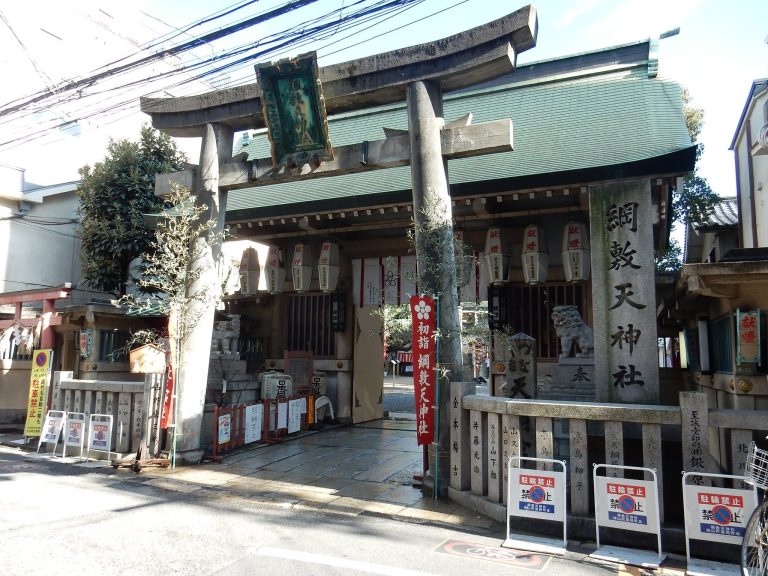
Ōsaka Tenmangū is a Shinto shrine in Osaka, Japan, whose origins are traditionally traced to 650, during the seventh century. Its history is closely connected with Sugawara no Michizane, a Heian-period scholar and court official whose divinized spirit became known as Tenjin and whose worship later became particularly associated with learning and scholarship.
The Great General Shrine and the foundation traditions
In 650, Emperor Kotoku is said to have established a guardian shrine called the Great General Shrine northwest of the Naniwa Palace. Its position was connected with the protective importance assigned to the palace’s northwest direction under yin-yang divination. The shrine was dedicated to Yachimatahiko, Yachimatahime, Okamuzumi, and Kunado.
A second foundation tradition connects the site with a beach where Emperor Jimmu, regarded in traditional imperial mythology as Japan’s first emperor, was believed to have landed. Another legend tells of a strange light witnessed by Emperor Murakami and links it with Michizane’s earlier visit. One of Michizane’s companions is traditionally regarded as the direct ancestor of the family that has served as the shrine’s hereditary priestly line.
Michizane and the establishment of the Tenmangu
In 901, Michizane visited the Great General Shrine while being transferred to Dazaifu in Kyushu, a major administrative and military headquarters in premodern Japan. He prayed there for safe passage. After his death in 903, devotion to him as Tenjin spread.
In 949, seven pine trees were said to have appeared before the Great General Shrine and to have given off a mysterious light. When the omen reached the imperial capital, Emperor Murakami ordered a Tenmangu to be founded at the site. The Great General Shrine became a subsidiary shrine, while the Tenmangu assumed the principal role. The institution has also been called Tenma Tenjin, Naniwa Sugawara Mausoleum, and Nakajima Tenmangu. Osaka residents commonly call it Tenma no Tenjin-san.
Fires, rebuilding, and modern status
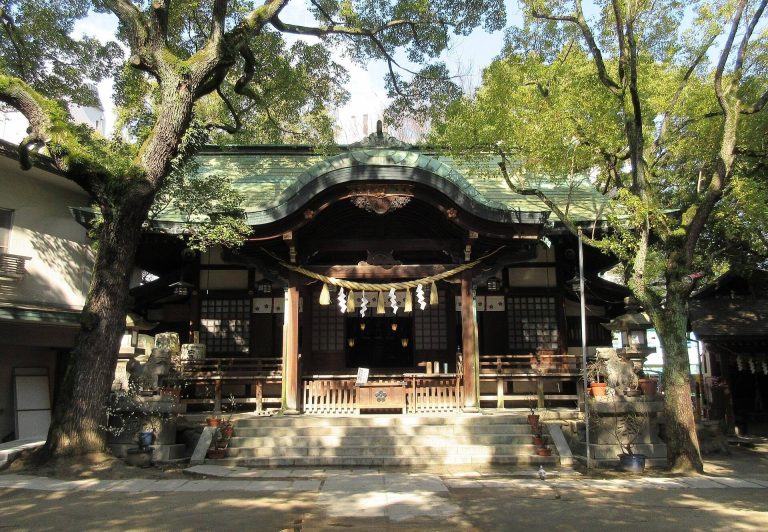
The Great Kyōhō Fire of 1724 destroyed the shrine complex. In 1837, a further conflagration associated with the revolt of Oshio Heihachiro, a nineteenth-century uprising in Osaka led by a former shogunate official, again burned the complex completely. The main shrine buildings were rebuilt in the 1840s, including the present honden and haiden in 1843.
During the Meiji period, Ōsaka Tenmangū was classified as a prefectural shrine. After the Second World War, it was included among the Association of Shinto Shrines’ Beppyo shrines, a category designated by that organization. The shrine escaped damage during Osaka’s second air raid on 1 June 1945. Several buildings later received cultural-property recognition: the honden, haiden, and Omote Main Gate were designated by Osaka City, while the Kaguraden, Assembly Hall, and Baikaden became registered tangible cultural properties of Japan.
Festivals, pilgrimages, and remembrance
The Tenjin Festival takes place annually from 24 to 25 July. Its origins are traditionally traced to 951, and since the sixteenth century it has been regarded as one of Japan’s major festivals and one of Osaka’s three major summer festivals. The observances include processions carrying portable shrines through the city, processions in historical costume, dances, bunraku performances, boat excursions on the Dojima, and other ceremonies. Tenmangu shrines elsewhere also hold Tenjin festivals, but the Osaka celebration is regarded as the most renowned.
Ōsaka Tenmangū is associated with the Sugawara Sacred Sites pilgrimage, the Naniwa Seven Fortunes pilgrimage, and the Pilgrimage Route of Shinto-Buddhist Sacred Places. The successive chief priests of Osaka Tenmangu are commemorated by a tombstone at Minamihama Cemetery, also known as Osaka municipal Nagahama Cemetery.
Remains
Sanctuary and principal entrances
Main sanctuary
The main sanctuary follows the Gongen-zukuri arrangement, in which the honden, the principal sanctuary containing the deity, and the haiden, the worship hall, are joined by an intervening structure to form one worship complex. Both buildings were rebuilt in 1843 after the nineteenth-century destruction of the shrine.
Dragon Gates and main entrances
The East and West Dragon Gates stand on either side of the honden. They are karamon, formal gabled gates with decorative features associated with Chinese-style architecture. The Omote Main Gate forms another principal entrance, while the Ebisumon stands on the southwestern side of the complex.
Subsidiary shrines and sacred buildings
The precinct contains numerous subsidiary shrines. The Shimmei Shrine is dedicated to Amaterasu and Toyouke, while the Hiru-ko Shrine, also called the Ebisu Relocation Hall, is dedicated to Hiru-ko. The Twelve Shrines together contain twelve deities or spirits: Kibi no Seirei, Prince Sawara, Lady Fuji, Prince Iyo, the Thunder Kami, the Fire-Birth Kami, Haniyasu-hime, Amenoyoshikazura-no-kami, Kawana-no-kami, the spirit of Fujiwara no Hiromitsu, the spirit of Tachibana no Hayanari, and the spirit of Bun Taifu.
The Hakumai Inari Shrine and the Inari Inner Sanctuary are dedicated to Inari, and the Hakumai Inari Shrine is regarded as the inner sanctuary of Fushimi Inari Taisha. Other shrines include the Yasaka Shrine, dedicated to Susanoo; the Tsumasha Shrine, dedicated to Okuninushi; and the Kamekichi and Tsuruhime Daimyojin Shrine, dedicated to Tsuruhime, Kamekichi, and Tenma Benzaiten. The Reifu Shrine venerates Ame-no-Minakanushi, the Matsuo Shrine venerates Oyamakui, and the Hachiman Shrine is dedicated to Emperor Ojin.
The Kibi Shrine is dedicated to Kibi no Mabi, while the Sumiyoshi Shrine is dedicated to the three Sumiyoshi deities, Uwatsutsunoo, Nakatsutsunoo, and Sokotsutsunoo. The Ancestral Spirits Shrine is dedicated to the spirits of the shrine’s priests and officials, parishioners, and other devotees. The Shiradaiyu Shrine is dedicated to Watarai Haruhiko, traditionally regarded as Michizane’s guardian, and the Oimatsu Kobai Hall venerates the spirits of Michizane’s beloved plum trees.
Storehouses, halls, and artistic features
The Mikoshi Storehouse houses portable shrines. The Horen Storehouse was originally the phoenix-carriage storehouse of Kawasaki Toshogu. After that institution was abolished during the Meiji-era movement to separate Buddhism and Shinto, the building was moved to its present location.
The Kaguraden was rebuilt in 1904, the Assembly Hall in 1911, and the Baikaden in 1928. The first floor of the Baika Academy is called the Sugawara Corridor. It contains a pictorial biography of Sugawara no Michizane recreated in Hakata dolls. Plum groves are distributed throughout various parts of the precincts, recalling the trees associated with Michizane.
Water, pond, and precinct institutions
Hoshiai Pond, also called Turtle Pond, is associated with the former site of the Tanabata ritual. A Star-Love Tanabata festival is held there on 7 July. The precinct also includes the Shrine Office and the Tenmangu Hall.
A spring called Tenma Tenjin’s Water was once celebrated as one of Osaka’s four famous clear springs. It dried up during the period of rapid economic growth, and a new well was dug in 2014 in an effort to revive it. The Well Deity is enshrined at the site of this water tradition.