Mikumano Shrine: A Kumano Shrine and Ritual Center in Japan


Site at a Glance
- Rating
- 4.4
- Popularity
- Low
- Country
- Japan
- Primary era
- Medieval
- External website
- Open
- Eras represented
- Medieval
- Civilizations
- Ashikaga shogunate
- Site type
- Religious
- Remains
- Sanctuary
On this page12 sections
History
Mikumano Shrine, formally called Kumano Shrine, is a Shinto shrine in Hanamaki, Japan, traditionally said to have been founded in 802 during the early Heian period. Its foundation is associated with Sakanoue no Tamuramaro, an imperial military commander involved in the court’s campaigns against groups it called the Emishi in northeastern Japan. Before a campaign, Tamuramaro is said to have prayed at the Kumano Three Mountains, the three sacred mountain centers of the Kumano pilgrimage tradition in the Kii region, from Seiyatate Forest. After his victory, tradition holds that he enshrined three Kumano deities at this site.
Heian and medieval traditions
The shrine’s history is also connected with Minamoto no Yoshiie, an 11th-century Minamoto military leader. In 1062, during the Former Nine Years War, a conflict in northern Japan involving the Abe family and regional authority, Yoshiie is said to have pursued Abe no Sadato to the area. He dedicated a whistling arrow and prayed for victory before completing the pacification of the Ou region.
The shrine enshrines Izanami no Mikoto, Kotosakao no Mikoto, and Hayatamao no Mikoto. These are Shinto kami, or sacred beings, traditionally said to have been transferred from the Kumano Three Mountains. Izanami is a primordial creator deity, while Kotosakao and Hayatamao are associated with the Kumano religious tradition.
During the medieval period, the Waga clan granted the shrine an estate assessed at 70 koku. A koku was a historical Japanese measure of rice-based land revenue, conventionally linked to the amount needed to support one person for a year. In 1618, Nambu Toshinao, lord of the Nambu domain, confirmed an estate of 23 koku.
Shinto and Buddhist institutions
During the early modern period, the shrine was known as Kumano Gongen Shrine and served as the guardian shrine of the adjacent Narushima Bishamondo. The shrine and Buddhist hall had long been administered by Narushima Temple. Their institutional relationship ended during the early Meiji-era separation of Shinto and Buddhism, a government policy that formally divided the two religious traditions and dissolved or converted many combined temple-shrine institutions. The shrine then became independent from the Buddhist hall. Its former official rank was village shrine.
Narushima Bishamondo has its own uncertain foundation tradition. It is attributed either to Sakanoue no Tamuramaro or to Ennin, a prominent Buddhist monk, although the precise circumstances of its establishment remain unsettled. Its three-day festival includes a nationwide crying-sumo event for children aged two or younger, open to children of either sex and attended by participants from across Japan.
The Twelve-Bout Sumo Ceremony
Mikumano Shrine’s September 19 festival includes the Twelve-Bout Sumo Ceremony, a ritual of crying sumo involving children from the North and South Narushima settlements. The Sarugaishi River flows westward south of the shrine and separates the two communities, whose representatives compete in the ceremony.
Six firstborn boys from each settlement are selected as wrestlers. They are two years old according to traditional Japanese age reckoning, producing 12 child participants in all. The ceremony follows the festival service at the main sanctuary and involves eight adult and juvenile officials: one hereditary sumo master, one sake attendant, and two cup attendants from each settlement. The sumo masters wear crested formal clothing with hakama and ceremonial robes. The sake attendants wear crested formal clothing and hakama, while the cup attendants are 12-year-old boys who have previously taken part in the rite. The sumo masters and sake attendants carry fans tucked into their collars.
The cup attendants conduct three rounds of ritual drinking, repeated seven, five, and three times. During this preparation, the sumo masters perform fan-taking and hand-taking rites. The sake attendants then take the children from their parents and pass them to the sumo masters, who carry them to the center of the ring. Each pair faces the other three times as the cry “Yo yo” is given. The child who cries first is judged the loser.
After six bouts, the children are paired with new opponents and six more bouts take place, bringing the total to 12. Rice cakes are scattered in the four directions at the conclusion. The result is judged between the two settlements, and tradition promises an abundant harvest to the victorious community.
The ceremony originally functioned as a form of divination for the year’s harvest. It also expresses prayers for the children’s healthy growth. Its tradition links the contest to a victory banquet attributed to Sakanoue no Tamuramaro, when young men from the two settlements supposedly wrestled and the winning settlement was promised a good harvest. Because adult contests could lead to bloodshed, the rite was changed to children’s crying sumo in 1706. The Twelve-Bout Sumo Ceremony became a Hanamaki municipal intangible folk cultural property in 1993.
The shrine’s main sanctuary was designated an Iwate Prefecture tangible cultural property in 1979. The sanctuary and the Twelve-Bout Sumo Ceremony are both recognized among the cultural properties associated with the site.
Remains
Shrine buildings
Main sanctuary
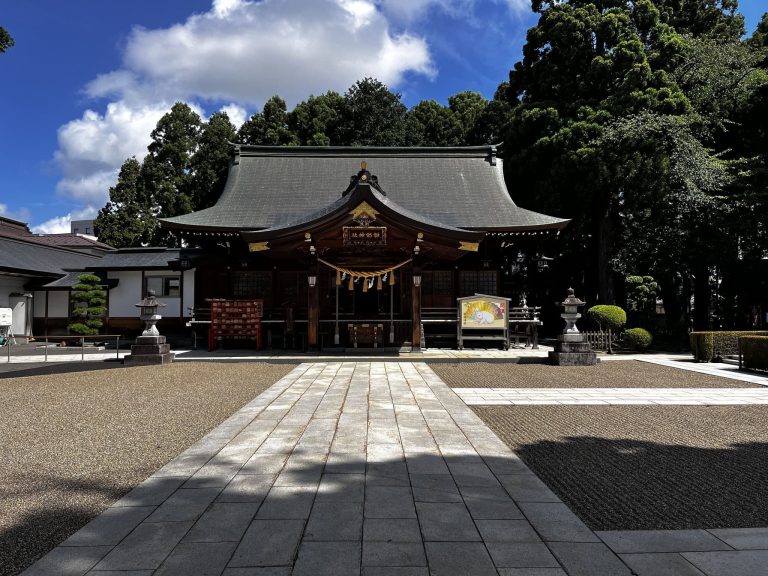
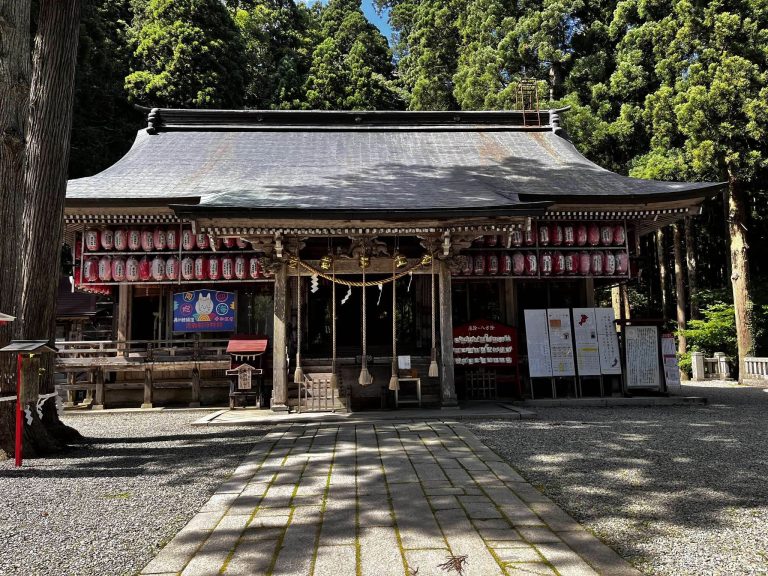
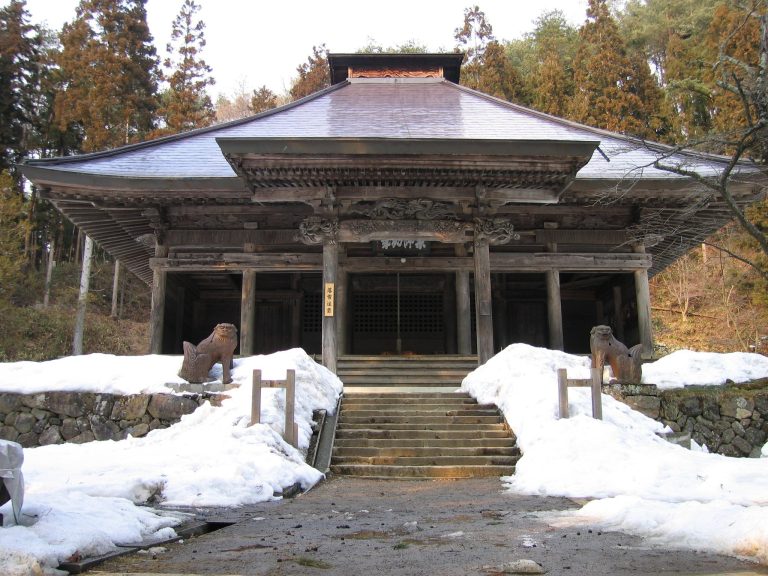
The main sanctuary is a gabled building with a three-bay frontage and a two-bay depth. Its entrance opens onto the long side. A three-bay open-front veranda extends across the front, and a one-bay-wide worship portico projects from its center. The roof is clad in sheet metal. The veranda and portico do not use the continuous downswept roof associated with the nagare-zukuri form. Instead, their roofs meet the main roof through a bent transition. Forked finials and log-like ridge ornaments decorate the ridge of the main building.
The sanctuary’s construction date is unknown, but the carved pictorial motifs on the noses of the rainbow beams in the veranda and worship portico show a provincial Muromachi-period style. The Muromachi period lasted roughly from 1336 to 1573, and the building is considered to date from that period. Its form preserves an unusual shrine arrangement thought to have been established at that time. A rare arched, modified curved tie beam joins the veranda and portico columns; three thorn-like projections run along its lower edge. The sanctuary is regarded as artistically accomplished, although restoration connected with its 1979 designation altered the original roof form.
Worship hall
The worship hall is a three-bay structure whose entrance is also placed on the long side. It has a hipped-and-gabled roof, forming the principal worship building associated with the sanctuary.
Narushima Bishamondo
Buddhist hall
Narushima Bishamondo stands beside Mikumano Shrine. Its Buddhist hall is a square, three-bay building with a hipped roof. Stylistic features place its construction in the later Muromachi period. The roof is now clad in sheet metal and was formerly thatched.
Tobatsu Bishamonten
A wooden standing statue of Tobatsu Bishamonten is associated with Narushima Bishamondo. Tobatsu Bishamonten is a form of Bishamonten, the Buddhist guardian deity of the north, shown standing on an earth deity whose raised hands support the figure. The statue dates from the middle Heian period. It measures 3.59 meters in height, or 4.73 meters when the earth deity beneath its feet is included.
The principal figure is carved from a single keyaki tree, and the two seated attendant demons are likewise made by single-block carving. The statue was moved from the interior of the hall to a storage building. A recent interpretation proposes that it was created under the direction of the provincial military headquarters during the first half of the 11th century.
Kisshoten
Another wooden standing figure associated with Narushima Bishamondo is traditionally identified as Kisshoten and dates from the early Heian period. Its form differs from the ordinary image of Kisshoten. The figure resembles a bodhisattva, raises both hands to about chest height, and bears two elephant heads on top of its head.