Watatsumi Shrine (Kobe): A Shinto Shrine for Sea Deities


Site at a Glance
- Rating
- 4.1
- Popularity
- Low
- Country
- Japan
- Primary era
- Unclassified
- External website
- Open
- Eras represented
- Unclassified
- Civilizations
- Unclassified
- Site type
- Religious
- Remains
- Sanctuary
On this page6 sections
History
Watatsumi Shrine (Kobe) is a Shinto shrine in Japan dedicated chiefly to the upper, middle, and lower Watatsumi deities, a group of sea deities associated with the ocean and marine life; Amaterasu, the sun deity, is also enshrined there. Its traditional foundation story connects it with Empress Jingu, a legendary early sovereign whose reign belongs to Japan’s traditional period before well-documented imperial history. According to the story, a storm stopped her ship during her return from the campaign traditionally linked with the conquest of the Korean states. After she prayed to the Watatsumi deities, the storm ended and she established a shrine at the site. Comparable foundation traditions appear in the Japanese chronicles, although those chronicles do not mention Watatsumi Shrine.
Early Records and Maritime Worship
The earliest surviving documentary reference to the shrine dates from 806, when ten shrine households were assigned to the Tarumi Sea Deity of Akashi. Its position at an important maritime transport location helped establish its early reputation as a protector of sea travel. The Engishiki, a tenth-century compilation of court procedures, laws, and shrine regulations, lists the shrine as three seats of the Sea Deity in Akashi District, Harima Province. It also places the shrine among the major institutions that received imperial rites. Along with Iwa Shrine and Ikaruga Amaterasu Shrine, Watatsumi Shrine is regarded as one of the three major shrines of Harima.
Medieval Decline and Early Modern Patronage
The shrine’s position weakened during the medieval period amid warfare and other disturbances. In 1587, Toyotomi Hideyoshi, the military ruler who unified much of Japan during the late Sengoku period, donated woodland in Tarumi Township as a prayer offering. During the Edo period, the successive lords of the Akashi domain continued to show the shrine strong devotion and customarily visited it every February.
Names, Status, and Continuing Festivals
From the beginning of the Edo period, the shrine was known as Hyuga Daimyojin. In 1871, when it became a government-supported middle-ranking shrine under the prewar state-sponsored shrine system, it resumed the name Watatsumi Shrine. In 1897, it was elevated to the status of an imperial government-supported middle-ranking shrine. The officially registered reading remains Watatsumi Shrine, while Kaijin Shrine is also widely used locally. Earlier readings included Ama Shrine and Tarumi Shrine. The Watatsumi reading was adopted in 1871 in accordance with a theory advanced by Norinaga Motoori, an Edo-period scholar associated with the study of ancient Japanese texts and traditions. Tarumi reflects the earlier name of the principal deity, while Ama refers to the shrine’s association with the Ama no Atai clan as its tutelary shrine. The shrine is now listed in the special category of the Association of Shinto Shrines.
Watatsumi Shrine maintains the Ebisu Festival for three days around January 10, with Ebisu venerated there as a sea deity. Its principal annual festival takes place on October 11. The coastal surroundings have also changed markedly in modern times. Before Japan’s period of rapid economic growth, the area around the main torii was a sandy beach. Land reclamation from 1960 onward turned the space in front of the torii into roads and a fishing harbor, altering the shrine’s former immediate maritime setting.
Remains
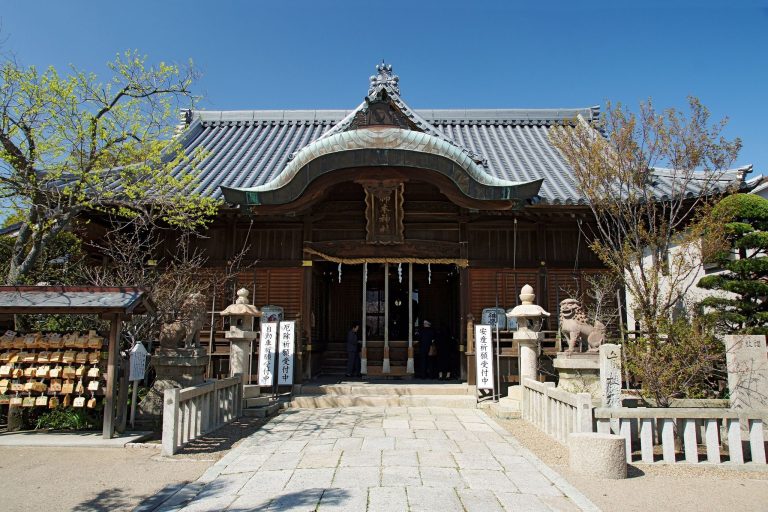
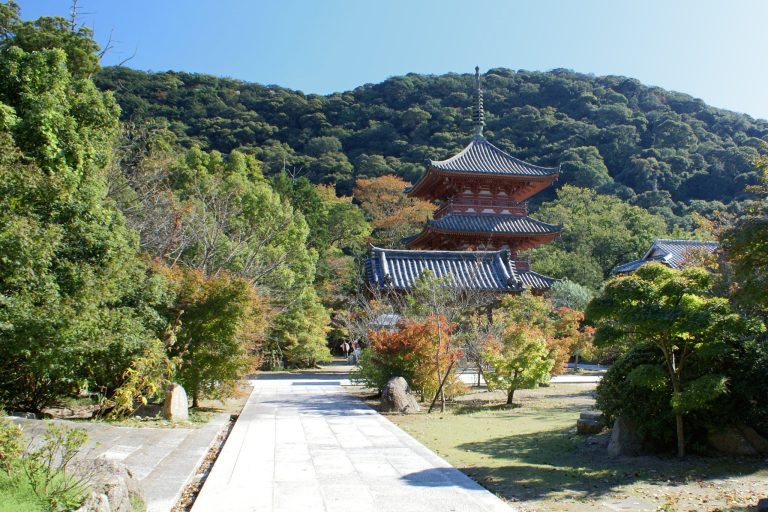
The surviving shrine complex includes a main sanctuary and a main torii whose setting reflects the transformation of the coast from sandy shoreline to reclaimed land occupied by roads and a fishing harbor. The sanctuary is a three-bay structure, meaning that its front is divided into three structural spaces, with a roof form that extends over the entrance side. Its roof is covered with copper sheets.
Main Sanctuary and Coastal Setting
The main sanctuary’s three-bay plan and extended roof belong to a traditional Japanese shrine form often described as a flowing-front design. The copper-sheet roof defines the surviving building’s principal external finish. The main torii stands in the area that formerly bordered the sandy beach, while the reclaimed coastal ground in front of it now contains roads and a fishing harbor. These physical features preserve the relationship between the shrine’s sacred architecture and the maritime environment that shaped its worship, even though the immediate shoreline has been substantially altered.