Iyama Hōfuku-ji Temple: A Rinzai Zen Temple in Okayama


Site at a Glance
- Rating
- 4.3
- Popularity
- Low
- Country
- Japan
- Primary era
- Early Modern
- External website
- Open
- Eras represented
- Medieval, Early Modern, Modern
- Civilizations
- Ashikaga shogunate, Japanese, Tokugawa
- Site type
- Religious
- Remains
- Monastery
On this page9 sections
History
Iyama Hōfuku-ji Temple is a Rinzai Zen temple in Soja, Okayama, Japan. It belongs to the Tōfuku-ji branch, a principal lineage of Japanese Zen Buddhism, and its principal image is Kokūzō Bosatsu, a bodhisattva associated with wisdom and memory. The temple’s foundation is traditionally attributed to the Tendai monk Nichirin, although its foundation date is unknown.
From Tendai temple to Zen institution
In 1232, the Zen monk Donan Esō, who came from Makabe in Bitchū Province, converted the institution from a Tendai temple into a Zen temple. Temple tradition connects this change with a story about Emperor Shijō’s illness. Donan is said to have prayed for the emperor’s recovery, after which a “guest star” supposedly fell before the prayer altar and the emperor recovered.
A well known as the Thousand-Shaku Well was dug where the star was believed to have fallen. This tradition is said to explain the temple’s mountain name, Iyama. A mountain name is the honorific geographical name traditionally used by many Japanese Buddhist temples, whether or not they stand on a prominent mountain.
Growth, warfare, and destruction
Iyama Hōfuku-ji later became an imperial prayer temple, a Buddhist institution supported for prayers on behalf of the emperor or imperial court. It flourished as a major religious center, eventually having 55 subsidiary temples and academies together with 300 subordinate temples.
During the Sengoku period, an era of widespread political and military conflict in Japan, the temple supported the local warlord clan known as the Mimura. Warfare in 1575 destroyed nearly all of the temple buildings, while the three-story pagoda survived.
Early Edo revival and Sesshū
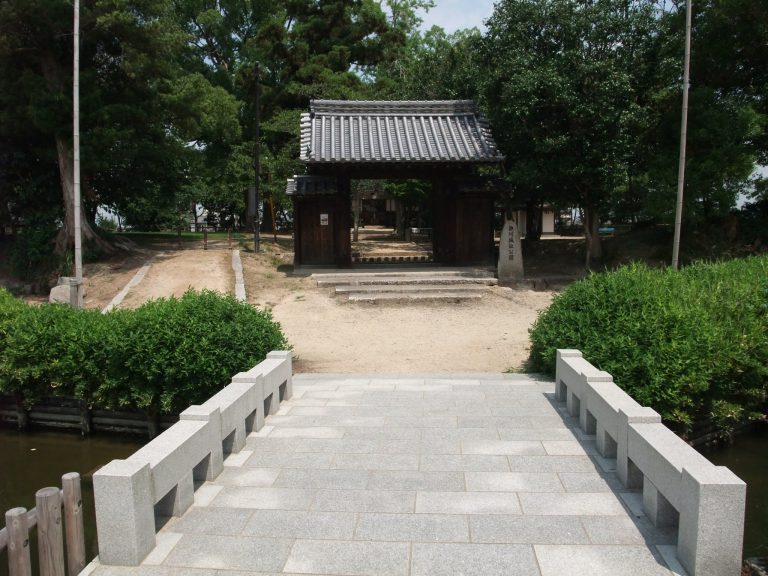
The temple remained in decline until its revival in the early Edo period, the era of rule associated with the Tokugawa shogunate. It was reorganized as a full Zen temple with the traditional seven-building complex, comprising a mountain gate, Buddha hall, abbot’s quarters, monks’ quarters, meditation hall, bell tower, and sutra repository. The Buddha hall was rebuilt in 1735.
Iyama Hōfuku-ji is also closely associated with Sesshū, the Muromachi-period monk-painter. Sesshū was born in Akahama in Bitchū Province and trained at the temple as a boy. A tradition says that he was tied to a pillar for neglecting his training and then painted a mouse on the floor with a tear and his toe. The supervising Zen priest thereafter stopped criticizing his painting. The floorboard associated with this story has since been removed.
Recognition and later associations
The three-story pagoda was designated a nationally important cultural property in 1927. Its associated inscribed tablet received an additional designation in 1970. The abbot’s quarters, the earthen wall surrounding them, the entrance, the dining hall, and other buildings were registered as tangible cultural properties in 2009. These structures date from the mid-Edo period through the Meiji period, the era of imperial rule and extensive political and social change that began in 1868.
The temple precincts also contain the graves of the politician Ryūgo Hashimoto and his son Ryūtarō Hashimoto. Ryūtarō Hashimoto served as Japan’s 82nd and 83rd prime minister.
Remains
The surviving precinct combines a Zen-style seven-building layout with historic structures from the Edo and Meiji periods. This arrangement groups the principal buildings of a developed Zen monastic complex around the temple’s religious and residential functions. The three-story pagoda forms the principal surviving monument from the earlier complex, while the early Edo rebuilding established the later arrangement of gates, halls, quarters, and service buildings.
Three-story pagoda
The three-story pagoda rises 18.47 meters and is the only major building specifically identified as having survived the destruction of 1575. Temple tradition once attributed its construction to a donation by Hōjō Tokiyori, the prominent regent of the Kamakura shogunate, in 1262. During dismantling and repair in 1967, however, an ink inscription dated 1376 was found, showing that the pagoda was built later, during the Northern and Southern Courts period, the fourteenth-century rivalry between competing imperial courts. It is the second-oldest surviving three-story pagoda in Okayama Prefecture.
Zen complex and historic buildings
The early Edo reconstruction provided a mountain gate, Buddha hall, abbot’s quarters, monks’ quarters, meditation hall, bell tower, and sutra repository. The Buddha hall, which serves as the main hall, dates in its present rebuilt form to 1735. The abbot’s quarters, their earthen perimeter wall, the entrance, the dining hall, and other structures belong to a sequence of buildings dating from the mid-Edo period to the Meiji period.
Memorial graves
Within the temple precincts are the graves of Ryūgo Hashimoto and Ryūtarō Hashimoto. Their location adds a modern political association to a site whose surviving buildings and traditions preserve a much longer religious and cultural history.