Ichibata-ji Temple: A Buddhist Center of Eye-Healing Worship in Japan
Site at a Glance
- Rating
- 4.4
- Popularity
- Low
- Country
- Japan
- Primary era
- Early Modern
- External website
- Open
- Eras represented
- Early Modern
- Civilizations
- Unclassified
- Site type
- Religious
On this page7 sections
History
Ichibata-ji Temple is a Buddhist temple in Izumo, Japan, traditionally associated with Yakushi Nyorai, the Buddhist Buddha of healing and medicine, whose role here is especially connected with healing the eyes. Its foundation tradition places its beginnings in 894, when a fisherman retrieved a statue of Yakushi Nyorai from the sea and, after entering religious life, established Iōji to enshrine it as the principal image.
From Tendai to Rinzai
The temple originally belonged to Tendai, a Japanese Buddhist school distinct from Rinzai Zen. It was revived in 1325 as a temple of the Nanzenji branch of Rinzai and received the name Jotokuji. In 1653, it was renamed Ichibata-ji. The temple transferred to the Myoshinji branch of Rinzai in 1790. Myoshinji and Nanzenji are major institutional branches within the Rinzai school.
Religious organization and pilgrimage
Ichibata-ji became the head temple of the Ichibata Yakushi religious organization when that body was established as a religious corporation in 1953. The organization has approximately 50 branch temples throughout Japan. Ichibata-ji is the first pilgrimage site in the Izumo Ten Yakushi circuit, the third site in the Izumo Shinbutsu sacred circuit, a special site in the Izumo Kannon circuit, and the twenty-sixth site in the Chugoku Thirty-Three Kannon circuit. These circuits are organized religious routes in which pilgrims visit temples for worship and devotional observances.
Modern cultural associations
The temple’s connection with eye healing also appears in its association with Nonnonba, a character from Shigeru Mizuki’s Nonnonba and Me. In the work, Nonnonba is portrayed as an Ichibata-ji believer who visits the temple. A festival associated with the character was held in 2012, and the precinct contains bronze statues of Nonnonba with the young Shigeru and Medama Oyaji from GeGeGe no Kitaro.
Remains
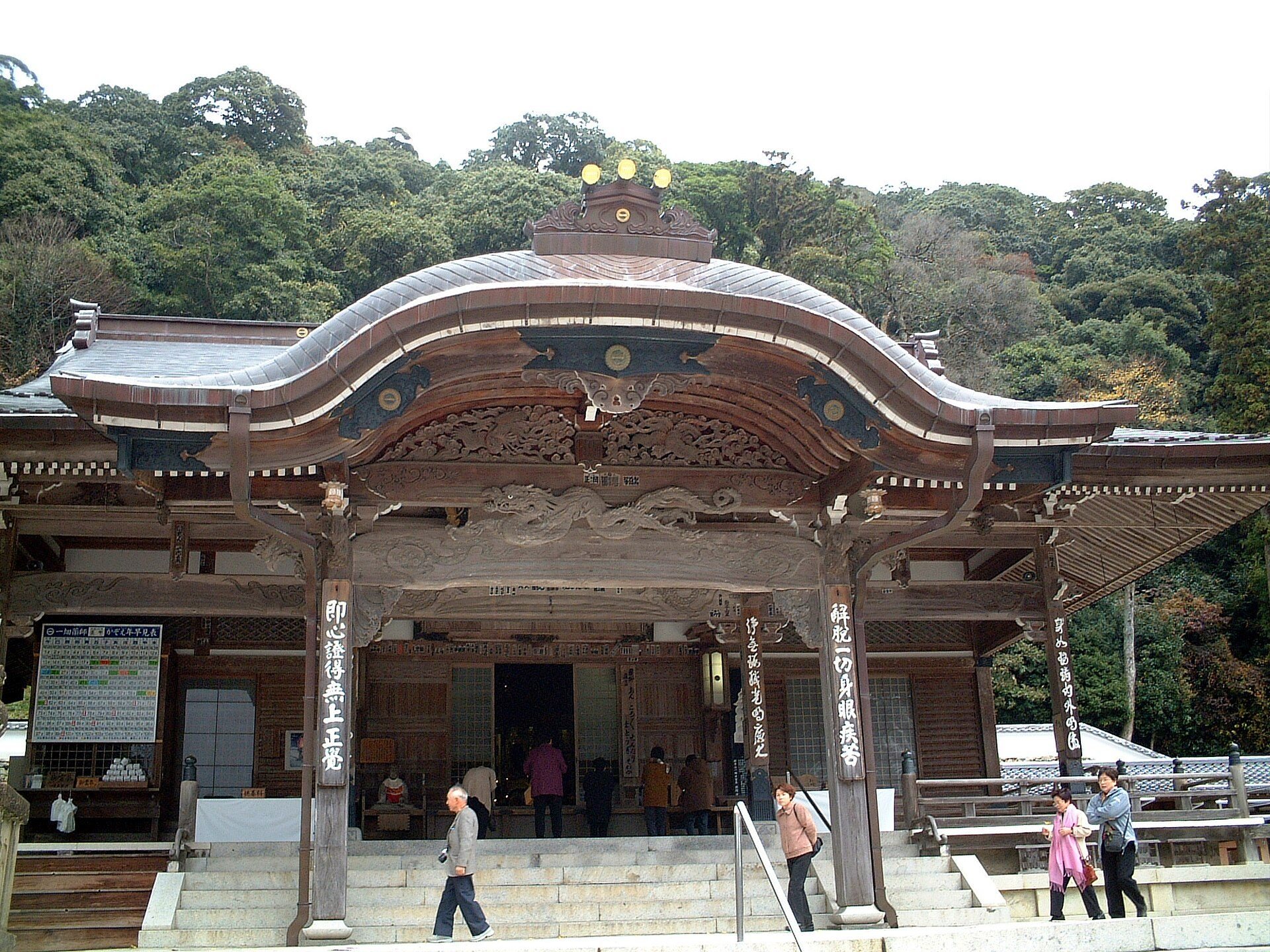
Ichibata-ji stands in a mountainous area of the Shimane Peninsula overlooking Lake Shinji. Its surroundings form part of the western district of the Lake Shinji Northern Hills Prefectural Natural Park. The precinct includes the Yakushi Main Hall and Ichibata-yama Cottage, a lodging facility that also provides spaces for Zen meditation experiences.
Bronze figures
Bronze statues in the precinct depict Nonnonba with the young Shigeru and Medama Oyaji. Their presence gives a physical form to the temple’s connection with Mizuki’s work and to its association with the religious tradition of eye healing.
Paintings and religious images
The temple preserves 22 paper sliding-screen paintings from a study, made with ink and color in 1815. The set is designated as a cultural property of Shimane Prefecture. It also preserves a silk painting of the Amida triad, an image group centered on Amida Buddha with two attendants. The painting is identified with the Goryeo period, the Korean dynasty that ruled from 918 to 1392, and is likewise designated as a prefectural cultural property.