Shimogamo Shrine: A Historic Shinto Sanctuary in Kyoto, Japan


Site at a Glance
- Rating
- 4.5
- Popularity
- High
- Country
- Japan
- Primary era
- Early Modern
- External website
- Open
- Eras represented
- Medieval, Early Modern
- Civilizations
- Tokugawa
- Site type
- Religious
- Remains
- Sanctuary
On this page14 sections
History
Shimogamo Shrine, formally Kamo-mioya Shrine, is a Shinto sanctuary in Kyoto, Japan, whose earliest recorded construction tradition dates to 677, during the reign of Emperor Temmu. Associated with the Kamo clan and the religious traditions of the Kamo kami, it developed alongside Kyoto’s history and, together with Kamigamo Shrine, became one of the Kamo Shrines.
Kamo traditions and early history
The shrine’s principal kami, or sacred presences in Shinto, are Kamo Taketsunumi no Mikoto and Tamayorihime no Mikoto. Taketsunumi is enshrined in the West Main Hall, while Tamayorihime is enshrined in the East Main Hall. In the shrine’s genealogical tradition, Tamayorihime is the mother of Kamo Wakeikazuchi, the principal kami of Kamigamo Shrine, and Taketsunumi is regarded as her father.
Shrine tradition places the descent of the kami at Mount Mikage during the reign of Emperor Jimmu, with the outlying Mikage Shrine marking that sacred location. Another tradition associates repairs to the shrine’s sacred enclosure with the reign of Emperor Sujin, around 97 BC. The earliest historically recorded construction tradition places shrine buildings at the confluence of the Kamo and Takano Rivers in 677. The foundation of the sanctuary is also broadly dated to the sixth or seventh century.
The shrine’s religious identity is closely tied to Kamo mythology. Taketsunumi is said to have guided Emperor Jimmu before settling in Yamashiro, where he married Ikakoyahime. Their daughter Tamayorihime became pregnant after taking a red arrow from the Kamo River. Her son was identified as the child of the thunder kami Honoikazuchi and became Kamo Wakeikazuchi. Taketsunumi is also connected in tradition with Yatagarasu, the three-legged raven, and with a golden hawk.
The Kamo Shrines and the Heian capital
One historical interpretation identifies Shimogamo’s predecessor as Mitsui Shrine, formerly a branch of Kamigamo Shrine. Under this interpretation, the Kamo religious complex divided into upper and lower sanctuaries between approximately 740 and 750, possibly in connection with state religious policy. In 750, the court granted Shimogamo ten stipend households, giving the shrine an economic base.
After the establishment of Heian-kyo in 794, the Kamo kami were regarded as protectors of the new capital and received increased imperial patronage. In 807, the shrine received the highest divine rank, Shoichi, and the Kamo Festival became an imperial festival. From 810, an unmarried imperial princess served at the Kamo Shrines as saiō, or consecrated priestess. This institution continued for approximately four centuries, while imperial envoys regularly visited or served the shrines. The Kamo Shrines were also designated the ichinomiya, the highest-ranking shrines, of Yamashiro Province.
During the Heian period, Shimogamo was an important religious and cultural center. The shrine appears in works such as The Tale of Genji and The Pillow Book. By the end of the period, more than sixty estates and ritual food-producing domains had been donated to support it. Many of those connections weakened during the later age of warfare.
Festivals, warfare, and early modern support
The Kamo Festival, commonly called the Aoi Festival, is held jointly with Kamigamo Shrine on May 15. Its origins are traditionally placed in the mid-sixth century, during the reign of Emperor Kinmei. The procession travels from the Imperial Palace through Shimogamo Shrine to Kamigamo Shrine, and its participants wear clothing modeled on the aristocracy of the Heian period.
The shrine’s ritual life also included mounted archery, known before the Meiji Restoration as kisha. Other continuing or revived practices include the January 4 kemari performance, a May mounted-archery demonstration, purification rites associated with Mitarashi Shrine, and the Aoi Festival procession. During the Edo period, Shimogamo regained land and support from the Tokugawa military government after losing ties with many medieval estates. The precinct also served as the setting for a number of Noh plays.
Modern changes and preservation
In 1868, during the Meiji Restoration, Shimogamo was designated a Kanpei-taisha, one of the highest ranks in the prewar state-supported shrine system. It remained a leading Kanpei-taisha alongside Kamigamo Shrine, became a Chokusaisha, a shrine visited by an official imperial ritual envoy, in 1883, and was included among the Beppyo shrines of the Association of Shinto Shrines in 1948.
The identities of the enshrined deities were also reconsidered. A document from 1767 identified the West Main Hall with Emperor Jimmu and the East Main Hall with his empress, Isuzuhime. After the hereditary shrine priesthood was abolished during the Meiji period, the government accepted a proposal to restore the older identification of the deities as Taketsunumi and Tamayorihime.
A typhoon in 1934 caused the worship hall and the fences on both sides of the tower gate to collapse. In 1937, a transfer ceremony for the Main Halls took place in the presence of an imperial envoy. In 1945, the shrine held a prayer service for the successful completion of the war. Government support ended after the Second World War, and the festivals were suspended; the festival tradition was restored in 1953.
Shimogamo Shrine and its sacred forest form part of the UNESCO World Heritage property Historic Monuments of Ancient Kyoto, inscribed in 1994. The shrine had also been protected as a state historic site in 1983, and its illustrated plan became an Important Cultural Property in 2017. The traditional twenty-one-year shikinen sengu cycle renewed the buildings while the sacred objects were retained or transferred according to the shrine’s rules. Because the two Main Halls are National Treasures and many other buildings are protected cultural properties, modern renewal generally consists of repairs and partial reconstruction.
Remains
Shimogamo Shrine occupies a roughly triangular area north of the meeting point of the Kamo and Takano Rivers. Its approach runs in a straight line from the confluence toward the sanctuary, creating an axial arrangement in which the sando, the formal route for worshippers and processions, leads directly to the shrine buildings. Tadasu no Mori surrounds much of the precinct. This approximately 12.4-hectare managed urban woodland consists mainly of deciduous trees and forms the setting for the approach and festival processions.
Forest approach and sanctuary layout
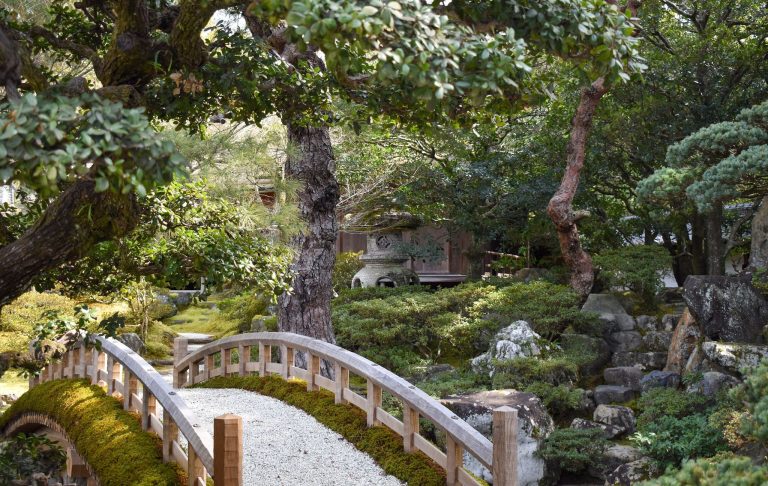
The sando passes through Tadasu no Mori and contains torii gates, bridges, covered passageways, and a stone temizuya basin shaped like a boat. A temizuya is a facility for ritual hand and mouth purification. The precinct contains 57 structures. Much of the complex was reconstructed in 1629 in a form intended to restore its Heian-period appearance, and the oldest surviving buildings date from that rebuilding.
Main Halls
The central sanctuary contains the West and East Main Halls, both National Treasures. The present buildings were erected in 1863 in the nagare-zukuri style, whose projecting front roof forms a covered porch. Their relatively plain forms are associated with the early Heian period and were influenced by the architecture of Ise Shrine. The buildings lack chigi and katsuogi, and their extended front eaves create sheltered spaces before the halls.
Gates and corridors
Two covered corridors, or kairo, enclose the Main Halls. The outer corridor is entered through the bright-red romon tower gate, while the inner corridor is reached through the chumon gate. Other principal buildings include the Maidono dance pavilion, Hosodono Hall, Hashidono Hall, Kugosho kitchen, Shinpukuden, Gokusho, Oidokoro kitchen, worship hall, and the east and west corridors. A well house is attached to the Oidokoro.
Associated shrines
Several subsidiary shrines occupy the wider precinct and connect the sanctuary with different strands of Kamo religious tradition. Mitsui Shrine contains three Main Halls dedicated to Taketsunumi, Ikakoyahime, and Tamayorihime. Its protected buildings include a worship hall, a roofed gate, east and west corridors, Suwa Shrine, Komori Shrine, and Shirahige Shrine.
Mikage and Kawai Shrines
Mikage Shrine stands at the foot of Mount Mikage and was rebuilt in 1693. It enshrines the rough spirits of Taketsunumi and Tamayorihime. Kawai Shrine is dedicated to Tamayorihime and contains a reconstruction of the Hojo-an, the hermitage traditionally associated with the writer Kamo no Chomei, whose father was a chief priest of Shimogamo.
Mitarashi and Aioi Shrines
Inoue Shrine, also called Mitarashi Shrine, stands over a spring. Stone steps lead to its rectangular purification pool, where the water is used to purify the Saiodai before the Aoi Festival. The spring bubbles up through the pool, and tradition connects the shapes of those bubbles with the origin of Mitarashi dumplings. Aioi Shrine contains the sacred Renri no Sakaki, two trees joined into one trunk that have produced a new shoot at their base. The shrine is associated with prayers for successful relationships.
Other precinct shrines
The seven Kotosha shrines stand together in one courtyard near the Main Halls. Built in the seventeenth century, they represent seven names or manifestations of Okuninushi and are associated with the sixty-year calendrical cycle and the Chinese zodiac. Their individual dedications are to Okunitama, Utsushikunitama, Omononushi, Okuninushi, Shikoo, Onamuchi, and Yachihoko. The nearby Inji Shrine is dedicated to the kami of seals, with present prayers concerning the successful conclusion of contracts.
Other associated shrines include Kawai, Kibune, Tobe, Kamo Hani, Iwamoto, Hashimoto, the six-shrine group, Inari, Hiyoshi, Sawata, Nijunisho, Kawasaki, the shrine for the spirits of successive Kamo priestesses, and Tenjingu. Kamo Hani Shrine and the buildings of Mitsui Shrine are among the protected components of the complex.
Protected buildings and historical records
Alongside the two National Treasure Main Halls, 31 structures are designated Important Cultural Properties, with a further 17 associated components carrying attached designation. The protected group includes the tower gate, Kamo Hani Shrine, the buildings of Mitsui Shrine, and several subsidiary shrines. An illustrated plan of the complex, now held by the Kyoto National Museum, is also an Important Cultural Property and preserves evidence of Shimogamo’s historical layout.
Public access to the Main Halls is normally restricted. They are opened or entered for particular festivals and ceremonies conducted by Shinto priests. The precinct also preserves evidence of later cultural history: in 1910, students of Kyoto’s former Third Higher School trained for rugby in the horse-riding ground of Tadasu no Mori after receiving instruction from the Keio rugby club. A monument erected beside Sawata Shrine in 1969 commemorates the first rugby kick there and the site’s association with the beginnings of Kansai rugby.