Shōjōke-in Temple: A Principal Pure Land Head Temple in Kyoto


Site at a Glance
- Rating
- 4.2
- Popularity
- Low
- Country
- Japan
- Primary era
- Modern
- External website
- Open
- Eras represented
- Early Modern, Modern
- Civilizations
- Japanese, Tokugawa
- Site type
- Religious
- Remains
- Monastery
On this page18 sections
History
Shōjōke-in Temple is a major Pure Land Buddhist temple in Kyoto, Japan, and one of the tradition’s seven principal head temples. It is also one of Kyoto’s four principal Pure Land temples and the 23rd site in the Twenty-Five Sacred Sites of Honen. Pure Land Buddhism centers on reliance upon the vow of Amida Buddha and the aspiration for rebirth in the Pure Land.
Palace Origins and the Honen Tradition
Temple tradition places the foundation of Shōjōke-in in 860, when the Tendai monk Ennin established a Buddhist hall and an inner-palace practice hall at the imperial palace at the request of Emperor Seiwa. Ennin, also known as Jikaku Daishi, was a prominent ninth-century Japanese Tendai monk. The early institution is said to have studied the Lotus teaching, Esoteric Buddhism, Pure Land Buddhism, and Buddhist precepts, although these palace-foundation traditions are not confirmed by the Nihon Sandai Jitsuroku or the Nihon Kiryaku.
A second tradition associates the temple’s development with Honen, the founder of Japanese Pure Land Buddhism. Honen is said to have given the Buddhist precepts to Emperors Go-Shirakawa, Takakura, and Go-Toba before receiving the temple from the retired Emperor Go-Shirakawa in recognition of his achievements. Shōjōke-in consequently regards Ennin as its founding abbot and Honen as the abbot connected with its conversion to Pure Land Buddhism. Honen’s receipt of the temple, however, does not appear in his biographies.
The temple remained close to the imperial residence from its earliest period and is traditionally said never to have established a precinct outside Kyoto. Its lack of a mountain name is associated with this palace-linked history. The institution’s existence becomes historically documented from the Kamakura period onward.
Kōa Zeshin and the Formation of the Temple
In 1302, the monk Kōa Shōken, also called Zeshin, received the buildings and principal image of Senshu-in, or Senshu Nembutsu-in, from his senior fellow disciple Senkū at Sanjo-Bomon-Takakura. Kōa later renamed the institution Jōka-in, a form that appears frequently in premodern records. By about 1333, the name Jōka-in was in use. Whether this institution directly continued the palace practice hall described in temple tradition, or was founded by Kōa, remains disputed.
Kōa is regarded as the temple’s de facto founder. He first entered religious life at Onjo-ji and later joined the Pure Land tradition under Reia Nenkū, an important transmitter of the Chinzei lineage in Kyoto. Kōa wrote the vernacular religious work Sanbu Kana-shō and helped restore the Chinzei branch of Pure Land Buddhism to Kyoto. His activities attracted patrons such as Prince Tsuneaki, a son of Emperor Kameyama, and Sanjo Saneshige. The temple held estates in Tamba Province and Nishitani Estate in Echizen Province.
The Muromachi Period
During the mid-fourteenth century, under its sixth head, Genshin, the temple moved to Tsuchimikado-Muromachi, near the district historically called Moto-Jōkainchō. The move is associated with the appropriation of the former Sanjo-Bomon-Takakura site for Ashikaga Naoyoshi’s establishment of Tōji-in, although the circumstances and sequence remain disputed. The temple’s presence at Tsuchimikado-Muromachi is documented by 1351, and the new site was traditionally identified with the former residence of the retired empress Shōkeimon-in.
At Muromachi, the temple stood beside Muromachi Street, near the residences of the imperial court and the Muromachi shogunate. Its location helped give its Pure Land lineage the name Chinzei Ichijo. By 1368, the institution had an organized network of affiliated temples, including Saifuku-ji in Tsuruga, Echizen. The monk Ryūkō, formerly associated with the Tendai tradition, joined the Ichijo branch after reading Kōa’s works and founded Konshō Amida-ji in Ōmi Province in 1413, extending the branch beyond Kyoto.
Imperial and aristocratic patronage, along with support from the Muromachi shogunate and warrior families, enabled further expansion. Emperor Go-Komatsu and the shogun Ashikaga Yoshinori contributed to the rebuilding of the Buddhist hall. The head priest Tōki became especially influential through his connections with Emperor Shōkō and Ashikaga Yoshinori. He received the first imperial permission in the Chinzei Pure Land tradition to wear the formal purple robe and was later granted the posthumous title Eshō Kokushi by Emperor Go-Hanazono.
Tōki had served as spiritual adviser at Emperor Shōkō’s death, and the title also recognized the temple’s transmission of the Endon precepts and the Chinzei lineage. The Endon precepts are a Tendai-derived system of Buddhist ethical rules. Shōjōke-in was the only non-Tendai institution recognized as a venue for conferring them. Tōki’s associate, the court noble Marikoji Tokifusa, recorded related affairs in his diary Kennaiki. The temple was regarded as a principal center of the orthodox Chinzei lineage and was supported by both the court and the shogunate.
Its medieval religious network also interacted with the monastic community of Sennyu-ji. The movement known as the disciples of Kenren combined Chinzei nembutsu teaching with the advanced monastic discipline associated with Sennyu-ji. This movement later disappeared during the Warring States period. The temple’s patrons included the Ise family, officials of the shogunate’s administrative office, and numerous court and warrior families. Their support involved religious patronage, placing sons in the temple, memorial services, and occasional political assistance, creating an early form of the priest-patron relationship that later developed into the established Buddhist household system.
War, Relocation, and Tokugawa Authority
Shōjōke-in was caught up in the opening battles of the Onin War, a late-fifteenth-century conflict that devastated Kyoto through rivalries within the shogunate and among powerful warrior houses. The temple suffered repeated wartime destruction, and its buildings could not be rebuilt until 1487. Its continuing authority is reflected in its participation in court and shogunal ceremonies and in its appearance in several sixteenth-century Rakuchu-rakugai screen paintings, which depict scenes within and around Kyoto.
Political upheaval during the Warring States period and the transition from the Toyotomi regime to the Tokugawa shogunate reduced the temple’s earlier prosperity. Toyotomi Hideyoshi’s urban-planning program moved it to its present precinct during the Tenshō era, between 1573 and 1592. The temple also faced difficulty controlling subordinate institutions, while the defection of Dōzan contributed to its decline. Dōzan later transferred to Kurodani, now known as Konkai Komyo-ji.
Under the Tokugawa shogunate, Shōjōke-in retained its position as a major head temple, although its formal relationship with the imperial court weakened as the shogunate tightened its control over the court. Permission to receive the purple robe required mediation by Chion-in. The appointment of head priests followed a procedure in which the shogunate ordered the appointment and the court formally approved it. Within the Pure Land organization, Shōjōke-in came under the administrative authority of Zōjō-ji and was treated as an authoritative temple outside the ordinary educational and advancement hierarchy of official training institutions.
Its imperial connections nevertheless continued. Numerous graves of imperial princes and princesses were established within the precinct, along with the graves of the imperial mothers Keihōmon-in and Kaimeimon-in. The temple also lodged officials and daimyo traveling to Kyoto. In 1729, an elephant imported from Vietnam for presentation to shogun Tokugawa Yoshimune stayed there before appearing at the imperial court. An enclosure, viewing stands, and bamboo barriers were erected for the animal.
During the final years of the shogunate, troops from domains responsible for guarding the imperial palace and maintaining order were housed at the temple. These included forces from Kumamoto, Tokushima, Satsuma, and Aizu. The Aizu lord Matsudaira Katamori stayed there for approximately six months. At the beginning of the Meiji period, the temple became one of the Satsuma domain’s bases during the Boshin War, the conflict that accompanied the overthrow of the Tokugawa shogunate and the establishment of imperial rule.
Fire, Reconstruction, and Recent Administration
Shōjōke-in suffered from the anti-Buddhist movement of the early Meiji period, internal disruption within the Pure Land school, and a fire that destroyed its buildings. Fires during the Kanbun era, the Hōei Great Fire, and the Tenmei Great Fire had also repeatedly damaged or destroyed earlier structures. Rebuilding sometimes used materials transferred from the imperial palace, preserving an architectural character associated with the court. The precinct was rebuilt for the seven-hundredth memorial observance of Honen in 1911.
The temple’s imperial associations are reflected in its use of a chrysanthemum emblem modified with leaves since the Meiji period. Its head priest traditionally joins the reception of the emperor or imperial family when they visit the Kyoto Imperial Palace. A succession dispute followed the end of Ryūkai Mano’s second eight-year term in 2018, producing a vacancy of more than two years and a temporary threat of withdrawal from the Pure Land organization. Mano died in September 2019 at the age of 97. An agreement in April 2021 allowed the head-priest selection committee to meet on May 26, 2021, when Jitsuo Iida was unanimously selected as the 83rd head priest.
Shōjōke-in also conducted recurring memorial services for victims of the 2019 Kyoto Animation arson attack. The services began with the seventh-day observance on July 25 and continued through the forty-ninth-day service on September 5, with monthly services recorded through January 2020. The temple’s long history of memorial practice thus continued into the modern period.
Remains
Principal Halls and Imperial Character
Main Image Hall
The Main Image Hall, also called the Great Hall, is the principal hall of the precinct. Its main image is a portrait of Honen, traditionally understood as the form he carved of himself at the age of 42, around the time he is said to have received the palace practice hall from the retired Emperor Go-Shirakawa. The hall also contains a memorial tablet altar for related members of the imperial family.
The present building was completed in 1911, when its former westward orientation was changed to face south. An entrance for imperial visitors lies on the western outer corridor and connects with the Imperial Envoy’s Gate. The inner sanctuary is unusually floored with tatami rather than boards. This arrangement is considered a survival of the residential character of imperial buildings used in earlier reconstructions. A step between the inner and outer sanctuaries is likewise interpreted, with some uncertainty, as a remnant of residential or imperial ceremonial form.
Amida Hall and Abbot’s Quarters
The Amida Hall is the former main hall of the subsidiary temple Shōrin-in. Its present structure was made from the reception hall and great corridor transferred from reception facilities erected at Nijō Castle for the enthronement ceremonies of Emperor Taishō. It retains Shōrin-in’s former principal image and is used for practical religious training. Shōrin-in had been an important subsidiary institution associated with traditions concerning Honen’s Shirakawa Zenbō and Shōrinbō. It had many aristocratic patrons, received exceptional treatment during the Edo period, and housed Matsudaira Katamori during the final years of the shogunate. It was incorporated into Shōjōke-in in 2003.
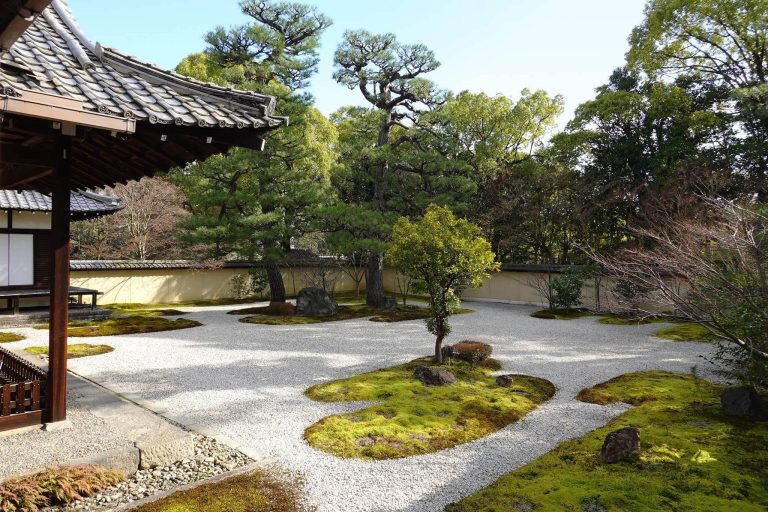
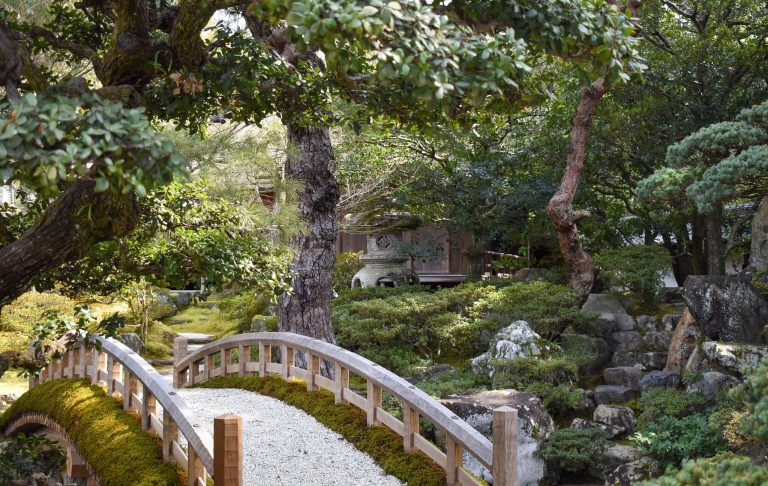
The Great Abbot’s Quarters houses a wooden seated Amida triad formerly enshrined in the Amida Hall. The central seated Amida is attributed to Genshin, also called Eshin Sōzu. The image once served as the principal image of the Kyoto Forty-Eight Vows pilgrimage. The seated attendant figures of Kannon and Mahasthamaprapta use the unusual posture known as “Yamato sitting.” The Smaller Abbot’s Quarters is also part of the precinct. The Garden of Universal Illumination, also called the Pure Land Garden, was designed by the Kyoto Garden Studio and Ono Masaaki. The tea house Seikatei was built in 1934.
Religious and Memorial Features
Ossuary and Honen Memorials
The Ossuary, built in 1934, houses a Buddha image made from the remains of approximately 3,000 deceased persons. The Honen Bone Stupa houses remains identified as Honen’s bones. They were rediscovered in 2018 in a stone tower within the precinct. Notes found with them indicate that they were probably deposited there in 1689. A new reliquary was made and the installation reorganized in 2019.
The Mausoleum contains another stone tower holding a portion of Honen’s remains. These relics are distinct from those housed in the Honen Bone Stupa. The precinct also contains the memorial tower for victims of the Tenmei Great Fire, a five-ring stone monument accompanied by an explanatory stele. A memorial service for victims of the later Genji Great Fire was held before it.
Guardian Shrines and Religious Halls
The Sanno Guardian Shrine is traditionally said to have been established after Ennin invited its protective deity. Its earlier form declined in modern times, and its deities were later changed under the influence of State Shinto. In 2011, it was restored to an older form and re-established through a new invitation from Hiyoshi Taisha. The Jōka Inari Shrine, another guardian shrine, had been abandoned by the early Shōwa period and was re-established in March 2017.
The temple preserves a painting identified with the Crying Fudo associated with Onjo-ji and with the illustrated scroll The Illustrated Tale of the Crying Fudo. The tradition includes a medieval version attributed to Takuma Hogen and an Edo-period copy made by Kano Eino at the request of Emperor Go-Mizunoo. Because the Crying Fudo is represented by a painting rather than a sculpture, the Fudo Hall houses a wooden seated image of Fudo Myoo, a wrathful Buddhist protector deity, approximately half life-size. The present hall was rebuilt in 2010 by converting the northern side hall of the Main Gate.
The Jizo Hall was rebuilt in 2011 by converting another side hall of the Main Gate. It enshrines the Sometono Jizo. Local tradition holds that Nakayama Yoshiko, a court lady of Emperor Kōmei and the mother of Emperor Meiji, frequently worshipped this Jizo and was blessed with the birth of Emperor Meiji. The temple also holds a statue of Moshime Sōnyū, the last lord of Moshime Castle. It originally stood as the founding image of Shoju-in, which Sōnyū established. After that temple moved to Okazaki as a retirement residence of Shōjōke-in and was abolished during the Meiji period, the statue and several old documents were transferred to the main temple.
Gates, Subsidiary Temples, and Other Structures
Gates and Bell Tower
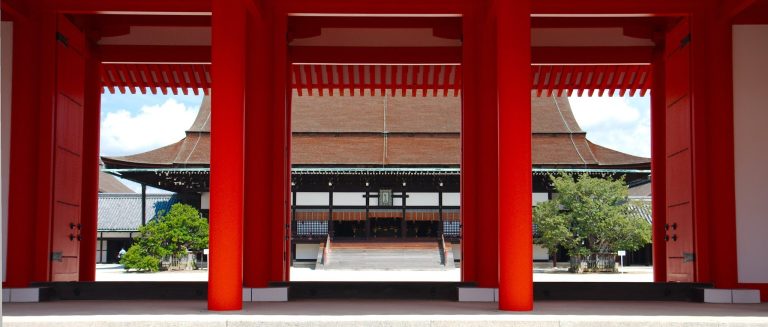
The East Gate is a rear gate opening toward Kawaramachi Street. Its ridgepole tablet is dated 1676, making it the oldest surviving building in the precinct. The Imperial Envoy’s Gate was rebuilt in 1934. Intended for imperial envoys and imperial visitors, it is normally closed and is opened today for the installation ceremony of a new head priest. During the Edo period, imperial envoys carrying authorization for the new priest’s installation and purple robe entered through it.
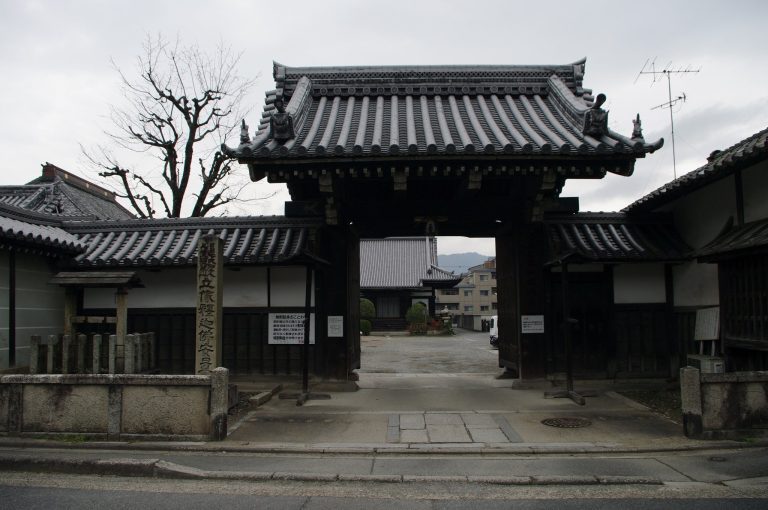
The Main Gate, also called the Front Gate or Korean-style Gate, opens toward Teramachi Street. Its rebuilding date is uncertain and is placed either in the Kansei era, from 1789 to 1801, or in the Meiji period. The Bell Tower was rebuilt in 2010. Its bell was cast in 1610 at the initiative of Onrenja Ryōdō, the abbot of Amida-ji in Sakai, Kawachi Province, and donated by Shinkō-in, the wife of a Konoe-family lord.
Subsidiary Institutions
Three subsidiary temples remain behind the Great Hall: Muryōju-in, Ryūsen-in, and Ryōju-in. Other former subsidiaries, including Jutoku-in, Eiju-in, Kōun-in, Kaikō-in, and Jōgyō-in, were abolished, merged, or relocated. The Jōzan Dormitory of Bukkyo University is a two-year, coeducational residential training institution for students in the university’s Buddhist specialized course and correspondence program.
Former Earthworks and Cemeteries
In 1708, the shogunate transferred the earthworks of the former city boundary on the temple’s eastern side to Shōjōke-in. The earthworks were dismantled and converted into a cemetery. The eastern cemetery now occupies this area. A cemetery called the Twenty-Eight Graves contains twenty-nine graves despite its name.
Archaeological and Historical Objects
A large foundation stone attributed to the presumed site of Hojoji was found at a nearby construction site in late 2021 with a stone image of Mahavairocana and a perforated stone. Construction workers brought it to the temple for devotional treatment because it was recovered with a Buddhist image. It did not come from an archaeological excavation, so the attribution is not definitive. Its 90-centimeter column-seat diameter and the identification of the surrounding area with the precinct of Hojoji, founded by Fujiwara no Michinaga, support the attribution. In 2022, the stone was arranged as a garden display in front of the Great Abbot’s Quarters.
The temple is associated with a recorded 1447 display of a firework-like “elegant performance” by a foreign visitor after a religious service. The entry is regarded as the earliest recorded reference to fireworks using gunpowder. This episode adds a distinctive historical layer to a precinct whose surviving buildings, memorials, religious images, and gardens preserve connections with the imperial court, Pure Land lineages, and Kyoto’s changing political order.