Rozan-ji Temple: Enjo Buddhist Head Temple in Kyoto


Site at a Glance
- Rating
- 4.2
- Popularity
- Low
- Country
- Japan
- Primary era
- Early Modern
- External website
- Open
- Eras represented
- Early Modern
- Civilizations
- Tokugawa, Toyotomi regime
- Site type
- Religious
- Remains
- Temple
On this page15 sections
History
Rozan-ji Temple is a Buddhist temple in Kyoto, Japan, founded by the Tendai Buddhist tradition in 938 and now serving as the head temple of the independent Enjo sect. Its formal name is Rozan Tendaikoji, while its mountain name refers to Mount Lu in China. The temple’s history combines Tendai, esoteric, Vinaya, and Pure Land teachings with long-standing connections to the imperial court.
Foundation and institutional development
In 938, Ryogen, the abbot of Enryaku-ji and a prominent restorer of Tendai institutional strength, established an earlier temple at the southern foot of Mount Funaoka. The site lay north of Heian-kyo and south of Daitoku-ji. A separate institution arose in 1245, when a devotee of Honen, the major Buddhist teacher who founded the Pure Land school known as Jodo-shu, established a temple at Izumoji and named it Rozan-ji after Mount Lu.
In 1368, the earlier temple absorbed the Izumoji institution under a shared abbot. It retained the name Rozan-ji and adopted the formal name Rozan Tendaikoji. The united institution became a center for the study of four traditions: Tendai Buddhism, esoteric Buddhism, the Vinaya tradition of Buddhist discipline, and Pure Land teaching.
Warfare, relocation, and destruction
Rozan-ji survived Oda Nobunaga’s 1571 attack on Enryaku-ji and other Tendai establishments. An imperial court document was issued to Akechi Mitsuhide, recording the emperor’s orders and words. Written by the court woman Madenokoji Fusako, the document is associated with Mitsuhide’s intervention to protect the temple.
In 1573, as Toyotomi Hideyoshi reorganized Kyoto and constructed the Teramachi district, Rozan-ji moved about three kilometers southeast to its present location. The temple was later destroyed in the Hoei fire of 1708 and again in the Tenmei Great Fire of 1788.
Imperial service and modern religious status
Until the Meiji Restoration, Rozan-ji was one of four temples responsible for Buddhist rites connected with the imperial court through the Okurodo, a private Buddhist chapel for the imperial family originally located within the palace. Temples associated with the Okurodo performed religious services for the court. Rozan-ji is the only surviving temple among those four that remains a sekke monzeki institution.
In 1872, the temple became affiliated with Tendai Buddhism and was revived by imperial order. Two years later it absorbed Kanayama Tennoji, traditionally attributed to Prince Shotoku as its founder. Rozan-ji became independent as the Enjo sect in 1948.
Murasaki Shikibu association and religious traditions
In 1965, the archaeologist and historian Tsunoda Bun’ei identified the temple grounds with the former residence associated with Murasaki Shikibu, the Heian-period author traditionally credited with The Tale of Genji. The identification drew on evidence that the residence of Fujiwara no Kanesuke, Murasaki’s great-grandfather, had stood there and on a statement in the medieval Kakaisho commentary on The Tale of Genji. The present temple site is not the location where the mansion originally stood. A memorial monument and the Genji Garden were created there in the same year.
Rozan-ji’s Setsubun ceremony, formally called the Demon-Exorcising Ritual, remains a historically important religious practice. Setsubun marks the seasonal transition between winter and spring and is associated with rituals to drive away evil. Three colored demons represent greed, hatred, and ignorance, the Buddhist three poisons. They dance to drums and conch-shell trumpets, interfere with prayers, and are overcome through a priestly fire ceremony and exorcism. In a related healing rite, the exorcised white demon places a sacred sword on a participant’s shoulder and prays for healing.
The temple’s historical collections include Ryogen’s testament to his disciple Jinzen, written in 972 and designated a National Treasure. It is deposited with the Tokyo National Museum. Other works designated as Important Cultural Properties include the court document connected with the temple’s protection during Nobunaga’s attack, a manuscript of Honen’s Senchaku Hongan Nembutsu-shu, and Ryogen’s twenty-six-article vow. A painted image of Fugen with the Ten Rakshasi and a wooden half-seated Nyoirin Kannon are deposited with the Kyoto National Museum.
Remains
Rozan-ji stands in Kamigyo Ward on the eastern side of the Kyoto Imperial Palace. The complex brings together buildings associated with the late Edo period, a garden created in 1965, temple facilities, surviving earthworks, and the Rozan-ji mausoleum area. Its architectural features preserve both imperial connections and the temple’s Buddhist functions.
Imperial and principal religious buildings
Main Hall
The main hall was created in 1794 by relocating part of the Sento Imperial Palace under the direction of Emperor Kokaku. It enshrines an Amida triad, with Amida Buddha accompanied by Kannon on the left and Seishi on the right. The seated figures form a welcoming-Amida composition. Kannon and Seishi slightly open their knees, lean forward from the waist, and wear robes swept by wind, conveying Amida’s descent to receive the dead.
Venerated Tablets Hall
The Venerated Tablets Hall is also traditionally said to have been moved from the Sento Imperial Palace under Emperor Kokaku’s direction. Its association with the palace forms part of the surviving architectural record of Rozan-ji’s relationship with the imperial court.
Gensan Daishi Hall
The Gensan Daishi Hall stands directly before the approach and was rebuilt in 1835. Its principal image is a statue of Gensan Daishi, a title of Ryogen, traditionally said to have been made by him. Before the image is a demon-faced attendant with a mouth split to the ears, open eyes, and a single-pronged vajra. The figure represents Gensan Daishi guiding people toward the defeat of impure thoughts.
The hall also houses a seated Jizo Bodhisattva traditionally regarded as Akechi Mitsuhide’s personal devotional image. Other images include Yakushi Nyorai, the Buddha associated with healing; Fudo Myoo, a wrathful protector of Buddhist teachings; Bishamonten, a guardian deity; and Nyoirin Kannon. The Nyoirin Kannon was formerly the principal image of Kanayama Tennoji and is associated with Rozan-ji’s position as the thirty-second stop on the Luoyang Thirty-Three Kannon pilgrimage.
Garden, boundaries, and supporting features
Genji Garden
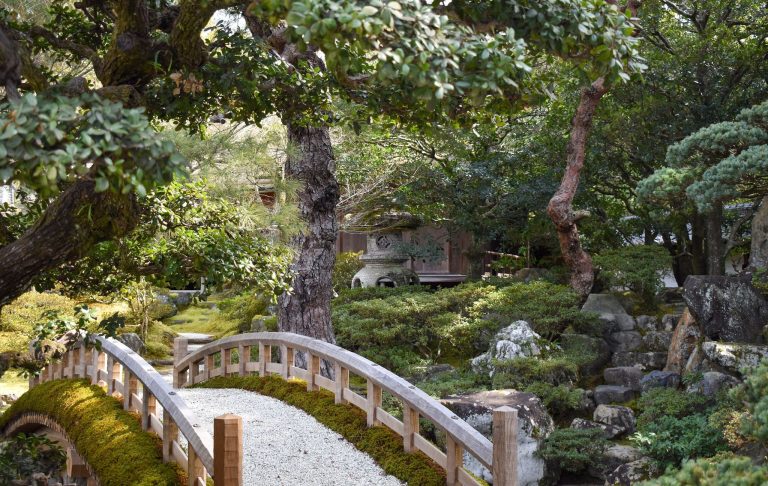
The Genji Garden lies south of the main hall and was laid out in November 1965. White sand, moss shaped like sandbars, and Japanese bellflowers create a composition representing the world of The Tale of Genji. The bellflowers bloom approximately from June to September.
Odoi earthwork
A section of Hideyoshi’s earthwork fortification, the Odoi, survives along the eastern edge of the grounds. It forms a physical reminder of the reorganization of Kyoto during the period when the temple was moved to its present location.
Temple facilities and gates
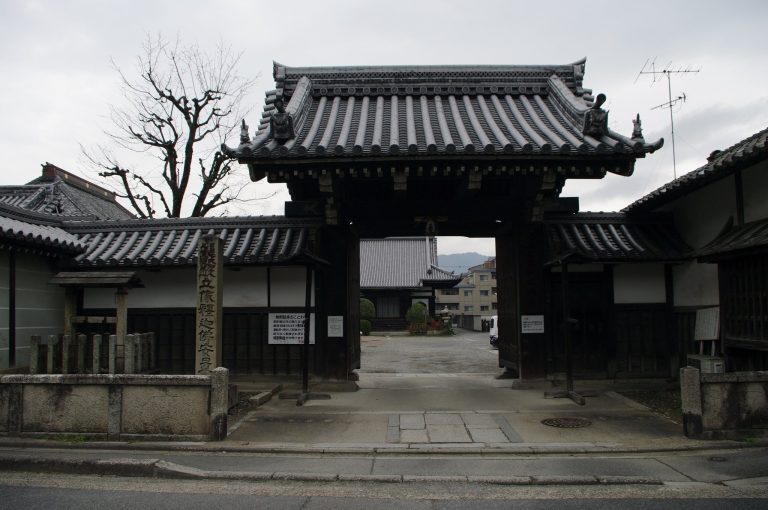
The complex includes the priests’ kitchen and quarters, a bell tower, and a brush memorial mound. Its entrances include a south gate of the yakui-mon type, a traditional gate with a principal roof and subsidiary roofs over its side posts, and a mountain gate, the formal entrance to a Buddhist temple.
Mausoleum area
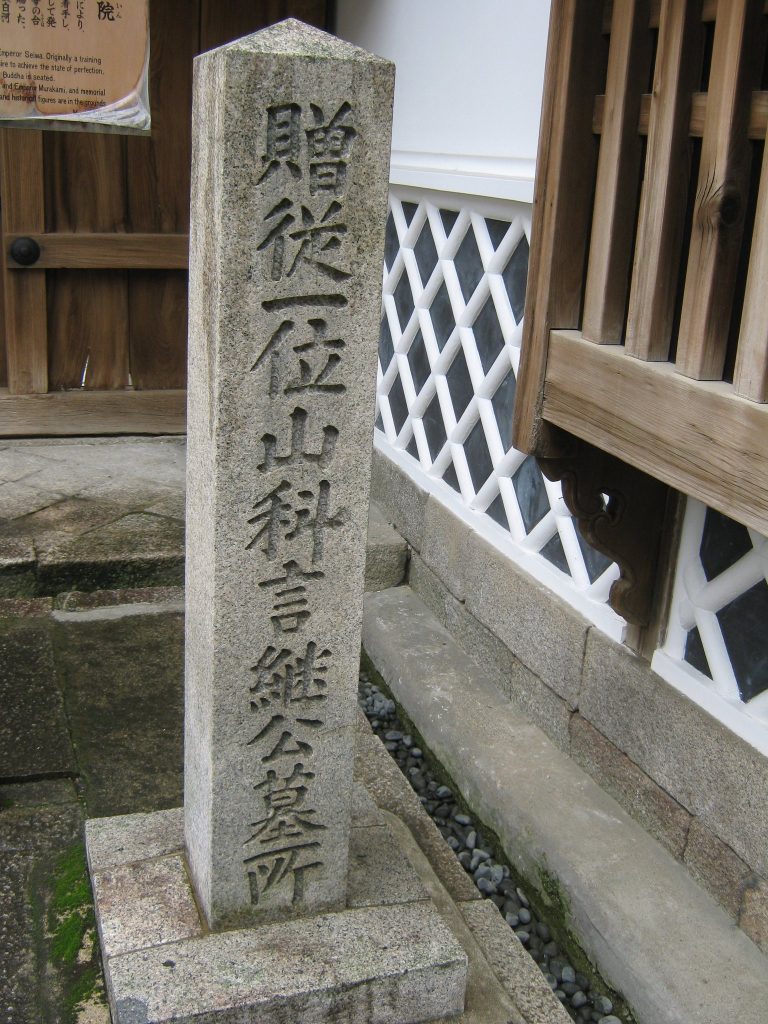
The Rozan-ji mausoleum area contains imperial and other graves, including the tomb of the Buddhist sculptor Jocho and the mausoleums of Emperor Kokaku’s parents. The imperial tombs are managed by Japan’s Imperial Household Agency.