Shōsan-ji Temple: A Shingon Buddhist Temple on Shikoku


Site at a Glance
- Rating
- 4
- Popularity
- Low
- Country
- Japan
- Primary era
- Modern
- External website
- Open
- Eras represented
- Modern
- Civilizations
- Japanese
- Site type
- Religious
- Remains
- Sanctuary
On this page17 sections
History
Shōsan-ji Temple is a Koyasan Shingon Buddhist temple in Japan, located in Kamiyama, Tokushima, and traditionally founded during the Taihō era around 701–704. It is formally known as Marozan Shōju-in Shōzan-mitsu-ji, takes Kokūzō Bosatsu as its principal deity, and is the 12th temple of the 88-temple Shikoku Pilgrimage.
Early foundation traditions
Temple tradition attributes the first foundation to En no Gyōja, an ascetic associated with the beginnings of Japanese mountain religious practice. During the Taihō era, he is said to have established a hermitage on the mountain and enshrined Zao Gongen, a syncretic mountain deity associated with Shugendō.
A later tradition places a decisive event in 815, when Kūkai, the monk regarded as the founder of Shingon Buddhism, came to the mountain after hearing of a fiery serpent attacking local villagers. When the serpent set the mountain ablaze, Kūkai advanced while forming the Maro water-wheel mudra, followed it into a rocky cave, and sealed it there through prayers to Kokūzō Bosatsu and Three-faced Daikokuten. He then carved the temple’s principal image of Kokūzō Bosatsu and established the temple. The names of the mountain and temple are traditionally linked to this subduing of the serpent.
Imperial and feudal patronage
Shōsan-ji later became an imperial prayer site under Emperor Go-Daigo. Ashikaga Takauji also designated it as a prayer site. During the Edo period, the Hachisuka family, lords of the Tokushima domain, provided the temple with devotion and patronage.
The temple has long been regarded as one of Awa’s three most difficult pilgrimage locations. The historic route from Fujii-dera, the 11th temple, crosses the mountain through Nagato-an, Ryūsui-an, and Jōren-an before reaching Shōsan-ji. Beyond the temple, the route is called the Ichinomiya Road and continues toward Dainichi-ji, the 13th temple. Pilgrimage tradition also places the death of Emon Saburō at a hermitage about 1.6 kilometres from Shōsan-ji.
Historic routes and cultural properties
Several sections of the Awa Pilgrimage Roads associated with Shōsan-ji have been designated as historic sites. The designated Shōsan-ji Road includes about 2.38 kilometres near Jōren-an and on the descent toward the Sōchi Valley, with 34 stone distance markers, two route markers, and 20 pilgrimage graves. Another designated section extends 0.960 kilometres from near the Sōchi Valley to a forest road at about 630 metres elevation. The designated Ichinomiya Road extends 0.953 kilometres from the temple precinct toward a road junction at about 480 metres, excluding an intervening road section.
The temple’s Kūkai statue, bronze bell, historic documents, and other associated cultural properties are listed as cultural properties. The cedar avenue and a wisteria colony within the precincts were designated in 1962, followed by the Kūkai statue in 1973 and the bell in 1984. The annual Okomori Buddhist service takes place on August 30, when many lanterns are lit throughout the precincts after sunset.
Remains
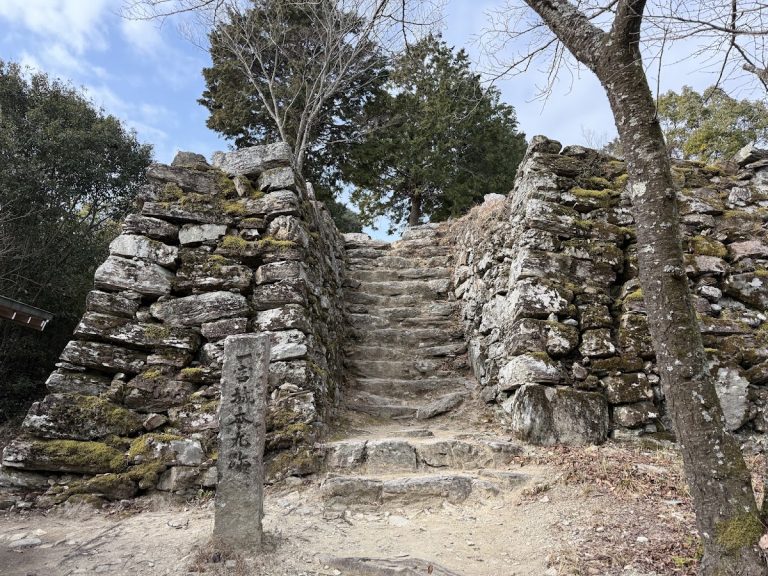
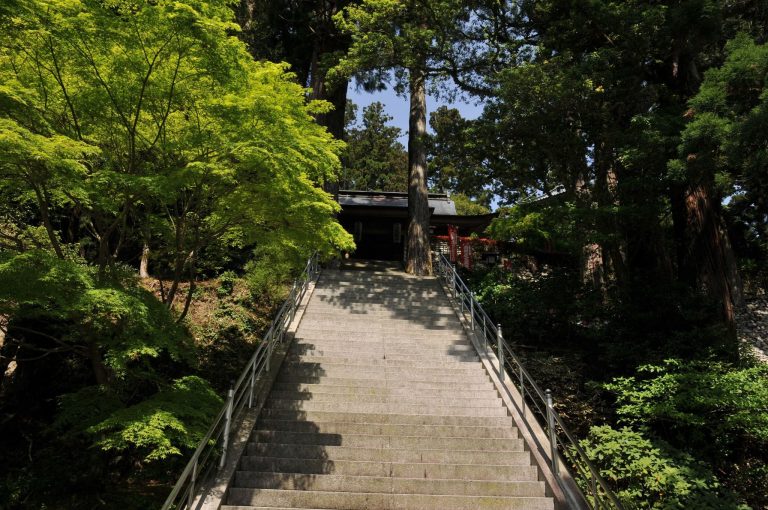
Shōsan-ji stands on the eastern side of Mount Shōsan, whose summit reaches 938 metres. The temple lies near the mountain’s eighth station at an elevation of about 706 metres, among very large cedars said to be several hundred years old. From the large parking area, an approach of about 500 metres leads to the temple gate, passing large stone images of Hotei, Kishimojin, and the Thirteen Buddhas. A stone poem monument at the parking area bears the verse, “With a flower-like heart, there is also the sound of flowers.”
Main precinct
Niōmon and central buildings
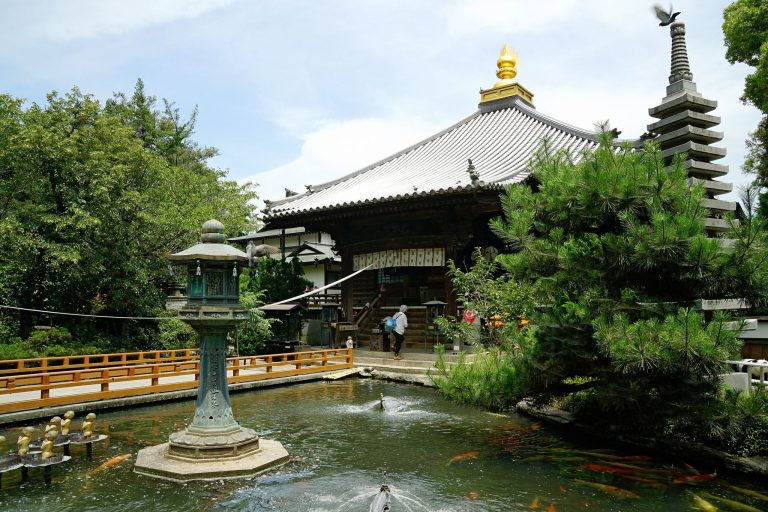
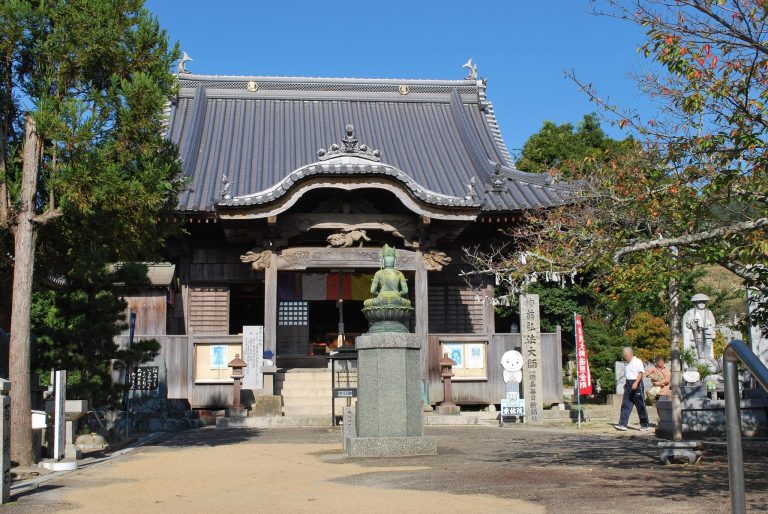
The eastern entrance is formed by a Niōmon, a temple gate guarded by paired protective figures called Niō. Inside the gate, the hand-washing basin stands to the left and the bell tower to the right. The Main Hall lies ahead. The Three-faced Daikoku Hall stands to its left, while the Daishidō and Junisha Shrine occupy the area to the right.
Main Hall and sacred images
The Main Hall presents a substitute image of Kokūzō Bosatsu, while the hidden principal image is kept in a repository on the slope behind the hall. The wooden seated Kokūzō Bosatsu is carved from a single block of kaya wood. Its eyes are carved rather than inlaid, and the image measures 112 centimetres in height.
Daishidō
The Daishidō, a hall dedicated to Kūkai, was completed in 2008 and stands to the right of the Main Hall. It contains a publicly viewed image of Kūkai, while the original statue is preserved in the repository behind the Main Hall. The wooden seated figure is a hollowed, joined-wood sculpture with crystal eyes. It is 79 centimetres high and carries an inscription recording polychrome work in 1400.
Three-faced Daikoku Hall
The Three-faced Daikoku Hall houses a hidden central image of Daikokuten, with Bishamonten on the right and Benzaiten on the left. Worship is normally directed toward a substitute Three-faced Daikokuten image. A Kangiten image formerly kept in the Great Kangiten Hall was transferred here and installed beside the substitute image. Kangiten is a Buddhist deity associated with an elephant-headed form of Ganesha and with prosperity and auspiciousness.
Junisha Shrine and subsidiary buildings
The Junisha Shrine has an uncertain foundation date. It once enshrined the Twelve Kumano Gongen, but since the beginning of the Meiji period it has housed the twelve deities of the Seven Generations of Heaven and the Five Generations of Earth. A small stone Tahōtō, a treasure-pagoda form associated with esoteric Buddhist architecture, stands within an enclosure before the Main Hall and enshrines Dainichi Nyorai.
The precinct also includes a tea-house structure behind the office and a reception and scripture-office building. The left side of that building serves as a pilgrims’ rest area and exhibition space. A bell tower forms part of the central precinct. The bronze bell is 103 centimetres high and 51 centimetres in diameter, and was made in 1649. Its inscription names Hachisuka Tadateru, the second lord of Tokushima, as its donor.
Separate hall and historic records
Great Kangiten Hall
The Great Kangiten Hall stands about 330 metres from the main temple area, beyond the storehouse buildings. Its principal Kangiten image has been transferred to the Three-faced Daikoku Hall, where it is installed beside the substitute image.
Documents and temple writings
Shōsan-ji preserves three historic documents, including a land-domain donation inventory and a donation document. It also possesses a five-volume group of temple writings dating from 1325 to 1357.
Pilgrimage road remains
Shōsan-ji Road
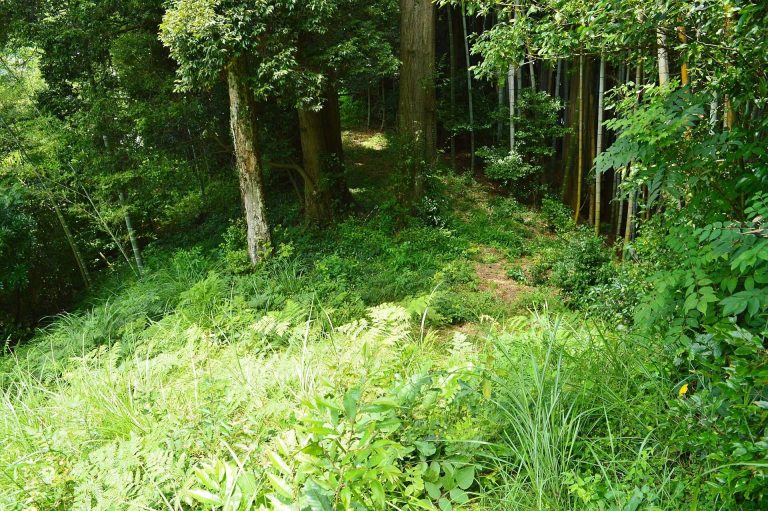
The route-associated remains lie outside the main temple precinct and include steep mountain paths descending toward the Sōchi Valley, stone distance markers, route markers, and pilgrimage graves. A cedar associated with Jōren-an is estimated to be 600 years old. It rises 30 metres, has a trunk circumference of 7.62 metres, and a crown measuring about 16.1 metres from east to west and 14.8 metres from north to south.
Jōren-an Kannon
Jōren-an also preserves a standing Thousand-armed Kannon. The gilt, joined-wood sculpture is 173 centimetres high and has 42 arms, forming part of the physical and devotional landscape along the historic approach to Shōsan-ji.