Hie Shrine (Numazu): A Shinto Shrine Founded in 1096


Site at a Glance
- Rating
- 4.2
- Popularity
- Low
- Country
- Japan
- Primary era
- Modern
- External website
- Open
- Eras represented
- Early Modern, Modern
- Civilizations
- Japanese, Tokugawa
- Site type
- Religious
- Remains
- Sanctuary
On this page12 sections
History
Hie Shrine (Numazu) is a Shinto shrine in Japan, founded in 1096 on the Ooka Estate, which belonged to the regent Fujiwara no Moromichi. Its principal deity is Oyamakui no Kami, a kami traditionally associated with Mount Hiei and the Hie and Hiyoshi shrine tradition.
Foundation tradition
The shrine’s foundation is traditionally attributed to Moromichi’s mother, the Kyogoku Kita-no-Mandokoro. In 1096, she invited a divided spirit, a sacred manifestation ritually brought from an existing shrine, from Hiyoshi Shrine to the estate. The act was intended to appease resentment connected with an earlier conflict involving Enryakuji, a major Buddhist monastery on Mount Hiei, and Hiyoshi Shrine, the Shinto shrine historically associated with the mountain’s religious complex.
The conflict took place in 1095, when Minamoto no Yoshitsuna, a member of the Minamoto warrior family, killed people associated with Enryakuji and Hiyoshi Shrine. Fujiwara no Moromichi was Yoshitsuna’s lord and rejected appeals from the two institutions. The foundation tradition holds that Moromichi later died at the age of 38 because of their curses. His mother also donated eight cho and eight tan of rice fields to support the new shrine.
Rebuilding and changing status
A fire in 1615 led to the shrine’s reconstruction and to its renaming as Sanno-gu. The name changed again to Hiyoshi Shrine in 1871 and to Hie Shrine in 1874. The shrine was also popularly known as Sanno-san.
Until the Meiji period, the shrine served as the principal tutelary shrine, or guardian shrine, of 22 villages. The modern shrine-ranking system, a state classification system that assigned official ranks to Shinto shrines, designated it a village shrine in 1873. It was elevated to prefectural-shrine status in 1926, during the early Taisho period.
Festivals and observances
The principal annual festival takes place on September 23 and 24. Its ceremonies begin with a white-sand-carrying ritual performed by a boy called Toudono and a girl called Omaedono. In the earlier form of the rite, the boy gathered 11 flat stones and the girl gathered 10 from Senbonhama, making 21 stones in total. They carried them in brocade bags. Because of worsening traffic conditions, the ritual is now held at an altar on the Kano River embankment. The stones are collected alternately, arranged in a circle, placed in the bags, and offered before the deity on a sanbo, a stand used for offerings, at the main sanctuary.
During the same festival, the shrine’s sacred palanquin is carried through the parish neighborhoods. The mikoshi, a portable shrine used to carry a deity ceremonially, was dedicated in 1723 by the wealthy merchant Tarui Koemon.
Other observances include the New Year’s Festival on January 1, the Tenjin Festival on the Sunday nearest January 25 for Hie Tenmangu, the Setsubun Festival, and the Kigensetsu Festival on February 11 associated with Kashihara Shrine. The calendar also includes the Spring Prayers Festival in March, the Flower Festival and Flower-Calming Festival in early April, and the Midsummer Purification Rite on June 30.
Remains
The surviving shrine complex includes a main sanctuary, a worship hall, a torii, four subsidiary shrines, and another rebuilt site building. Their dimensions are given in traditional Japanese units, including the ken, commonly the interval between structural posts, and the shaku, a smaller traditional unit of length.
Principal sanctuary buildings
Main sanctuary
The main sanctuary was built in 1803 using zelkova and has a copper-covered roof. The roof was completely re-covered in 1869 and has since received repeated repairs because of leaks. The sanctuary measures three ken square.
Worship hall
The worship hall was damaged by the Ansei Earthquake of 1855, a major earthquake that struck Japan that year. It was rebuilt as a temporary hall in 1869. A further rebuilding began in 1912 and was completed in the early Taisho period. After later leakage, the roof was replaced with a bronze roof in 1970. The hall measures 5.5 ken across the front and four ken in depth.
Entrance and subsidiary buildings
Torii
A torii built in 1935 stands 18 shaku 8 sun high and has an opening 11 shaku wide.
Subsidiary shrines
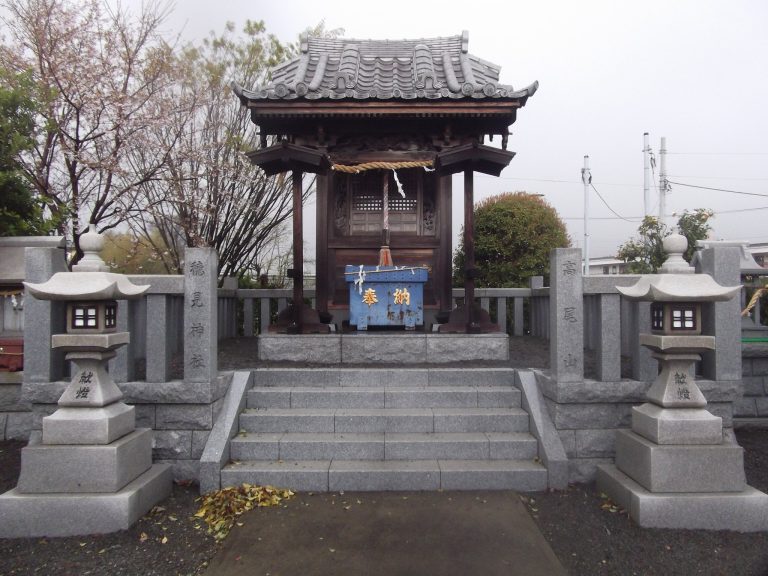
Four subsidiary shrines stand on the grounds. The first subsidiary shrine measures four shaku across the front and five shaku in depth. Kamado Shrine has the same dimensions. Tenmangu measures one ken one shaku across the front and one ken three shaku in depth, while Konpira Shrine measures five shaku across the front and one ken in depth.
Rebuilt site building
Another building on the grounds was rebuilt in 1935. It measures 2 ken 5 shaku across the front and 9 ken 3 shaku in depth.