Shiogama Shrine: A Historic Shinto Shrine in Japan


Site at a Glance
- Rating
- 4.5
- Popularity
- Medium
- Country
- Japan
- Primary era
- Early Modern
- External website
- Open
- Eras represented
- Early Modern, Modern
- Civilizations
- Japanese, Tokugawa
- Site type
- Religious
- Remains
- Sanctuary
On this page13 sections
History
Shiogama Shrine is a Shinto shrine in Shiogama, Japan, associated with the historical development of northeastern Japan and regarded as the head shrine of several hundred Shiogama shrines throughout the country. Its foundation date is unknown, but shrine tradition connects its beginnings with Amaterasu-Omikami, the principal solar sacred being of Shinto, who sent the martial kami Takemikazuchi-no-Kami and Futsunushi-no-Kami to develop the Tohoku region under the guidance of Shiotsuchi-Oji-no-Kami. After peace had been established, Shiotsuchi-Oji taught local people to make salt from seawater, and a shrine was erected in gratitude.
Shiogama Shrine now shares its precinct with Shiwahiko Shrine. The two have operated as a single juridical corporation under the formal name Shiwahiko Shrine and Shiogama Shrine since the Meiji period. Shiotsuchi-Oji-no-Kami, Takemikazuchi-no-Kami, and Futsunushi-no-Kami are enshrined in separate sanctuaries. Shiotsuchi-Oji is associated with the sea, salt production, navigation, transport safety, and safe childbirth, while Takemikazuchi and Futsunushi are regarded as kami sent to pacify the Tohoku region. Shiwahiko-no-Kami, enshrined in the adjoining shrine, is associated with agriculture, industry, and territorial development.
Early records and medieval patronage
The shrine first appears in the historical record in 820, when it received 10,000 bundles of grain as a state ritual allowance. The same allowance was assigned under the Engishiki, a tenth-century compilation of court regulations and ritual procedures, in 927. This was an exceptionally generous allocation compared with those given to the other state-supported shrines listed there. Shiogama Shrine was not included in the Engishiki shrine register, however, and its early promotion in the hierarchy of sacred rank is not securely documented.
An imperial treasure mission visited the shrine in 1017 at the accession of Emperor Go-Ichijo. Official divination may also have taken place in 1070 and 1074, although the reading of the shrine name in the relevant record is uncertain. By the medieval period, successive regional rulers revered Shiogama Shrine. The Oshu Fujiwara regime provided patronage, including a document concerning shrine land in 1186 and an iron lantern donated in 1187 by Izumi Saburo Tadahira.
After the Oshu Fujiwara regime fell in 1189, the Kamakura shogunate protected the shrine’s lands and prohibited disorder within its territory. A document from 1193 calls Shiogama Shrine the ichinomiya of Mutsu. An ichinomiya was the highest-ranking shrine traditionally recognized within a historical province, and Mutsu covered much of what is now northeastern Japan.
Administrators and changing regional power
From 1190, the Isawa family held administrative authority over the shrine. Its descendants later adopted the surname Rusu, organized shrine personnel as their retainers, and controlled Shiogama Jinguji, the Buddhist temple responsible for shrine administration. By the end of the Warring States period, this administrative role had passed to Horenji, which continued to serve as the shrine’s administrative temple during the Edo period.
The Nanboku-cho conflicts, a period of competing imperial governments and warfare in the fourteenth century, weakened the Rusu family’s authority as the Taga provincial government declined. The Oshu governors appointed by the Muromachi shogunate nevertheless continued to support the shrine. Shiba Iekane submitted a prayer document in 1354, Shiba Naomochi supported construction of a temporary sanctuary and donated a horse in 1356, and Kira Sadatsune made pledges in 1360 for a torii, shrine buildings, a cast ritual cauldron, a sacred horse, Buddhist sutra recitations, and kagura performances. Kira also donated Takeshiro estate.
A late-fourteenth-century register identifies Shiogama Shrine as the ichinomiya of Mutsu, while a later Muromachi-period register assigns that status to Tsutsukowake Shrine. Shiogama was consequently sometimes described as an early-modern ichinomiya, although it was recognized and visited in that capacity during the seventeenth century.
Decline and Date restoration
Shiogama Shrine declined during the medieval period as cultivation encroached on its land. Fires during the Tensho era destroyed ritual implements, origin records, and other materials. After rebuilding in 1675, the shrine had become a very small sanctuary measuring approximately six by five shaku. It was then merged with Gozu-Tenno Shrine at Iwakiri, now known as Yasaka Shrine.
The Date clan of Sendai provided extensive patronage from the Edo period through the Meiji period. Its lords officiated at rituals as chief priests and donated lands, swords, and sacred horses. Date Masamune built shrine buildings in 1607 and donated land in 1619. Date Tadamune rebuilt the bell tower in 1636, repaired the long floor in 1650, and rebuilt the worship hall in 1664.
Date Tsunamune carried out a substantial rebuilding in 1663 and donated additional land. In 1685, Date Tsunamura exempted Shiogama from taxation, authorized a market, and improved the port. He secured the shrine’s promotion to Senior First Rank in 1687, commissioned an origin record in 1693, and began the major rebuilding project that produced the present principal shrine group in 1695. His successor, Date Yoshimura, completed the work in 1704 and made a further land donation.
A twenty-year cycle of ceremonial shrine renewal was established after the 1704 completion and continues to the present. In 1868, the French military officer Jules Brunet visited Shiogama while accompanying Enomoto Takeaki’s former shogunate fleet and sketched the front approach. The sketch is regarded as the earliest known work by a foreigner depicting the shrine.
Shiwahiko Shrine and modern status
Shiwahiko Shrine was historically associated with the left bank of the Kammurigawa, another name for the Nanakita River, at Iwakiri. Its precise medieval location is uncertain, but it was probably near a major route from the Tosan-do to Taga Castle, in an area that also contained important fortifications such as Iwakiri Castle. A 1695 origin record states that the shrine first received imperial offerings in 665. It was promoted from Junior Fourth Rank to Senior Fourth Rank in 859 and listed as a Myojin Taisha in the 927 Engishiki.
Shiwahiko Shrine later declined and was incorporated into the Iwakiri Gozu-Tenno Shrine. During the Meiji period it was transferred to the Shiogama precinct, where a newly built sanctuary received it in December 1874. The shrine was classified as a National Shrine of the Middle Rank in 1871, a state designation used before the prewar shrine-ranking system was abolished. In 1877, a divided spirit was installed at the former Iwakiri site as Kammurigawa Shrine, a subsidiary shrine.
State-funded rebuilding restored Shiwahiko Shrine between 1934 and 1938, while state-funded repairs at Shiogama Shrine took place from 1938 to 1942. After the Second World War, the former shrine-ranking system was abolished, and the two shrines became a Beppyo Shrine under the Association of Shinto Shrines. A Beppyo Shrine is listed separately because of its historical or institutional importance. The complex was recognized in 2016 as a component cultural property within the Japan Heritage designation under the registered name Shiogama Shrine.
The shrine’s principal annual festival is held on July 10, while Shiwahiko Shrine’s festival takes place on March 29. The Shiogama Minato Festival begins at Shiogama Shrine, whose mikoshi, or portable sacred shrines, travel through the city and around Matsushima Bay accompanied by approximately 100 vessels, including a ceremonial boat. The subsidiary Okama Shrine preserves the salt-making ritual that expresses Shiogama’s traditional connection with seawater and salt.
Other observances include the Hana Festival, established in 1778 to pray for protection of crops from flooding, and the Hote Festival, begun by local townspeople in 1882 for Shiogama’s protection and prosperity. The July Rensai festival includes salt making from seawater and mounted archery.
Remains
Shiogama Shrine occupies the ridge of Ichimoriyama, a branch-like hill of the Matsushima Hills approximately 50 meters above sea level. The ridge extends eastward into the former inlet of Chiga-no-Ura, now Shiogama Port, while subsidiary shrines occupy the lower southern slopes. The former inlet between the surrounding V-shaped hills has largely become reclaimed and urbanized land. Taga Castle stood on the southern slopes of the Matsushima Hills southwest of the shrine, and Chiga-no-Ura served as the outer port of the Mutsu provincial government. South of Ichimoriyama, the former watercourse is now the east-flowing Harai River, part of which runs underground beneath a prefectural road.
Principal sanctuaries
Left and Right Sanctuaries
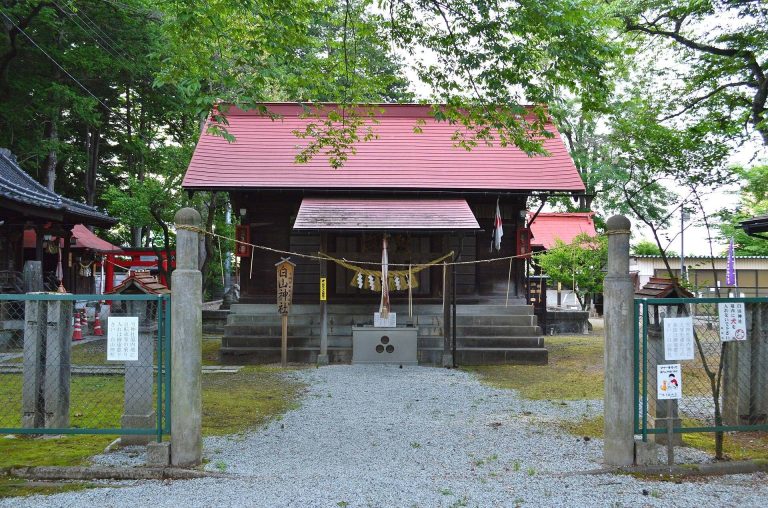
The principal group was laid out after ground-breaking in 1695 and completed in 1704 under Date Tsunamura and Date Yoshimura, with Matsubara Sukebe Shigenari as master carpenter. The Left Sanctuary and Right Sanctuary stand parallel from east to west. Each has a three-bay nagare-zukuri honden, a sanctuary with a gabled roof whose front slope extends over the entrance, together with a gabled offering hall, covered corridor, and sacred enclosure marked by a mizugaki, or boundary around the holy space.
The corridors have a gabled central section facing the entrance and gabled side sections whose ridges run parallel to the front. In front of them, the worship hall has an irimoya-zukuri roof, combining a gabled upper roof with hipped lower sections. The sanctuaries, offering halls, corridors, and enclosures have cypress-bark roofs and unpainted woodwork with restrained metal fittings. The worship hall is roofed with copper sheets and finished in vermilion lacquer.
Detached Sanctuary
The Betsugu, or Detached Sanctuary, stands east of the Left and Right Sanctuaries and faces west toward them. It contains its own sanctuary, offering hall, corridor, sacred enclosure, and worship hall. Its sanctuary and offering hall match the scale and design of those in the principal pair, while its corridor and enclosure are smaller but follow the same arrangement and treatment.
The Betsugu worship hall measures five bays wide and three bays deep, compared with seven bays by four bays for the worship hall of the Left and Right Sanctuaries. Its sanctuary, offering hall, corridor, and enclosure have cypress-bark roofing and unpainted woodwork. The worship hall has copper-sheet roofing and vermilion lacquer.
Gates, approach, and historic objects
Karamon and Zuishinmon
In front of the Left and Right sanctuaries stands the Karamon and its adjoining corridors, followed farther south by the Zuishinmon. The Karamon is a four-legged, gabled gate. Although its conventional name refers to a curved gable, this gate does not have one, so its official cultural-property designation calls it simply a gate. The gate and corridors have copper roofs and vermilion-painted surfaces.
The Zuishinmon is a three-bay tower gate with a copper-sheet roof and vermilion paint. A steep stone stairway of 202 steps approaches the shrine from below, ending at a granite Myojin-style torii erected in 1663. Fourteen buildings and one torii in the precinct are collectively designated as Important Cultural Properties.
Lanterns and sundial
A stone sundial in the precinct dates to 1792. The grounds also contain an iron-and-copper lantern approximately fourteen feet high, donated in 1807, and the Bunji iron lantern donated in 1187 by Izumi Saburo Tadahira. The Bunji lantern stands in front of the Left and Right Sanctuary worship hall. Long-term deterioration has removed its former roof fittings, including a finial, wind bells, and a decorative roof base.
Subsidiary shrines, landscape, and collections
Magaki-ga-shima, an island associated with the shrine, forms part of the Landscape of Oku no Hosomichi scenic designation. Matsuo Basho described the shrine’s pillars, painted ceiling, stone stairway, votive lanterns, and vermilion fence in his travel account. Shiogama-zakura, a distinctive cherry tree associated with the shrine, is designated a national Natural Monument. The precinct also contains a tarayou holly designated a natural monument of Miyagi Prefecture and cryptomeria designated a natural monument by Shiogama City.
The outer subsidiary shrine in the city center houses the sacred cauldron known as the shrine’s divine cauldron, which is associated with the origin of the place-name Shiogama. At the edge of a hill opposite the front steps, a small stone shrine enshrines the Four Harai Deities. Worshippers formerly purified themselves there before visiting Shiogama Shrine, and the summer purification rite was held there. The summer and New Year’s purification rites now take place before the purification area south of Shiwahiko Shrine’s ablution pavilion.
A museum established in 1996 houses shrine treasures including swords, armor, documents, and art objects, as well as materials related to salt manufacture. The precinct and its associated collections also preserve ritual and historical objects connected with the Date lords and the shrine’s salt-making tradition.