Fujisan Hongū Sengen Taisha: Head Shrine of Mount Fuji Worship in Japan


Site at a Glance
- Rating
- 4.4
- Popularity
- High
- Country
- Japan
- Primary era
- Early Modern
- External website
- Open
- Eras represented
- Early Modern
- Civilizations
- Tokugawa
- Site type
- Religious
- Remains
- Sanctuary
On this page22 sections
History
Fujisan Hongū Sengen Taisha is a Shinto shrine in Fujinomiya, Japan, built and developed through Japanese religious traditions around the worship of Mount Fuji. It is the head shrine of approximately 1,300 Asama or Sengen shrines in Japan and the ichinomiya, or foremost shrine, of former Suruga Province.
Origins of Mount Fuji worship
The shrine venerates Mount Fuji as a sacred mountain. Its principal kami, a sacred being in Shinto, is Konohanasakuya-hime, also known as Asama-no-Okami. She is associated with blossoms, Mount Fuji, fire, and childbirth. Ninigi-no-mikoto and Ōyamatsumi-no-mikoto are enshrined as associated kami. In earlier periods, the deity was generally worshipped as the Asama kami and, within the historical combination of Buddhist and Shinto institutions known as shinbutsu shūgō, under titles including Asama Daibosatsu and Fuji Gongen.
A late eighteenth-century foundation tradition places the first worship of the Asama kami at the foot of Mount Fuji during the reign of Emperor Suinin. It states that Yamato Takeru established a sacred boundary at the predecessor sanctuary now called Yamamiya Sengen Shrine after praying to the deity during a fire-related military danger. The same tradition says that Sakanoue no Tamuramaro built a shrine at the present Ōmiya site in 806 on the order of Emperor Heizei.
Historical evidence gives a more cautious picture of the shrine’s beginnings. The cult was established sometime between the eruption recorded in 781 and the relocation to Ōmiya in 806. State worship of the Asama kami appears to have been connected with attempts to calm Mount Fuji’s volcanic activity. Yamamiya Sengen Shrine remained closely involved in ritual life even after the deity was said to have been transferred to Ōmiya, and the two sanctuaries preserved complementary roles in the tradition of the shrine.
Recognition and provincial status
Fujisan Hongū Sengen Taisha first appears in historical records in 853, when the Asama kami received the junior third court rank and was recognized among the myōjin. This was a category of highly ranked shrine recognized in the Engishiki, a tenth-century compendium of court regulations and ritual practice. The deity received the senior third rank in 859. The Engishiki also listed the shrine as a myōjin taisha and as the ichinomiya of Suruga Province.
After the major Fuji eruption of 864 to 866, the imperial court attributed the disaster to neglected rites and extended Asama worship into Kai Province. Since another Asama shrine near the provincial capital of Suruga was treated as the New Shrine, this institution became known as the Hongū, meaning Main Shrine. It was also called Ōmiya Sengen Shrine, Fuji-no-Miya, Fuji Hongū, and Fuji Sengen Shrine. The official name changed from Fujisan Hongū Sengen Jinja to Fujisan Hongū Sengen Taisha in 1982.
Warrior patronage and pilgrimage
Court nobles and warrior governments repeatedly supported the shrine. Minamoto no Yoritomo donated estate lands, while Hōjō Yoshitoki is associated with construction during the Kamakura period. Tradition attributes the beginning of the shrine’s yabusame ceremony to Yoritomo’s offering of mounted archery during a hunting expedition at the foot of Mount Fuji. In yabusame, riders gallop while shooting arrows at targets as a religious offering.
From the medieval period onward, the shrine became a major center of Fuji worship and the starting point of the Ōmiya-Murayama ascent route. Pilgrims and shugendō practitioners visited before climbing the mountain. Shugendō is an ascetic tradition centered on mountain practice, in which difficult climbs and ritual discipline served as religious cultivation. Shrine personnel supported this pilgrimage system through more than thirty documented dōja-bō lodging houses in the late Muromachi period.
The Yamamiya ceremonial procession between Yamamiya Sengen Shrine and the main shrine is recorded by 1577 and continued until 1873. It has been interpreted either as the deity’s return to its former sanctuary or as the descent of the mountain deity to the rice fields in the role of a field deity. This rite maintained a visible connection between the older mountain sanctuary and the Ōmiya shrine.
Support from medieval and early-modern rulers
The Ashikaga, Imagawa, Takeda, Toyotomi, and Tokugawa regimes supported the shrine through land grants, tax exemptions, repairs, construction, and ritual patronage. Takeda Shingen submitted a vow, while Takeda Katsuyori sponsored rebuilding that culminated in the transfer of the sanctuary in 1578. Toyotomi Hideyoshi issued a document confirming the shrine’s lands.
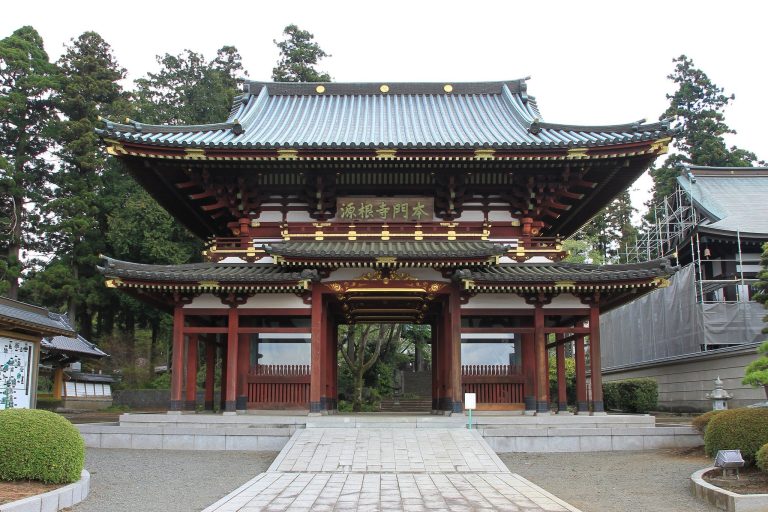
Tokugawa Ieyasu confirmed 867 koku of shrine land and commissioned the principal reconstruction after his victory at Sekigahara in 1600. The main shrine was constructed in 1604, and the rōmon was completed in 1614. The Tokugawa shogunate continued to support repairs and prayers. In 1609 the shrine obtained priority rights to collect coins offered at the summit of Mount Fuji, and in 1707 the shogunate granted silver for rites intended to calm the volcano.
The shrine and its buildings suffered repeated damage from warfare and earthquakes, including the Kōtō Conflict, the 1707 Hōei earthquake, and the 1854 Ansei Tōkai earthquake. A document from 1854 describes the major damage inflicted on the shrine buildings. These events altered the surviving precinct and contributed to the loss of several earlier structures.
Authority over the summit
The shrine’s role in pilgrimage developed into administrative authority over the upper mountain. A shogunal judgment of 1779 formally recognized its control from the eighth station upward, including responsibility for the summit area and for pilgrims who died there. The summit religious complex included Buddhist buildings, among them the Dainichi Hall and Yakushi Hall, as part of the combined Buddhist and Shinto tradition surrounding Mount Fuji.
During the Meiji period, the separation of Buddhism and Shinto led to the removal of Buddhist images and the conversion of the summit buildings. The former Dainichi Hall became the Okumiya, or inner shrine, while the former Yakushi Hall became Kusushi Shrine. In the nineteenth-century land reorganization, the shrine lost substantial foothill property, and the summit and crater were treated as state property. A postwar dispute ended with a 1962 legal decision recognizing the shrine’s claim to land above the eighth station, except for specified parcels such as the weather station and telecommunications facilities. The transfer deed was finally issued in December 2004, although registration remained unresolved because the Shizuoka-Yamanashi prefectural boundary had not been settled.
Modern status and continuing rites
The Meiji government classified the shrine as a National Shrine of the Middle Rank in 1871 and promoted it to a National Shrine of the Great Rank in 1896. After the Second World War, it became a shrine on the special register of the Association of Shinto Shrines. The shrine celebrated its 1,200th anniversary in 2006 and became part of the UNESCO World Heritage property Fujisan, sacred place and source of artistic inspiration in 2013, together with the religious sites at the summit.
Its religious identity remains connected with protection from volcanic disasters and pilgrimage to Mount Fuji. Traditional activities also include rites for safe ascent, purification, agriculture, childbirth, and the seasonal cycle. Major annual observances include the Yabusame Festival from May 4 to 6, the main annual festival from November 3 to 5, and the Okumiya festival on August 15. The Okumiya holds an opening-of-the-mountain rite on July 11 and a closing rite in September. Priests normally remain at the summit through the climbing season, while the sanctuary is unmanned after the closing rite until the following opening.
Remains
Hongū precinct and surviving buildings
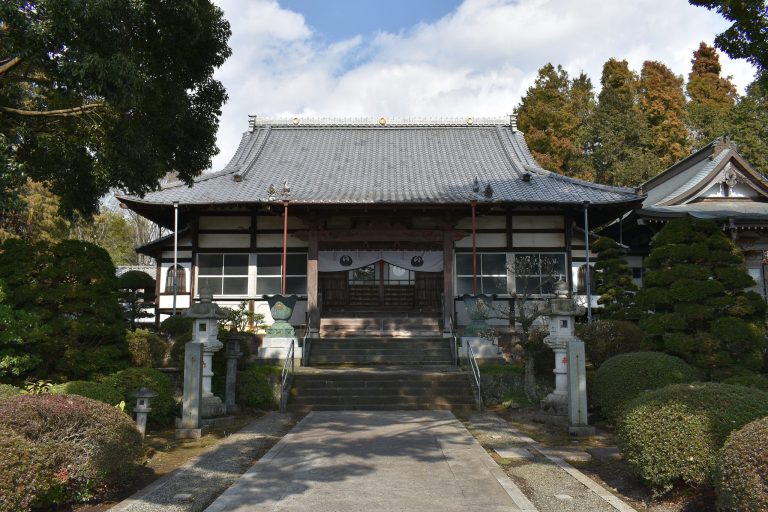
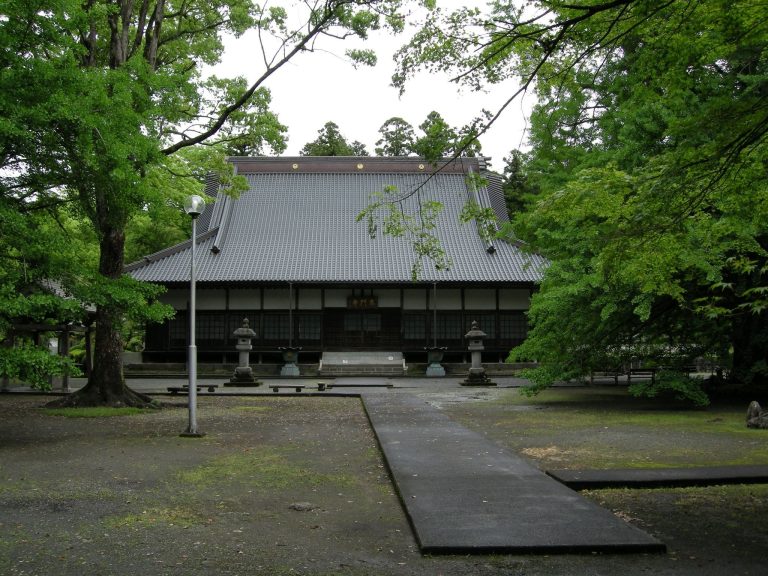
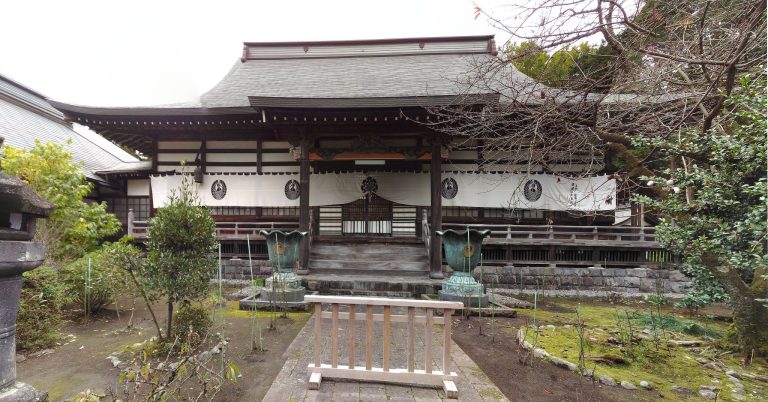
The institution has two principal sanctuaries, the Hongū in Fujinomiya and the Okumiya at the summit of Mount Fuji. The Hongū precinct covers approximately 17,000 square metres. Its surviving principal buildings are the honden, haiden, and rōmon, while other structures were destroyed or severely damaged by earthquakes and later disasters. The buildings and sacred landscape preserve the shrine’s connection with both the mountain deity and the long history of pilgrimage.
Honden
Constructed under Tokugawa Ieyasu in 1604, the honden is an Important Cultural Property of Japan and an example of the distinctive Sengen-zukuri form. This is a rare two-level shrine design in which a five-bay-by-four-bay, hip-roofed lower structure supports a three-bay sanctuary with a flowing roof form. Cypress bark covers the roofs. Tokugawa hollyhock emblems and the Fuji clan’s shuro-palm emblem appear on the building, whose bracketed decoration includes chrysanthemum, hollyhock, and paulownia motifs, together with representations of Mount Fuji.
Haiden and rōmon
The haiden, or worship hall, has a front-facing gabled entrance, an irimoya-style front roof, and a kirizuma-style rear roof. Its roof is covered with cypress bark, and the building is finished inside and outside with red pigment. The offering hall and lattice fence belong to the associated shrine complex. The rōmon, a gate building, was completed in 1614.
Water, gardens, and subsidiary shrines
Wakutama-ike and Mizuya Shrine
Wakutama-ike lies on the eastern side of the Hongū precinct. Spring water emerges between successive layers of Mount Fuji’s lava to form the pond, which supplies the Mitarashi stream and ultimately the Kanda River. Wakutama-ike is a nationally designated Special Natural Monument. At the spring’s source, the vermilion Mizuya Shrine stands on rock. Facing the pond, this subsidiary shrine enshrines the water-related kami Mii-no-kami and Naruikazuchi-no-kami, and its annual festival is held on January 4.
Cherry grove and ceremonial spaces
The grove behind the honden is called Kandateyama. About 500 donated cherry trees in the precinct are associated with Konohanasakuya-hime. Seven cherry trees in front of the haiden were traditionally attributed to Takeda Shingen, and the trees now called Shingen’s Cherry Trees are regarded as their second generation. Traditions also describe extensive planting by Takeda Katsuyori and an ancient cedar known as the Everlasting Cedar, which later died.
Sakura-no-baba extends east to west before the rōmon and is used for mounted-archery rites. The precinct also contains Kagami-ike, or Mirror Pond, and a stone bridge associated with the enthronement of Emperor Taishō. A former ceremonial route to Yamamiya began at the sacred Shinkō Bridge. A marker for that route, dated 1691, was found buried in the precinct in 1984 and is displayed beside Wakutama-ike.
Other precinct shrines
Several subsidiary shrines remain within the Hongū precinct. Sannomiya Sengen Shrine stands beside the honden, while Shichinomiya Sengen Shrine is on the opposite side. Inari Shrine is near Wakutama-ike, Itsukushima Shrine occupies an island in the pond, and Tenjin Shrine stands at the entrance to Kandateyama. The Edo-period network was larger, comprising nineteen external subsidiary shrines and fifteen internal branch shrines. Ten internal shrines were badly damaged in the Ansei earthquake and were subsequently merged into the sanctuary’s inner enclosure.
Archaeological remains and associated sites
Former Goma Hall
A Buddhist three-story pagoda formerly stood in the precinct, as shown on a shrine plan from 1670. Another former Buddhist structure, the Goma Hall, stood north of Wakutama-ike. An excavation in 2008 identified its foundations, a stone-paved approach, and a medieval concentration of stones. Finds from the area included celadon bowls, a white porcelain jar, and related blue-and-white porcelain.
Yamamiya Sengen Shrine
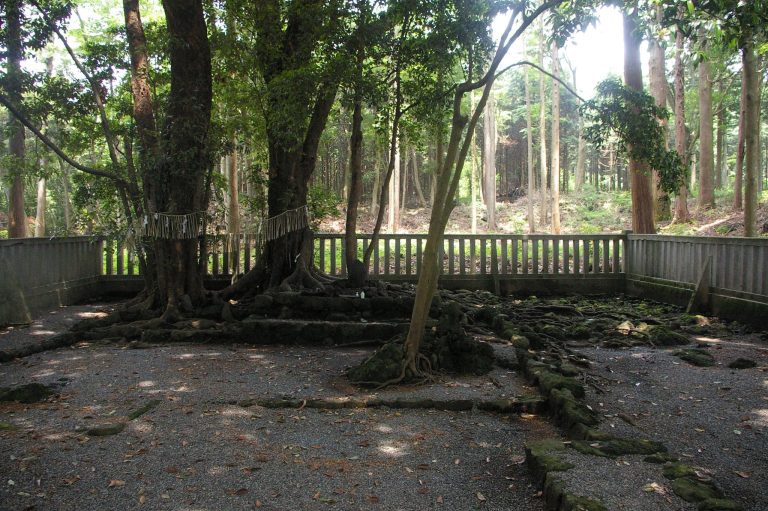
Yamamiya Sengen Shrine is regarded in the foundation tradition as the original sanctuary. It has no honden. Instead, its open sacred area provides a place from which Mount Fuji is worshipped at a distance, preserving an older form of mountain ritual. The shrine’s continuing relationship with the Hongū is also reflected in the former ceremonial procession between the two sites.
Summit sanctuaries
Okumiya
The Okumiya stands at the summit of Mount Fuji on the Ōmiya-Murayama climbing route. Its entire precinct lies within the Fuji special protection district of Fuji-Hakone-Izu National Park. A stone monument inscribed with the shrine’s name serves as a summit landmark, while the sanctuary doors carry a large gold inscription referring to the pacification of the nation and the mountain’s unsurpassed peak. The shrine’s traditional estate above the eighth station covers approximately 3.85 million square metres.
The former Dainichi Hall became the Okumiya after Buddhist images were removed during the Meiji separation of Buddhism and Shinto. The former Yakushi Hall, which had also served as a collection point for mountain fees, became Kusushi Shrine. Many Buddhist images and offerings were removed from the summit during the same process, leaving a portion of the earlier material remains. Kusushi Shrine now stands near the summit on the former site of the Yakushi Hall.
Crater features
A rock projecting into the summit crater is called Tora-iwa, or Tiger Rock, because its form resembles a tiger. A nearby monument bears a copy of the Record of Mount Fuji. These features form part of the summit landscape associated with the Okumiya and the religious interpretation of Mount Fuji.
Paintings, weapons, and ritual objects
The shrine preserves the nationally protected Fuji Mandala, a Muromachi-period painting on silk measuring 180.2 by 117.8 centimetres. It presents an idealized golden Mount Fuji with three peaks, divine images within the peaks, pilgrims climbing the slopes, and the sun and moon beside the summit. The composition expresses the mountain’s religious geography through both its sacred peaks and the acts of those who ascend it.
Among the shrine’s weapons is a Muromachi-period tachi sword traditionally attributed to Takeda Shingen. Its inscription invokes the Medicine Buddha and associates the blade with Kagemitsu of Bizen Osafune. A Muromachi-period wakizashi made by the Nobukuni school bears the date 1427 and an inscription dedicating it to Fuji Hongū. Anayama Nobutomo later donated the sword in 1547 in a lacquered box.
A late-Muromachi five-plate suit of red-threaded iron armor is traditionally attributed to a donation by Takeda Katsuyori. Its body is joined by hinges, its fittings carry gold-speckled lacquer, and its decoration includes flower-diamond emblems and a helmet crest modeled on Mount Fuji. The body measures 31 centimetres in height and 88.5 centimetres in circumference, while the kusazuri, the skirt-like protective plates, measure 30 centimetres in height. Other associated objects include armor traditionally attributed to Takeda Shingen, large shoulder guards with related diamond decoration, two koto instruments donated by Takeda Katsuyori during the sanctuary transfer, and a manuscript of the Record of Mount Fuji written by Miura Akitsugu.