Yachū-ji Temple: An Asuka-Period Buddhist Temple in Japan


Site at a Glance
- Rating
- 3.9
- Popularity
- Low
- Country
- Japan
- Primary era
- Classical
- External website
- Open
- Eras represented
- Classical, Early Modern
- Civilizations
- Tokugawa, Yamato
- Site type
- Religious
- Remains
- Monastery
On this page9 sections
History
Yachū-ji Temple is a Buddhist temple in Japan, located in Habikino, Osaka, whose construction began around 650 during the Hakuchi era, part of the Asuka period. Its surviving foundations reveal a large complex planned in a manner associated with Hōryū-ji at Ikaruga. The temple belongs today to the Kōyasan Shingon-shū branch of Shingon Buddhism, and its principal image is Yakushi Nyorai, the Buddha of healing and medicine.
Origins and early development
Temple tradition names Yachū-ji as one of 48 temples founded by Soga no Umako at the command of Prince Shōtoku. Prince Shōtoku was an early seventh-century imperial prince traditionally linked with the promotion of Buddhism and the establishment of temples, while Soga no Umako was a powerful court leader and Buddhist patron. Archaeological evidence places the beginning of construction around 650, several decades after the deaths of both men, so the traditional foundation story and the physical evidence belong to different historical frames.
The temple stood beside the Takeuchi Kaidō, an ancient highway linking the capital at Asuka with the coast. Its location may have connected it with the Funa clan, a family of immigrants from the Korean kingdom of Baekje who had settled in the area by the end of the Kofun period. The Funa family also maintained strong connections with Soga no Umako. This setting placed Yachū-ji within the developing network of Buddhist institutions that accompanied the formation of Japan’s early state.
Destruction and rebuilding
The early complex suffered destruction or severe damage in fires during the Nanboku-chō period, a fourteenth-century era marked by rival imperial courts and warfare. The extent to which the original buildings survived remains uncertain. By the beginning of the Edo period, the temple appears to have been close to abandonment.
Revival began in 1661 under the priest Kakue, supported by the Sayama and Tannan domains. The buildings later faced another fire during the Kyōhō era, from 1716 to 1735, although the Jizō-dō, a hall dedicated to Jizō Bosatsu, survived. In 1724, Yanagisawa Yoshisato, the daimyō, or domain lord, of the Yamato Kōriyama Domain, gave the temple a new refectory and guest hall. Other structures were rebuilt during and after the Kyōhō era, and reconstruction continued through the end of the Edo period.
Religious affiliations and modern status
During the Edo period, Yachū-ji served as a seminary of the Risshū tradition, which emphasizes monastic discipline and the formal rules of the Buddhist order. Along with Shinpō-ji in Izumi and Saimyō-ji at Makio, it was regarded as one of the three major Risshū monastic establishments. The temple changed its affiliation to Kōyasan Shingon-shū during the middle of the Meiji period, after the formation of Japan’s modern imperial state.
Yachū-ji is also known as Naka-no-Taishi, meaning “Middle Prince.” The name reflects its place among temples associated with Prince Shōtoku, between Eifuku-ji and Taiseishōgun-ji. The temple is linked with the Saigoku Yakushi pilgrimage, a religious circuit joining temples dedicated to Yakushi, with sacred sites connected to Prince Shōtoku, and with the ancient temples of Kawachi Asuka. Nonoue Hachiman Shrine stands beside the temple on its western side. It was formerly the guardian shrine of Yachū-ji.
The former temple complex, including remains of the early buildings, became a National Historic Site in 1944. In 1972, two monks’ residences, the guest hall, and the refectory received designation as Osaka Prefectural tangible cultural properties. A camellia associated with Yachū-ji was designated an Osaka Prefectural natural monument in 1981; that designation was later revoked after the tree died.
Two Buddhist images connected with the temple also received national recognition. A wooden standing Jizō Bosatsu from the Heian period became an Important Cultural Property in 1915. A seated gold-bronze Miroku Bosatsu from the Asuka or Hakuhō period received the same designation in 1921, after its discovery in a temple warehouse in 1918. The Miroku image is opened for viewing on the eighteenth day of each month.
Remains
The early temple plan
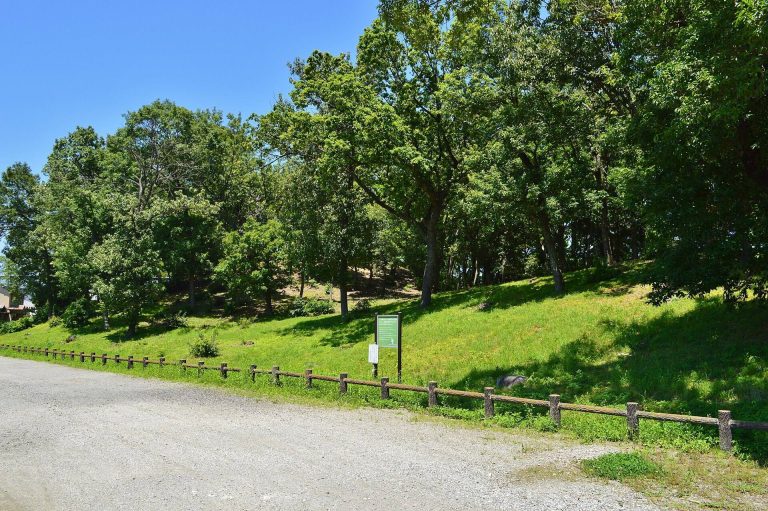
The surviving foundations show that the Asuka-period temple and the temple built during the first half of the Nara period formed a substantial complex. Its arrangement followed a plan patterned after Hōryū-ji at Ikaruga, a major early Buddhist temple associated with Japanese Buddhist architecture. Archaeological remains mark the positions of the Middle Gate, Main Hall, pagoda, Lecture Hall, and cloister, a covered passage enclosing or linking parts of the complex. Cornerstones and other foundation stones remain within the precincts, preserving the structural layout of buildings whose upper parts were lost in historical fires.
Buildings and archaeological features
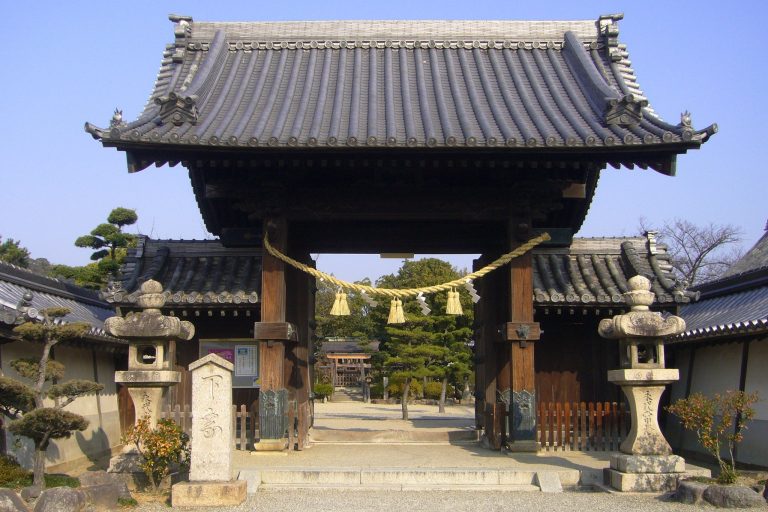
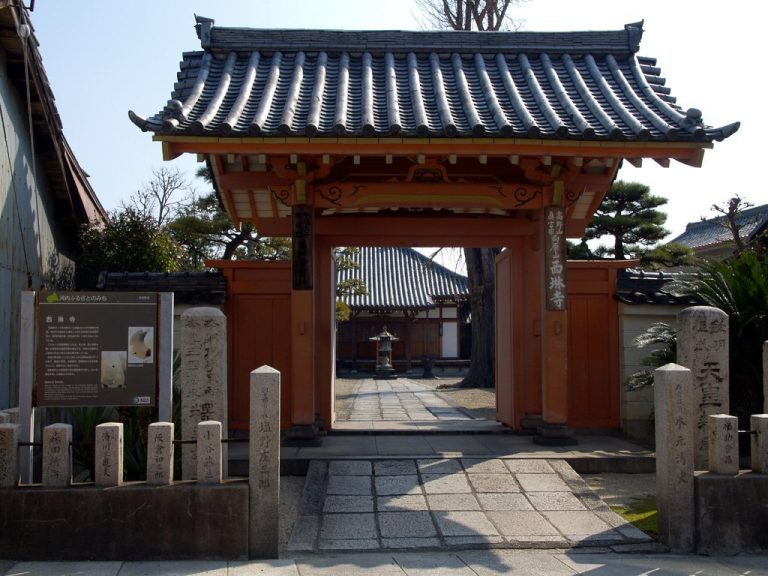
The present grounds include the Jizō-dō, the site of the former Kondō, the site of a three-story pagoda, and the Sanmon. The Kondō was the temple’s main hall, while the pagoda was a tiered Buddhist monument. These places combine standing buildings with marked archaeological locations, allowing the early complex to be understood through its surviving foundations and later religious buildings.
The grounds also contain the stone sarcophagus from Hichinjo Ikenishi Kofun. The Kofun period was the era named for the large burial mounds that preceded the Asuka period. The sarcophagus therefore connects the temple precinct with the earlier funerary landscape of the region.
The Miroku Bosatsu
The seated gold-bronze Miroku Bosatsu represents Maitreya, the bodhisattva regarded in Buddhism as the future Buddha. It is 18.5 centimetres high and has a large head, a narrow waist, and a substantial three-sided head ornament. Carefully engraved patterns cover the robe and pedestal. The left leg hangs downward, while the right hand touches the cheek in a contemplative half-lotus pose, with the palm facing forward, an unusual feature for this type of image.
A 62-character inscription is incised on the pedestal in a single line arranged across 31 lines. Its reading remains disputed, but it identifies the figure as Miroku and records its dedication after a central imperial figure became ill. The inscription gives the date as a Bingyin year, identified as 666, and names a group of devotees associated with a place or institution whose identification remains unsettled.
The inscription gives the image a securely dated place in the history of Miroku sculpture. Its large-headed proportions retain features common in Asuka and early Nara bronze images, while its face lacks the archaic smile often seen in Asuka sculpture. The phrase “Central Palace Emperor” has been interpreted as referring to Emperor Tenji, Empress Saimei, or Empress Hashihito, and no interpretation has gained universal acceptance. The calendar expressions in the inscription are also debated.
The Jizō Bosatsu
The wooden standing Jizō Bosatsu is installed in the Jizō-dō and dates from the Heian period. Jizō is a compassionate bodhisattva especially associated with protecting beings in difficult conditions. The hall and its image preserve one of the temple’s later religious layers alongside the archaeological remains of the early complex.