Nakayama Shrine: The Former Ichinomiya of Mimasaka Province

Site at a Glance
- Rating
- 4.3
- Popularity
- Low
- Country
- Japan
- Primary era
- Early Modern
- External website
- Open
- Eras represented
- Early Modern, Modern
- Civilizations
- Japanese, Tokugawa
- Site type
- Religious
- Remains
- Sanctuary
On this page22 sections
History
Nakayama Shrine is a Shinto shrine in Tsuyama, Japan, whose traditions and institutions developed in the medieval and early-modern religious landscape of Mimasaka Province. It was the province’s ichinomiya, the highest-ranking shrine in the historical system of provincial worship, and its principal deity is Kagamitsukuri-no-kami. Ame-no-Nukado-no-kami and Ishikori-dome no Mikoto are also enshrined there. The shrine is known by several other names, including Nakayama Daijingu, Nakayama Daimyojin, and Nangu.
Origins and foundation traditions
The foundation of Nakayama Shrine remains uncertain. One shrine tradition places the deity’s first manifestation at Narahara in 706. Later that year, the deity was moved to Kiriyama in Tanabe District, and in 707 appeared at Nakayama, where Nakajima Yorina worshipped it. A temporary sanctuary was built in 707, followed by the formal transfer of the deity in 708.
Another tradition concerns Katano Mononobe Odomaru, who had worshipped Okuninushi at the site. In this account, he yielded the sanctuary to the Nakayama deity and moved to Yuge Estate. A different theory connects the shrine’s establishment with the separation of Mimasaka from Bizen Province in 713 and the ritual invitation of a deity from Kibitsu Shrine. The name Ariki occurs in traditions about the deity’s manifestation and about the relocation of the Kibitsu deity in Bitchu Province.
The meaning of Nakayama has also been explained in several ways. Shrine tradition associates it with a mountain between Mount Kagurao and Mount Kurosawa, while another explanation refers to Mount Kibi Nakayama on the former Bizen-Bitchu frontier. The shrine’s older Sino-Japanese readings, Chuzen and Chuzan, have been connected with the area’s iron production and with references to iron in The Classic of Mountains and Seas. Its association with mirror manufacture has likewise been linked to the place-name Kagami, whose pronunciation resembles the Japanese word for mirror.
Ranks and provincial importance
The earliest surviving documentary reference dates from 860, when the deity’s rank rose from Junior Fifth Rank, Lower Grade, to Junior Fourth Rank, Lower Grade. Nakayama became a government shrine in 864, received Junior Third Rank in 865, and was promoted to Senior Third Rank in 875. The rapid promotions have been associated with Mimasaka’s military importance, the appointment of military officials as provincial governors, and the region’s iron production. In 888, an imperial messenger visited the shrine carrying imperial treasures.
The Engishiki, a tenth-century register of shrines and court institutions, lists Nakayama among Mimasaka’s eleven listed shrines. It was one of two listed shrines in Tomahigashi District and the province’s only Myojin taisha, a particularly eminent shrine category. A shrine document uses the title Nakayama Daijingu in 721, while an imperial envoy’s visit in 1333 also refers to that name.
The shrine rose to Senior Second Rank in 942 after prayers connected with disturbances in the eastern and western provinces, and reached Senior First Rank in 1081. In 1017, it was one of only four shrines in the San’yodo region to receive imperial ritual offerings during the great purification held after Emperor Go-Ichijo’s accession. In 1107, a ritual involving a halberd was believed to have helped suppress the rebellion of Minamoto no Yoshikichika. The Ryojin Hisho consequently praised Nakayama as a military deity west of the Osaka Barrier.
Nakayama paid dues to the Office of Deities in 1165. A document from 1191 provides the earliest documentary evidence for the title Mimasaka Ichinomiya. In 1245, the shrine was again among the San’yodo shrines ordered to offer imperial ritual treasures.
Landholdings and medieval religious life
The shrine’s landholdings were extensive, although surviving records give different figures. A record from 862 assigns it 80 cho of sacred rice land, approximately 0.79 square kilometers. Other records give 880 cho, approximately 8.73 square kilometers, with exemption from entry by military governors. In 1224, the land was described as tax-exempt property nominally belonging to Sen’yomon’in. In 1301, revenues from Ichinomiya Estate were donated to Kasuga Shrine.
During the Mongol invasions, Hojo Tokimune, the Kamakura-period regent associated with Japan’s defense, selected Nakayama in 1281 for prayers for victory alongside major provincial ichinomiya shrines such as Hikawa, Nukisaki, Mishima, Asama, Wakasa Hiko, and Aso. After the prayers were considered successful, Nakayama received 330 cho of sacred land, approximately 3.27 square kilometers. It remained nominally tax-exempt land of Chokodo in 1407, administered by the Bojo family, but the estate was contested by provincial authorities during the 1440s.
The monk Ippen, founder of the Ji-shu Buddhist movement, visited in 1285. A shrine official initially prevented Ippen and people regarded as impure or outcast from passing through the gate. A dream involving earthquakes, serpents, and the Nakayama deity then led to their admission to the worship hall. Porridge prepared in the shrine’s ritual kettle was distributed, after which Ippen and his followers preached to local landholders and farmers.
War, rebuilding, and changing interpretations
During the Sengoku period, a local uprising of provincial landholders and farmers opposed the invading Amago clan in 1533. When Amago Haruhisa assembled troops in the shrine precincts, he set fire to the buildings, which burned. He ordered the shrine rebuilt in 1559 and restored its festivals. After the Mori clan expelled the Amago from the region, Mori Motonari instructed the shrine’s hereditary priestly family to resume its customary festivals and repair work in 1569.
The main sanctuary was begun under Haruhisa in 1537 and completed in 1559. This rebuilding preserved a physical connection with the period of Amago control, even though the shrine’s religious interpretations continued to develop. In addition to Kagamitsukuri-no-kami, historical and scholarly traditions have identified the principal deity with Okuninushi, Nakayama-no-kami, Kibi no Takehiko, Kibitsuhiko-no-mikoto, Kanayamahiko-no-kami, and a monkey deity.
These interpretations reflect different associations. The mirror and metalworking explanations connect the shrine with mirror production and ironworking. The monkey-deity interpretation has been related to iron sand and charcoal gathering in the mountains and to the shrine located behind the main sanctuary. Alternative accompanying deities include Okuninushi and Ninigi-no-mikoto, interpretations associated with Izumo’s influence and with seafaring groups that reached the Tsuyama Basin along the Yoshii River.
The shrine repeatedly sought to identify its principal deity as Kagamitsukuri-no-kami. When the modern shrine-rank system designated Nakayama a National Shrine of the Middle Rank in 1871, Kanayamahiko-no-mikoto was used as the enshrined deity. The change to Kagamitsukuri-no-kami was finally accepted when the shrine became a religious corporation in 1946.
Early-modern grants and religious observances
Later grants and confirmations connected Nakayama with successive regional rulers. Land or revenues were granted in 1564, and 310 cho were recorded under the Mori. Ukita Hideie granted ten koku in 1596 after reducing the shrine’s temple and shrine lands from 1584 onward. Kobayakawa Hideaki granted ten koku in 1601; Mori Tadamasa granted thirty and seventy koku in 1604; Mori Nagatsugu granted ten koku in 1635; Mori Nagayoshi confirmed eighty koku in 1688; and Matsudaira Nobutomi granted fifteen koku in 1698. Approximately two koku from former Shinnoji land were granted in 1872.
Nakayama formerly maintained 112 subsidiary shrines, most of which were destroyed in the Amago attack. Five remain, including Soshinden, which gathers deities from former subsidiaries and the deities of Mimasaka. The Kuni-sha, Misaki-sha, Saru-sha, and the shrine beneath the Iwai-gi zelkova continue separate local cults.
The spring rice-planting festival, or Otaue Festival, was once held on the second horse day of the fourth month, then on April 24, and since 1980 on April 29. A portable shrine is carried before the sacred fence while parishioners and farmers pray for abundant crops and successful agriculture. Hoe-wielding rites and lion dancing form part of the ceremony. A summer purification festival began in 1912 and includes passage through a large ring of cogon grass while human effigies are carried for ritual purification.
The autumn sacred procession developed from an earlier spring observance. It was formerly held on the twenty-first day of the ninth lunar month and later on October 21. A phoenix-shaped palanquin carries the deity to a temporary sanctuary about one kilometer away, accompanied by drums, flutes, lions, banners, sacred branches, ritual weapons, musicians, priests, parishioners, and offerings. The chief priest recites prayers there before the procession returns.
Other observances included the Deer Festival, Ox-King Festival, Konpon-shiki, and Nozaki Festival. The Deer Festival involved offering two deer from Mount Osuga and ended during Emperor Kanmu’s reign after the offering was transferred to Shiro Shrine. The Ox-King Festival distributed a sacred seal. Konpon-shiki commemorated the deity’s enshrinement with first-fruit offerings and Noh performance. The Nozaki Festival, abolished during the Meiji Restoration, reenacted the deity’s invitation through first fruits, a halberd, and white-paper offerings.
The December Onshime Festival, formerly called the Halberd Festival or Halberd-Planting Festival, derives from prayers for victory over foreign forces during the Mongol invasions. The shrine’s Ichinomiya Market accompanied seasonal festivals and traded clothing, household goods, medicines, food, horses, and cattle. By the early modern period, it had become one of the largest horse and cattle markets in the Chugoku region, drawing dealers from Harima, Inaba, Hoki, Izumo, Bizen, Bitchu, and Bingo. It also developed into a center of popular entertainment and culture.
Modern protection
Nakayama was designated a National Shrine of the Middle Rank in 1871. It became a Beppyo shrine in 1948, when it was included among the shrines listed in the postwar regulations of the Association of Shinto Shrines. The principal shrine building received designation as a National Important Cultural Property in 1914. The shrine gate, Soshinden, historical documents, drum, and other features also received municipal designations in Tsuyama, while the shrine grove and its natural features gained prefectural or municipal protection.
Remains
Sanctuary complex
Nakayama Shrine stands at the eastern foot of Mount Nagao in the Kagurao mountain system, within the Tsuyama Basin. The Miyagawa flows east toward the Yoshii River and meets the Unohagawa and Yokonogawa near the shrine. The precinct is recorded at different sizes, from approximately 9,000 to 71,818 square meters, with another figure of about 54,717 square meters.
Honden
The honden, or principal sanctuary, occupies approximately 135.5 square meters and measures about 10.45 meters on each side. It is a south-facing wooden building arranged in three bays by three bays, with zelkova pillars and an irimoya roof, a hipped-and-gabled form whose entrance is through the gable end. Its cypress-bark roof, decorated ridge timbers, and one-bay projecting worship porch with a curved gable create the distinctive Nakayama-zukuri form. The building is regarded as the oldest surviving example of this rarely found regional style. Construction began in 1537 and ended in 1559. The sanctuary was repaired in 1742, and its cypress-bark roofing was renewed in 1971.
Heiden and haiden
The heiden, also called the hanging hall, is a one-bay-by-one-bay structure of approximately 22 square meters with a gabled roof. In front of it, the haiden, or worship hall, occupies about 80 square meters. It has six bays across the front and three along the side, an irimoya roof entered from the long side, and a projecting porch with a curved gable. Both buildings have cypress-bark roofs and were designed by Egawa Saburohachi. The haiden roof was renewed in 1952.
Service buildings and entrance
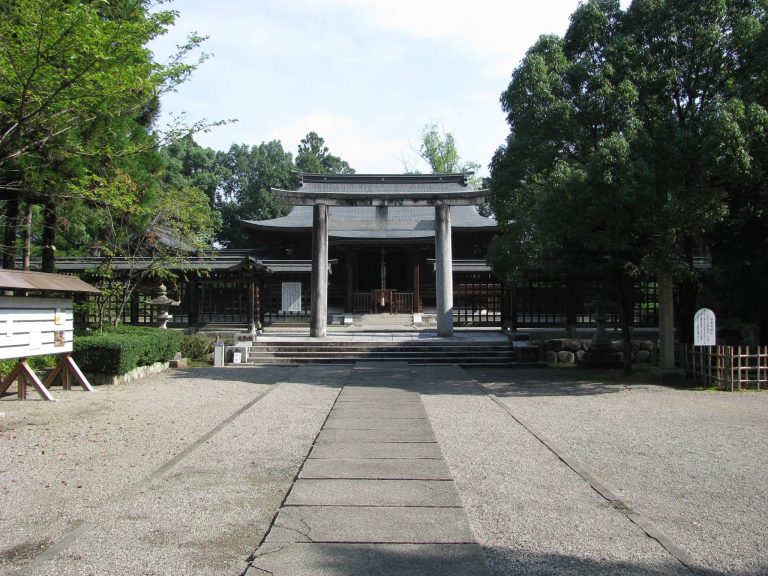
East of the haiden is the shinsenjo, a five-by-three-bay building connected to it by a corridor one bay wide and six and a half bays long. A stable hall north of the shinsenjo measures one and a half bays by two bays and contains two ox statues and two horse statues. A kagura hall stands southwest of the haiden. The main granite torii at the entrance dates from 1791, measures approximately 8.5 meters high and seven meters wide, and follows the unusual Nakayama-torii form. Its upper members curve upward, while the crossbeam below the plaque does not pass through the supporting pillars.
The main gate, known as the Omote Shinmon or Four-Legged Gate, stands between the torii and the haiden. It has magnolia-wood pillars and a gabled roof. The gate originally stood in the second bailey of Tsuyama Castle and was moved to the shrine in 1874. A stone bridge is positioned in front of it.
Stone monuments and later buildings
Lanterns and guardian figures
Two hexagonal stone lanterns in front of the honden were erected by Mori Tadatsugu in 1668 and stand three meters high. Two lanterns beside the main torii date from 1816 and are approximately 4.55 meters high. Other lanterns date from 1772, 1781, and 1868. A monkey-shaped guardian statue was made in 1764.
Memorials and Butokuden
The precinct contains a stone lantern and guardian figures erected in 1908 to commemorate victory in the Russo-Japanese War. Other monuments record roof renewals and related work in 1953 and 1960. A rebuilt bronze ox statue from 1960 stands on a base approximately 3.64 meters square. The grounds also contain a haiku monument from 1963 and a monument to a waka poet from 1976.
The Butokuden was constructed in 1922 as a hall for kendo, Japanese swordsmanship. Its former site is now used as the shrine parking area.
Subsidiary shrines and sacred trees
Soshinden
Soshinden stands north of the kagura hall. Built in 1742, it is a small Kasuga-zukuri shrine with a cypress-bark roof. The building is approximately 2.5 meters long and 2.25 meters wide, with a projecting worship porch about 2.12 meters long and 0.78 meters wide. It enshrines deities from former subsidiary shrines and all the deities of Mimasaka, including three shrines that were once separate.
Kuni-sha and Misaki-sha
Kuni-sha and Misaki-sha stand west of the honden and haiden. Kuni-sha was built in 1877, originally stood near the Mitarai River, and was moved to its present position in 1913. It is a nagare-zukuri shrine, a form whose front roof slope extends over the entrance porch, and is dedicated to Okuninushi. A stone beside it once held a halberd. When prayers were needed during a national crisis, the stone was moved to the honden.
Misaki-sha was built in 1876 in the Kasuga-zukuri style. Its deity has been associated with Inari, the shrine’s local misaki deity, an ancestral deity, or the ancestral deity of the Nakayama deity.
Saru-sha and the Iwai-gi shrine
Saru-sha stands in the remote part of the precinct behind the honden, in a rocky mountain area. It is associated with Sarutahiko-no-kami. Worshippers offer monkey dolls when praying for abundant harvests, and women who have given birth safely have also brought monkey dolls there.
The shrine beneath the main torii stands below the approximately 800-year-old zelkova called Iwai-gi and is dedicated to Okuninushi. The grove covers approximately 6.78 hectares and became an Okayama Prefecture local natural conservation area in 1992. It includes the Iwai-gi zelkova, an approximately 500-year-old tree to the left of the torii, and an approximately 25-meter-tall ginkgo east of the honden. Zelkova, Japanese fir, ubame oak, trident maple, camphor, and evergreen oak grow beside the approach. Hinoki cypress predominates where the grove meets Mount Kagurao, while evergreen oak grows around Saru-sha’s rocky area. Holly, camellia, cherry, alder, and other trees are also present.
Documents and ritual objects
Sengoku letters
The shrine preserves five letters and grants from the Sengoku period concerning victory prayers and offerings. They include a document by Amago Haruhisa, two by Mori Motonari, a letter signed by Yoshikawa Motoharu and three other men, and a document by Uragami Munekage. In 1690, the Tsuyama domain elder Nagao Katsuaki bound them into a single scroll.
Muromachi drum
The shrine’s drum was made in 1388 during the Muromachi period from a single piece of zelkova. Its inscription records five repairs carried out between the Kanbun and Bunsei eras, preserving a material record of its continued ritual use.