Kisaichi-Maruyama Kofun: A Fifth-Century Burial Mound in Japan


Site at a Glance
- Rating
- 4.1
- Popularity
- Very Low
- Country
- Japan
- Primary era
- Classical
- External website
- Open
- Eras represented
- Classical
- Civilizations
- Yamato
- Site type
- Burial
- Remains
- Burial Mound
On this page9 sections
History
Kisaichi-Maruyama Kofun is a mid-fifth-century burial mound in Japan, built during the middle Kofun period in the central reaches of the Yura River, north of the Fukuchiyama Basin and within the former Tanba Province. The Kofun period, generally dated from about the third to the sixth centuries, was an era when powerful political leaders were buried in large monumental mounds.
A regional ruler’s burial
The quantity and quality of the objects placed in the central burial have led to the interpretation that it belonged to a king who ruled the middle Yura River region. The identities of the people buried at the site are not known. The relationship between the central and northern occupants remains uncertain, including whether they were siblings or parent and child. Agricultural tools in the southern burial indicate that its occupant may have been an attendant.
Discovery and preservation
The mound was discovered in 1988 during a preliminary survey for construction of the Kinki Expressway, now the Maizuru-Wakasa Expressway. Its existence had previously been unknown. After the discovery, the highway plan was changed from a cutting through the mound to a tunnel, allowing the burial site to be preserved.
Ayabe City subsequently prepared an environmental-improvement plan for the tumulus. Restoration and development created Maruyama Kofun Park, which opened in May 1993. The mound became a National Historic Site of Japan on March 23, 1994, a designation that identifies it as a nationally protected cultural property. Excavated materials received Kyoto Prefecture cultural-property designation in 2004 and are kept by the Ayabe City Museum. In August 2014, heavy rain caused a collapse about 10 meters wide in the northwestern middle section of the mound.
Remains
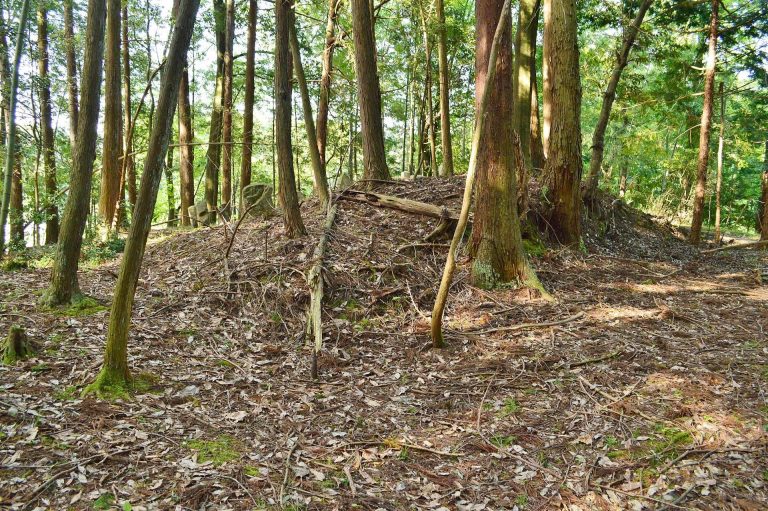
Kisaichi-Maruyama Kofun is a circular mound approximately 70 meters in diameter and 10 meters high, with an overall length also recorded as 81 meters. It stands at an elevation of about 94 meters and is formed in three tiers. River stones from the Yura River were fitted across the earthen surfaces as fukiishi, a covering that protected the mound and formed part of its exterior. Rows of cylindrical haniwa, clay funerary objects placed on burial mounds, stood on the level areas of the first and second tiers. During restoration, the stone covering was relaid and replica cylindrical haniwa were installed.
Burial facilities and grave goods
Central burial
Three burial facilities occupy the center, north, and south of the mound. A wooden coffin was found in the central facility. Its grave goods included banded metal armor, such as plate armor or a short cuirass and a helmet with a projecting front. Iron swords and other weapons and equipment were deposited with agricultural tools, a mirror, and beads or other ornaments.
Northern burial
The northern facility also contained a wooden coffin and banded armor. Its weapons and equipment included iron swords, a mirror, and beads or other ornaments. A quiver covered with gilt material held 38 arrows, adding to the evidence for the martial character of this burial.
Southern burial
Agricultural tools were placed in the southern facility. Their presence supports the interpretation that this burial belonged to an attendant rather than the ruler associated with the central grave.
Haniwa and pottery
Excavation recovered figurative haniwa, including examples shaped as houses and armor, together with Haji ware, an unglazed earthenware pottery made in ancient Japan. These objects complement the cylindrical figures that once stood along the mound’s terraces and help identify the range of funerary material associated with the site.