Jissō-in Temple: A Court-Connected Buddhist Temple in Kyoto


Site at a Glance
- Rating
- 4
- Popularity
- Medium
- Country
- Japan
- Primary era
- Early Modern
- External website
- Open
- Eras represented
- Early Modern
- Civilizations
- Tokugawa
- Site type
- Religious
On this page12 sections
History
Jissō-in Temple is an independent Buddhist temple related to the Tendai tradition in Kyoto, Japan, founded in 1229 by the monk Jōki. Its principal object of worship is Acala, a wrathful guardian deity associated with immovable spiritual resolve, and its historical identity is closely connected with the imperial household and court nobility.
Foundation and relocation
Jōki, identified as a son of the court noble Takatsukasa Kanemoto, established the temple in Murasakino, in what is now northern Kyoto. It later moved to the Imadegawa-Ogawa area of present-day Kamigyo Ward. In 1474, during disturbances associated with the Onin War, a conflict that caused widespread disruption in Kyoto, Jissō-in was transferred to its present location in Iwakura. The new site stood beside a branch temple of Onjoji on the former grounds of the subtemple Jōkongo-in. Warfare had destroyed many of its halls by the end of the Muromachi period.
Imperial and Tendai connections
At the beginning of the Edo period, Ashikaga Gijin, son of Ashikaga Yoshiaki, the last Muromachi shogun, entered Jissō-in and became its head. His brother Jōson led Enman-in, while their maternal half-brother Dōkōshin later headed Shogo-in. Together, the three brothers led the three Tendai-ji-mon monzeki temples. A monzeki temple was an elite Buddhist institution traditionally headed by a member of the imperial family or court nobility.
These family relationships strengthened Jissō-in’s ties with the imperial household. Gijin rebuilt the temple with assistance from the imperial court and the shogun Tokugawa Iemitsu. Components from disused Kyoto court buildings were incorporated into the reconstruction, giving the complex a close material connection with court architecture. Successive temple heads also remained connected with the imperial family.
Late Edo and modern history
During the late Edo period, the courtier and politician Iwakura Tomomi lived temporarily at Jissō-in. Records of confidential discussions held there have survived, adding a political dimension to the temple’s history.
In the Meiji period, Jissō-in absorbed Shōkōji, a Nichiren Buddhist temple founded by Furuichi Tane in northern Iwakura. Nichiren Buddhism is a Japanese tradition based on the teachings of the medieval monk Nichiren. In 1952, Jissō-in became independent of the Tendai-ji-mon school.
The temple’s surviving cultural properties include historic buildings and associated materials. A handwritten kana text by Emperor Go-Yozei is an Important Cultural Property, while the four-legged gate and guest hall are registered tangible cultural properties. The Jissō-in documents consist of three volumes, four booklets, and 182 documents. One hundred and eighty-one were designated in 2015, followed by one additional document in 2017. The Jissō-in Diary, kept by successive heads for 260 years, preserves an extended record of the temple’s history. The temple documents are held by the Kyoto City Historical Archives.
Remains
The present complex combines courtly residential buildings, temple spaces, gardens, paintings, sculpture, and historical materials. Its principal structures include the guest hall, entrance, kitchen quarters, study hall, tea room, main gate, and garden areas.
Courtly buildings
Guest hall and entrance
The guest hall, which also serves as the main hall, was built in 1708 as the palace residence of the consort of Emperor Higashiyama. A palace residence of this type belonged to the imperial court’s residential complex and was associated with an empress or imperial consort. The building was moved to Jissō-in in 1721 and is regarded as one of the few surviving palace residences of this kind from the imperial court. A Kamakura-period statue of Acala stands in the main hall.
Carriage approach and four-legged gate
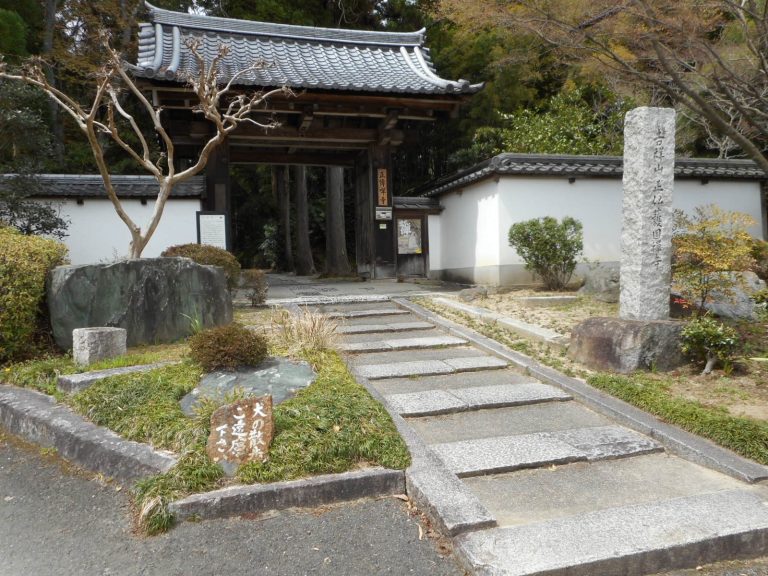
The entrance porch, or carriage approach, and the four-legged gate were also built in 1708 as parts of the palace residence. Both were relocated to Jissō-in in 1721, preserving further elements of the courtly complex within the temple grounds.
Gardens and interior decoration
Gardens
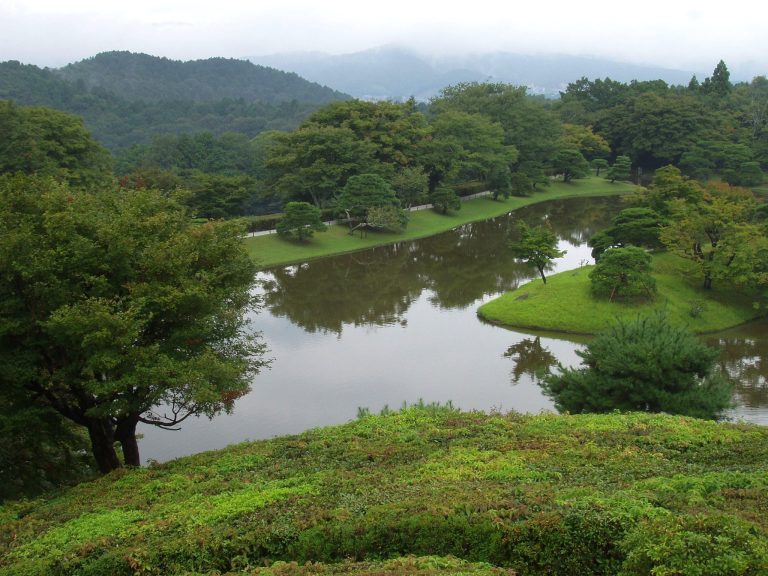
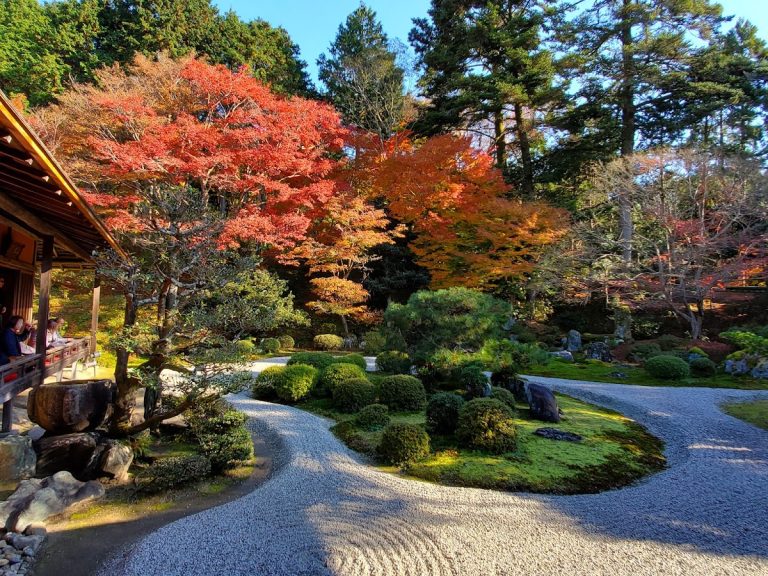
Jissō-in contains a pond-and-circuit garden, a landscape garden, and the dry landscape garden known as the Garden of the Heart. The pond-and-circuit garden includes stone lanterns associated with the painter Ganku, and its pond is inhabited by forest green tree frogs. The dry garden follows the kare-sansui tradition, a style that represents natural features through arranged stones, gravel, and limited vegetation rather than a pond or flowing water.
Waterfall Room
The floor of the guest hall’s Waterfall Room is coated with black lacquer. Reflections of autumn foliage and snow appear across its surface, producing effects known as “floor greenery,” “floor maple,” and “snow-reflecting floor.”
Paintings and stone lantern
The temple contains wall paintings by Kano Eikei, the fourth-generation representative of the Kyoto Kano school, a major lineage of painters associated with elite, temple, and court commissions in early-modern Japan. In the inner courtyard stands a stone lantern depicting Hanshan and Shide, made by the late Edo-period painter Ganku. The lantern originally belonged to Shōkōji.