Kawaguchi Asama Shrine: A Shinto Shrine of Mount Fuji

Site at a Glance
- Rating
- 4.5
- Popularity
- Medium
- Country
- Japan
- Primary era
- Early Modern
- External website
- Open
- Eras represented
- Early Modern
- Civilizations
- Tokugawa
- Site type
- Religious
- Remains
- Sanctuary
On this page16 sections
History
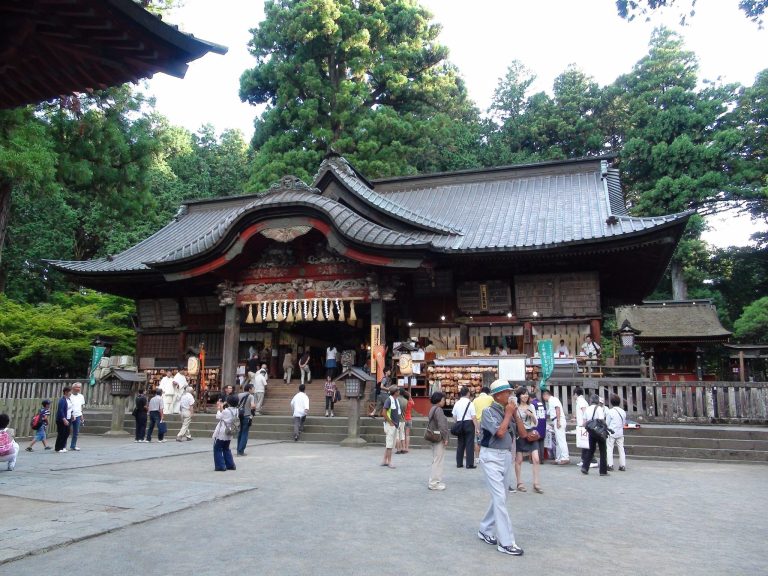
Kawaguchi Asama Shrine is a Shinto shrine in Japan, located in Kawaguchi on the northern foothills of Mount Fuji. Founded in 865 during the mid-Heian period, it was established for the worship of Asama Okami after a destructive eruption of Mount Fuji that began in 864. The shrine faces the mountain across Lake Kawaguchi, with the Misaka Mountains behind it, and remains associated with the religious traditions of Mount Fuji.
Foundation after the 864 eruption
The eruption caused extensive damage in the surrounding region, burying Lake Motosu and the former Lake Senoumi. The Nihon Sandai Jitsuroku, a historical record of Japan’s early imperial court, states that worship of the Asama deity was considered necessary in Kai Province after the disaster. The corresponding shrine in Suruga Province was said to have been neglected, so a shrine to Asama Myojin was established south of the Kai provincial administrative center in 865 and given official status.
Kawaguchi Asama Shrine has long been regarded as one possible location of the ancient shrine listed in the Engishiki, a mid-Heian register of shrines. That register names the “Asama Shrine of Yatsushiro District, Kai Province” as a major shrine. The identification remains disputed, however, and Asama Shrine in Fuefuki is another principal candidate.
Ancient settlement and Fuji pilgrimage
Archaeological finds from the Nishikawa site in front of the shrine include pottery bearing inscriptions and vessels associated with salt making. The inscribed pottery points to a literate social group, while the salt-making pottery indicates connections with the Suruga region. These discoveries have supported the proposal that an important administrative facility of ancient Yatsushiro District stood in this area.
The settlement around the shrine later developed as a community of oshi, hereditary or professional religious guides who arranged lodging, worship, and pilgrimage services for visitors to sacred mountains. As popular pilgrimages to Mount Fuji expanded, these guides helped sustain the local religious community. The settlement gradually declined during the Edo period as Fuji confraternities, lay groups devoted to Mount Fuji worship, and the oshi community at Yoshida gained greater influence. Decline continued during the nineteenth century.
Religious traditions and modern status
The shrine’s principal deity is Asama Okami, traditionally associated with Mount Fuji and protection from volcanic danger. Kawaguchi Asama Shrine identifies this deity with Konohanasakuya-hime, a Shinto figure linked with Mount Fuji, beauty, and the fragile nature of life. Shrine tradition also holds that her husband, Ninigi-no-Mikoto, and her father, Oyamatsumi-no-Kami, are enshrined with her.
The annual festival on April 25 includes a procession to Ubuyagasaki Shrine, where Konohanasakuya-hime’s son and his wife are enshrined. The ceremony is understood as her visit to her grandson, Ugayafukiaezu-no-Mikoto, and is therefore called the Grandson-Visiting Festival. Girls perform Daidai Kagura, a formal sacred dance, during the event. The Fire-Quelling Thanksgiving Festival on July 28 is traditionally said to recall children comforting the rough spirit of the Asama deity during the eruption of 864, and it also includes Daidai Kagura.
In 1871, the shrine was classified as a village shrine under Japan’s modern shrine-rank system. It was promoted to prefectural shrine status in 1924. Its registered religious-corporation name is Asama Shrine, while Kawaguchi Asama Shrine is the name commonly used for the site. It is one of the component properties of the UNESCO World Heritage site Fujisan, sacred place and source of artistic inspiration.
The shrine’s traditions continued to attract scholarly and artistic attention in the modern period. Folklorist Kunio Yanagita visited on April 25, 1949, with the Kawaguchiko-born writer Seiko Nakamura while studying relationships between mountain sanctuaries and village sanctuaries. He observed the shrine’s mountain sanctuary and the Grandson-Visiting Festival. In 2020, the artist Bunta Inoue dedicated a painting of Mount Fuji to the shrine.
Remains
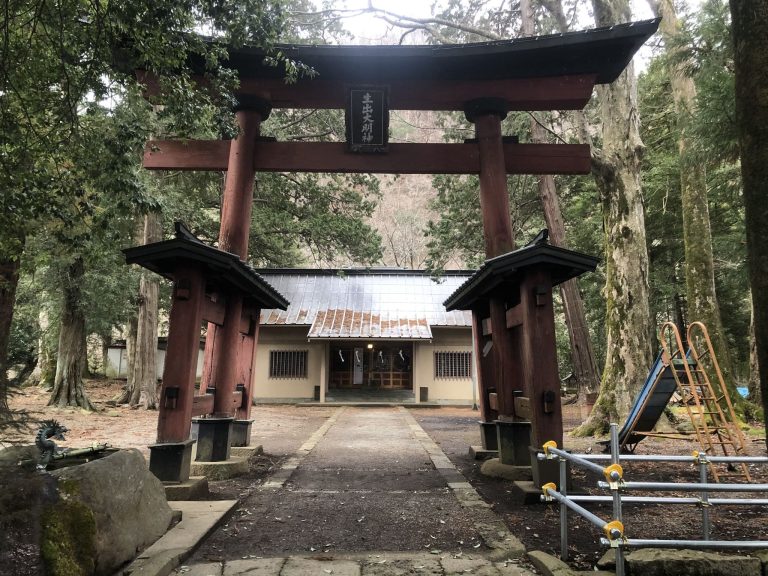
The shrine complex combines a central sanctuary, a worship space, sacred trees, a cedar-lined approach, and subsidiary religious sites extending toward Mount Mitsutoge and Lake Kawaguchi. Its surviving features include timber shrine architecture, a stone object associated with the foundation tradition, old trees, a waterfall used for purification, and ritual artworks connected with Mount Fuji worship.
Main buildings and sacred trees
Main sanctuary
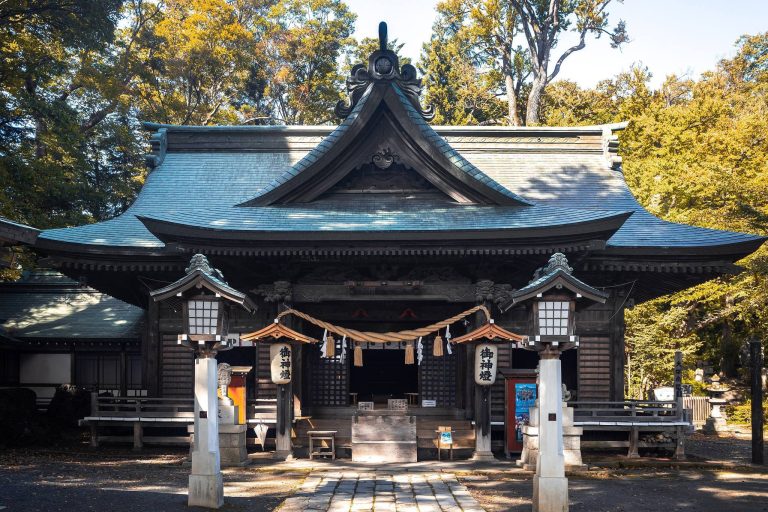
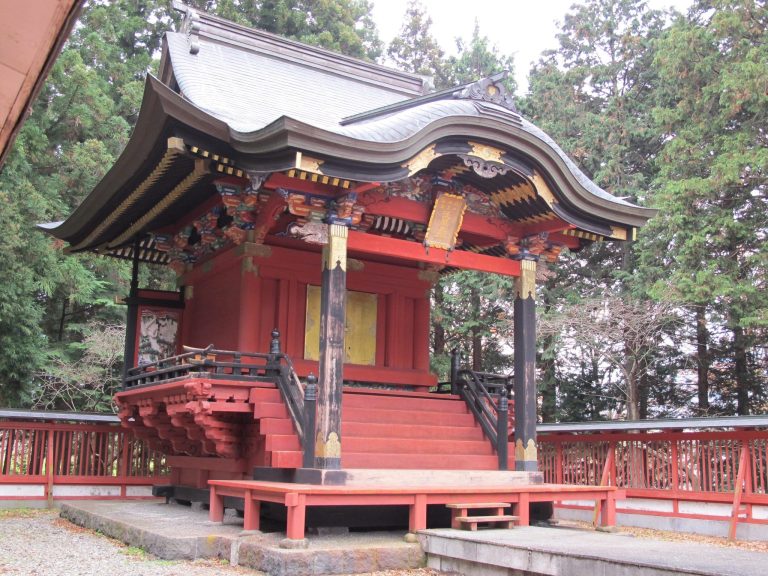
The main sanctuary is a one-bay structure in the nagare-zukuri style, in which the roof projects forward to cover the entrance porch. Its roof is covered with copper sheets, and the projecting worship porch has a karahafu, a decorative curved gable. The building is traditionally said to have been rebuilt in 1607 by the local lord Torii Naritsugu after a fire destroyed the shrine in 1606. It was dismantled and repaired in 1965. The main hall is designated as a Fujikawaguchiko municipal tangible cultural property.
Beautiful Stone
In front of the worship hall stands a stone shrine known as the Beautiful Stone, or Hiiraishi. Shrine tradition identifies it with the ancient stone structure said to have been used when the Asama deity was first enshrined. That foundation tradition is connected with the account of the shrine’s establishment after the eruption of Mount Fuji.
Sacred cedars
Seven sacred cedar trees stand around the shrine buildings, each traditionally regarded as approximately 1,200 years old. Their names are Mishirushi, Ubuya, Reikaku, Shinmen, Kazuiro, and Tenjo. Kazuiro refers to two trees that are joined at the base. Known also as the Twin Pillar Cedars, the Male-and-Female Cedars, or the Cedars of Marriage, they are associated with the story of Izanagi and Izanami. A tradition held that couples would become united by passing between them. Passage is now prohibited, and their roots are enclosed to protect them from damage. The seven cedars are designated as a Yamanashi Prefecture natural monument.
Cedar avenue and associated trees
A cedar avenue forms part of the approach to the shrine. A Japanese horse chestnut and a fir tree are also associated with the grounds. The avenue, horse chestnut, and fir tree are designated as Fujikawaguchiko municipal natural monuments.
Mountain and lakeside sanctuaries
Mother’s White Waterfall
The shrine property extends into Mount Mitsutoge. Along the route from the main shrine toward the mountain is Mother’s White Waterfall, where pilgrims staying in the Kawaguchi area performed misogi, a ritual washing or cleansing before worship. Mother’s White Waterfall Shrine stands beside the falls and enshrines Takuhatachiji-hime, traditionally regarded as the mother-in-law of Konohanasakuya-hime.
Ubuyagasaki Shrine
Ubuyagasaki Shrine occupies a promontory projecting into Lake Kawaguchi. It enshrines Hikohohodemi-no-Mikoto, regarded as the son of Konohanasakuya-hime, and Toyotama-hime, his wife. The shrine is also the destination of the procession held during the Grandson-Visiting Festival on April 25.
Ritual artworks and sacred images
Black Horse Votive Painting
The Black Horse Votive Painting is an ema, a painted or inscribed offering presented at a Shinto shrine. Made in 1697 during the Edo period, it depicts a black horse associated with the Kai Black Horse tradition. Kano Kuninobu, also known as Dogen, painted it in lacquer on a gold ground. An inscription names the donor as Tadazane Toda, an official responsible for temples and shrines who later became lord of Sakura Domain. He was the younger brother of Takachika Akimoto, lord of the nearby Tanimura Domain.
Horse traditions
A shrine tradition states that Prince Yamato Takeru rested a horse here during his eastern expedition. The shrine also preserves a paired horse-shaped sacred image associated with the former Komagata Shrine at the entrance. The paired form represents a male horse and a female horse.