Kurohimeyama Kofun: A Fifth-Century Keyhole-Shaped Burial Mound in Japan

Site at a Glance
- Rating
- 3.9
- Popularity
- Very Low
- Country
- Japan
- Primary era
- Classical
- External website
- Open
- Eras represented
- Classical, Medieval
- Civilizations
- Yamato
- Site type
- Burial
- Remains
- Burial Mound
On this page11 sections
History
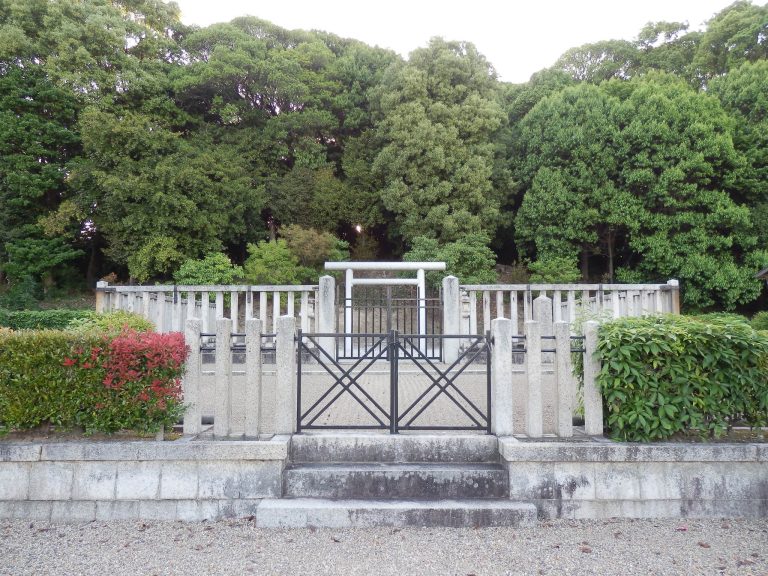
Kurohimeyama Kofun is a large keyhole-shaped burial mound in Japan, located at Kuroyama in Sakai, Osaka. Built during the middle to later fifth century, it belongs to the Kofun period, when elite mound tombs were constructed as political authority expanded across the Japanese archipelago. The mound stood independently on a level terrace between the Mozu and Furuichi burial-mound clusters.
The Tajihi Region in the Fifth Century
Kurohimeyama Kofun is associated with the Tajihi clan, an ancient lineage that controlled the surrounding area during the middle fifth century. The identity of the buried individual remains unknown. The tomb may have belonged to a Tajihi leader who developed the region through a direct relationship with the royal court and later became an ancestor figure for the clan.
The mound’s date places it within the period associated in historical records with the Five Kings of Wa, a group of rulers mentioned in accounts of fifth-century Japan. The buried person may have served Wa king Chin, who is often identified with Emperor Hanzei, but this proposed connection remains an interpretation rather than an established identification.
Names, Reuse, and Changing Identifications
Historical records referred to the locality as Kuroyama. The mound was also once called Hakayama, while the name Kurohimeyama Kofun was established in a 1953 research report to distinguish it from Hakayama Kofun. A less securely supported tradition connects the name with Kurohime, a consort of Emperor Richu, although there is little evidence that she was the person buried in the mound.
During the medieval period, the mound was adapted as a fortified position. Its earthworks were changed, and a building supported by foundation stones was later identified on the northern projecting platform. Additional earth was also placed on the lower mound and around the platform, altering parts of the original form.
The mound was repeatedly assigned to different imperial figures in historical and early-modern records. In 1679 it was described as the mausoleum of Emperor Temmu, and records from 1699 identified it as the imperial tomb of Emperor Ninken. An 1801 record called it an abandoned tomb or Hakayama. In 1875 it was officially designated as the tomb of Princess Kasuga no Oiratsume, the empress of Emperor Ninken, but that designation was cancelled in 1879.
Robbery and Archaeological Investigation
The rear burial chamber had been robbed by the nineteenth century. Traditions written down in 1855 and 1857 indicate that the robbery may have taken place before 1734. One tradition says that seventeen local people died while opening the mound and that a vessel covered in red pigment was sold during repairs at Shitennoji.
The forward burial chamber was exposed during wartime extraction of pine roots for aircraft fuel. Koichi Mori examined armor from the chamber in 1945. Excavations followed in 1947 and 1948 under Masao Suenaga, Koichi Mori, and the Osaka Prefectural Board of Education. The investigations examined the forward chamber, the mound, the haniwa rows, an enclosure on the rear summit, the rear burial facility, and the upper parts of the mound.
Later work examined the western outer bank in 1977, the southeastern outer bank during road construction in 1988, and the forward chamber and mound during site improvements in 1990. These investigations clarified the mound’s construction, burial facilities, surrounding banks, and associated features. Kurohimeyama Kofun became a National Historic Site in 1957, and the protected area was expanded in 1978 to include part of the outer bank. The excavated armor received designation as a Sakai municipal tangible cultural property in 2008.
Conservation and site development took place between 1989 and 1993. The area is maintained as the Kurohimeyama Kofun Historical Plaza. Excavated artifacts are held by the Sakai Mihara History Museum, and a reconstructed forward burial chamber is displayed at the plaza’s guidance facility.
Related Mounds
Six small mounds were formerly recorded around Kurohimeyama Kofun. Current interpretation regards Don-yama Kofun, northeast of the main mound, as probably the only deliberately arranged satellite mound. It reportedly yielded about ten iron swords, which may represent a related mass deposition. The other small mounds are regarded as a later group of tombs.
Saba-yama Kofun stood south of Kurohimeyama. Its surviving mound was levelled in 1949, and excavation before expressway construction in 1986 identified a 34-metre scallop-shell-shaped mound, probably from the later fifth century, with haniwa. Chinju-yama Kofun lay to the north and reportedly produced two small bell-shaped objects that may have been horse bells. Kenken-yama Kofun and Saru-yama Kofun stood to the west, while an unnamed mound called Mound 24 lay southeast of Kurohimeyama.
Remains
Mound and Surrounding Earthworks
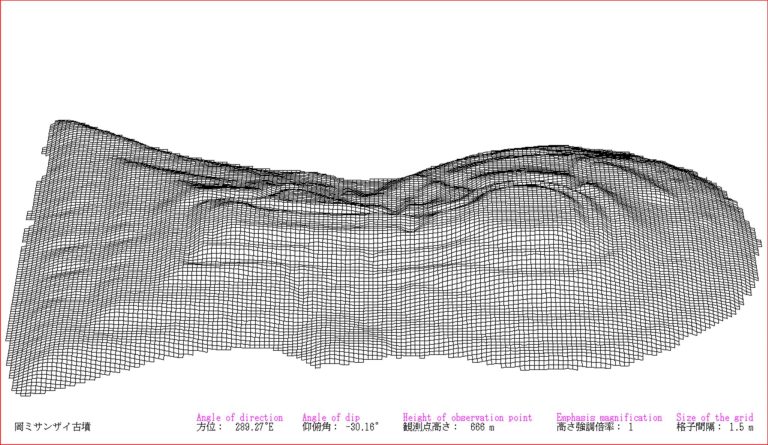
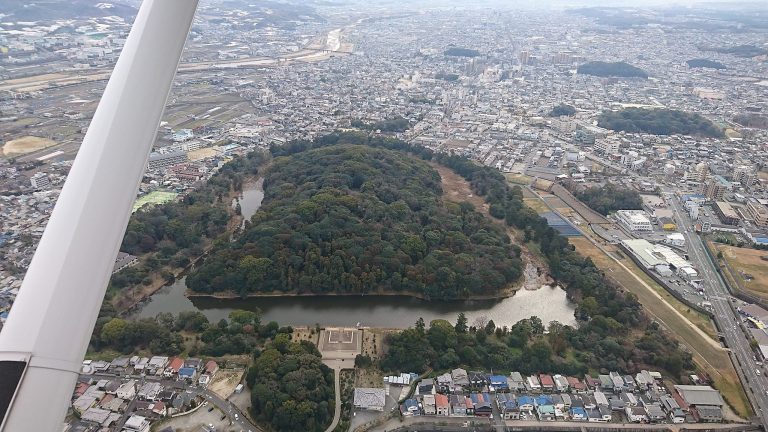
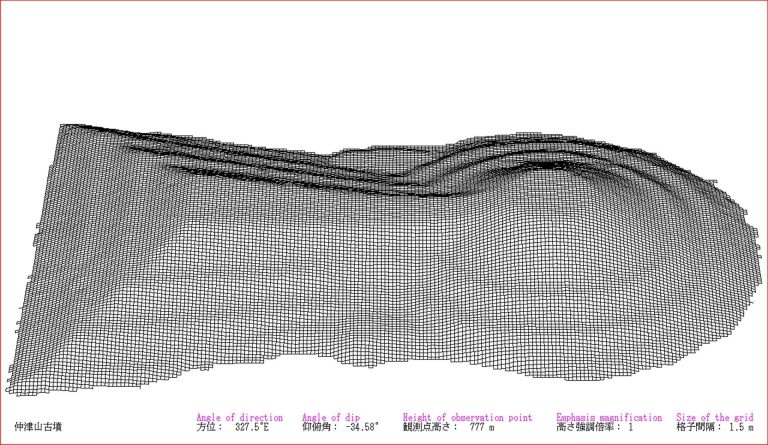
Kurohimeyama Kofun is oriented westward and has the characteristic form of a keyhole-shaped tumulus, with a circular rear section joined to a rectangular forward section. It measures approximately 122 metres in length. The rear section is about 64 metres across and 11 metres high, while the forward section is roughly 65 metres wide and 11.6 metres high. Both parts were constructed in two tiers.
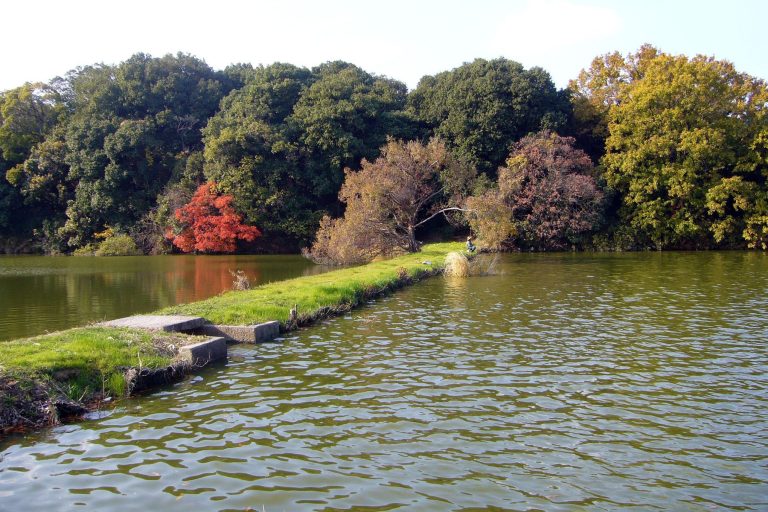
River stones covered the mound as a protective revetment, and haniwa were arranged along the summit and terrace surfaces. A platform projects from the northern side near the junction of the circular and rectangular sections. A shield-shaped moat surrounds the mound, measuring about 15 metres across and 2 metres deep. Its earlier form survives on the eastern, southern, and western sides, while the northern side appears to have been enlarged later. Material dredged during that work may account for the additional earth placed on the mound.
An outer bank surrounded the moat. Investigations identified a slope and a ditch-like feature beyond the bank, adding another element to the mound’s defensive and enclosing landscape. The combination of the moat, outer bank, stone covering, and raised terraces gave the tomb a carefully bounded architectural form.
Haniwa Arrangement
Continuous rows of cylindrical haniwa encircled the summit and middle terrace. Haniwa were fired-clay funerary and symbolic objects placed on and around Japanese burial mounds. The cylinders were set into shallow trenches, with approximately one-quarter of each object buried. Lid-shaped haniwa stood outside the cylindrical rows at regular intervals.
The summit produced 357 cylindrical haniwa and 42 lid-shaped examples. The middle terrace is estimated to have held about 660 cylindrical examples, and the total for the mound, including the northern platform, may have exceeded 1,100. The objects are notably consistent in form and manufacturing technique, with little variation. This uniformity has led to the view that they were made in a workshop established specifically for Kurohimeyama Kofun.
The assemblage included cylindrical, bell-shaped, lid-shaped, house-shaped, shield-shaped, quiver-shaped, armor-shaped, and chicken-shaped haniwa. Small clay pieces were interpreted as a deer antler, a dog tail, and possibly an animal leg. The haniwa probably date to the middle fifth century, while the armor belongs probably to the later fifth century. Their different dates suggest that the haniwa formed part of the original construction and that the armor may have been added later to commemorate the deceased.
Burial Facilities
Rear Burial Chamber
The rear burial facility was probably a pit-type stone chamber, a below-ground chamber built from stones and covered by large roof slabs. It contained a boat-shaped stone coffin, a long stone sarcophagus with raised ends. Robbery destroyed much of the chamber. The coffin was reportedly removed and used as rain barrels beside a Yakushido before being sold in the early twentieth century, and its present whereabouts are unknown.
The coffin may have been made from Aso welded tuff, a volcanic stone used for comparable boat-shaped coffins in nearby middle-period mounds. Another interpretation proposes Tatsuyama stone. A surviving roof stone is made of Tatsuyama stone, and the chamber is consequently considered similar to the pit-type stone chambers at Nagamochiyama and Karatobiyama. Another stone, probably a roof slab from the chamber, was reused as a bridge and is preserved in the grounds of Hirokuni Shrine.
A double square enclosure of figurative haniwa surrounded the rear robbers’ pit. It measured approximately 6.5 metres from east to west and 5.5 metres from north to south, with the fronts of the figures facing inward. A row of shield-shaped haniwa marked the boundary between the rear and forward sections. A small pebble-covered area lay between this enclosure and the shield-shaped row, measuring about 2.5 metres from north to south and 1.8 metres from east to west.
Objects from the robbed facility included a stone spindle whorl, two fragments of pointed helmets, and several fragments of Sue ware, a high-fired gray ceramic tradition used in Japan from the Kofun period onward. Many more Sue-ware fragments were recovered during the 1947 investigation but were lost while being transported.
Forward Armor Chamber
The forward summit contained a separate pit-type stone chamber used for grave goods rather than the burial of a body. Its east-west axis ran parallel to the main axis of the mound. The chamber measured 4.03 metres long internally, with a width of 0.83 metres at the western end and 0.75 metres at the eastern end. Its internal height was 1.3 metres.
Oval river stones were laid end-on to form the walls, and the floor consisted of small stones placed over clay. Eight large sandstone slabs formed the roof. One central slab had fallen into the chamber before excavation and badly damaged the central group of deposits. The chamber contained 24 suits of armor arranged in two rows. The suits at the western end faced west, while those at the eastern end faced east. In many cases, a neck guard had been placed upside down beneath an inverted helmet.
The armor consisted of 24 riveted cuirasses, body armor assembled from overlapping metal plates fastened with rivets. The cuirasses included triangular-plate and horizontal-strip types. One triangular-plate cuirass had an unusual projecting shoulder section and a collar at the back of the neck. The 13 visored helmets represented three forms, made with small riveted plates, horizontal riveted strips, or square riveted plates. All 11 pointed helmets belonged to the horizontal-strip type.
Armor fittings included neck guards, shoulder guards, and tassets, protective skirt-like components. Black lacquer, a three-tailed iron fitting on one pointed helmet, and the unusual collared cuirass have been interpreted as signs of authority connected with the central government. The excavated total of 24 armor sets is the largest reported from a kofun in Japan, although fragmentation and the chamber’s earlier opening mean that the original number must be treated cautiously.
Nine spears lay over the cuirasses at the western end of the chamber, with their points facing outward, and corresponding spear butts were found at the eastern end. A long sword lay at the western end. Other swords came from the eastern end, the east-central area, and the centre, with their points directed east toward the rear portion. Only a few iron arrowheads from the other weapons can now be confirmed because of later confusion in the handling of the finds.
The forward chamber’s use as a stone-built repository for armor is unusual in the Mozu and Furuichi region. Comparable deposits in smaller mounds generally placed armor directly in wooden coffins or chests. The chamber’s limited wall bracing and relatively loose joints have been associated with stone-chamber construction traditions linked to immigrant groups.