Daiun-ji Temple: A Historic Buddhist Temple in Kyoto

Site at a Glance
- Rating
- 4
- Popularity
- Very Low
- Country
- Japan
- Primary era
- Modern
- External website
- Open
- Eras represented
- Modern
- Civilizations
- Japanese
- Site type
- Religious
- Remains
- Monastery
On this page15 sections
History
Daiun-ji Temple is a Buddhist temple in Kyoto, Japan, traditionally founded in 971 during the Heian period. It became a powerful branch temple of Onjo-ji, also known as Mii-dera, and developed into an important center associated with the Jimon branch of Tendai Buddhism.
Foundation and imperial patronage
The temple’s foundation tradition begins with a Buddhist service on Mount Hiei. A group of court nobles saw five-colored sacred clouds rising above the mountains, and the court official Hino Fuminori followed the phenomenon to Iwakura. There he met an elderly nun identified with the local deity of Ishiza, who told him that the place was a Pure Land of Kannon. Kannon is the Buddhist bodhisattva associated with compassion. Fuminori chose the site for a temple, and after the story reached the emperor, Daiun-ji was founded with the monk Shinkaku as its first founding monk.
Shinkaku was the son of Fujiwara Atsutada. His secular name was Fujiwara Sari, and he was a different person from the celebrated calligrapher of the same name. Shinkaku had served near Emperor Murakami before entering religious life on Mount Hiei after the emperor’s death. When Daiun-ji was established, a guardian shrine was transferred into the temple grounds and enshrined there.
In 980, Emperor Enyu designated Daiun-ji as a temple for imperial prayers. Five years later, Princess Shoshi, the consort of Emperor Reizei and daughter of Emperor Suzaku, established Kannon-in within the precincts. She consequently became known as the Empress Kannon-in, while Bunkyo, Shinkaku’s son and a cleric, became the institution’s first administrator. Her tomb survives nearby as the Iwakura Imperial Mausoleum.
Growth and Tendai conflict
Daiun-ji and Kannon-in expanded into a large monastic complex containing forty-nine halls and pagodas and as many as 1,000 monks. The complex was closely connected with Yokei, also called Chiben, who led Onjo-ji and served as abbot of Hossho-ji. In 981, Yokei moved to Daiun-ji with several hundred monks from his lineage.
This movement took place amid rivalry between the Jimon and Sanmon branches of Tendai Buddhism. Onjo-ji, or Mii-dera, was the principal institution of the Jimon branch, while Enryaku-ji represented the Sanmon branch. Their prolonged disputes included armed conflict, and affiliated temples such as Daiun-ji were affected by repeated military fires. In 1136, the buildings that remained at the complex were completely destroyed by fire.
Healing tradition and later displacement
A tradition called the “Origin of the Sacred Fragrant Water” connects Daiun-ji with healing. In 1069, a daughter of Emperor Go-Sanjo was believed to be possessed by a fox. After prayers were offered to Daiun-ji’s Kannon and she drank water from the temple well, she recovered. People who believed themselves similarly afflicted later began visiting the temple.
During the Onin War, a civil conflict that devastated Kyoto in the fifteenth century, the monzeki temple Jisso-in moved in 1474 from the Imadegawa-Ogawa area of central Kyoto to its present location. A monzeki temple was traditionally headed by a member of the imperial family or aristocracy. Jisso-in settled on the former site of Daiun-ji’s subtemple Jokongo-in, a subtemple being a dependent or affiliated religious establishment, and the two institutions subsequently came into repeated conflict.
Daiun-ji was burned again in 1571 during Oda Nobunaga’s attack on Mount Hiei. In the Edo period, its main hall and other buildings were rebuilt in 1641 with the support of Emperor Go-Mizunoo and under the direction of Gison, the monzeki of Jisso-in.
Relocation and continuing religious life
After the Second World War, Daiun-ji became an independent head temple of the Tendai Shomon school, continuing its religious lineage. The tradition of tea houses caring for people seeking the temple’s healing benefit also contributed to the establishment of several psychiatric hospitals in and around the former temple grounds.
In 1985, the former temple grounds at Iwakura Kamikura-cho 303 were sold to a civil-engineering and related-work company, reportedly to settle substantial temple debts. All buildings there were demolished in July of that year. Daiun-ji then moved a short distance to the former site of its subtemple Hoto-in, east of the guardian shrine, where a temporary main hall was erected. The temple’s treasures were dispersed during the relocation and debt settlement, but all were recovered by 1998. The hidden Buddhist image and the treasures are now kept in the temporary main hall, and Daiun-ji continues to attract worshippers seeking healing for illnesses of the brain.
Daiun-ji has also been proposed as one possible model for the unnamed “temple in the northern hills” in the “Wakamurasaki” chapter of The Tale of Genji. The historian Fumio Tsunoda identified Daiun-ji, or alternatively Kurama-dera, in connection with that literary setting.
The former bronze bell
Daiun-ji’s former bronze bell, now a National Treasure, bears an inscription dated 858. It had originally been transmitted at the western pagoda of Enryaku-ji on Mount Hiei and was said to have been moved to Daiun-ji in 993 because of internal conflict at Enryaku-ji.
The bell was kept at Jisso-in from 1982 while it underwent repairs. In 1985, Daiun-ji agreed to sell it for 100 million yen to the real-estate company Sankyo Nishiyama, later renamed Pexim. The bell then disappeared temporarily and was found in October 1985 at the Jotenkaku Museum within Shokoku-ji in Kyoto. Before its discovery, it had been transferred without authorization to the former treasure hall of Koryu-ji on October 1 and to Renge-ji on October 26.
More than ten people connected with the transfers, including the real-estate company’s president, the head priest of Koryu-ji, and the deputy head priest of Renge-ji, were referred for possible violations of Japan’s Cultural Properties Protection Law. The law regulates protected cultural properties, including ownership and changes in location. Kyoto Prefectural Police temporarily seized the bell. The Kyoto District Public Prosecutors Office returned it to Kyoto Prefecture because ownership was unclear, but the Supreme Court later overturned that disposition after the company filed a special appeal.
The bell returned temporarily to the Jotenkaku Museum. A 1995 judgment ruled that the sale contract between the temple and the company was invalid. After the company appealed, a settlement restored ownership to Daiun-ji, and in October 1998 the bell was transferred to Sagawa Express in exchange for payment. It is now held by the Sagawa Art Museum.
Remains
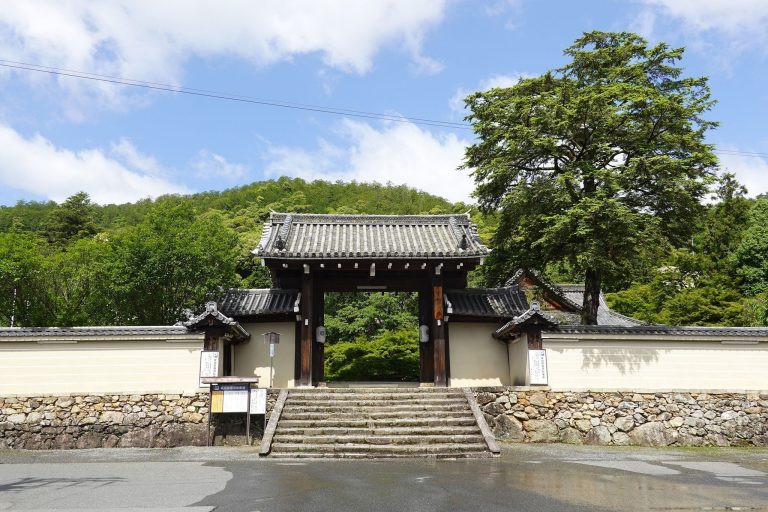
Daiun-ji is formally called Ishizayama Daiun-ji and has also been associated with the mountain names Shiunzan, Ishizayama, and Iwakurayama. The temple is known as Iwakura Kannon, Iwakura Kannon Temple, Ishiza Temple, and Jitsudo-in. Its present precinct occupies the former site of the Hoto-in subtemple, slightly away from the old grounds and east of the guardian shrine.
Principal worship and present temple
Hidden eleven-faced Kannon
The principal object of worship is an eleven-faced Kannon image kept as a hidden Buddhist image, meaning a sacred image normally kept from public view. The image is traditionally attributed to the sculptor Gyoki and described as a single-block carving modeled on Emperor Shomu. Tradition also says that it was made from the same tree as the eleven-faced Kannon at Hasedera in Yamato Province. It was transmitted from the imperial palace before Fujiwara Tokihira, Shinkaku’s grandfather, bestowed it on the temple.
Temporary main hall
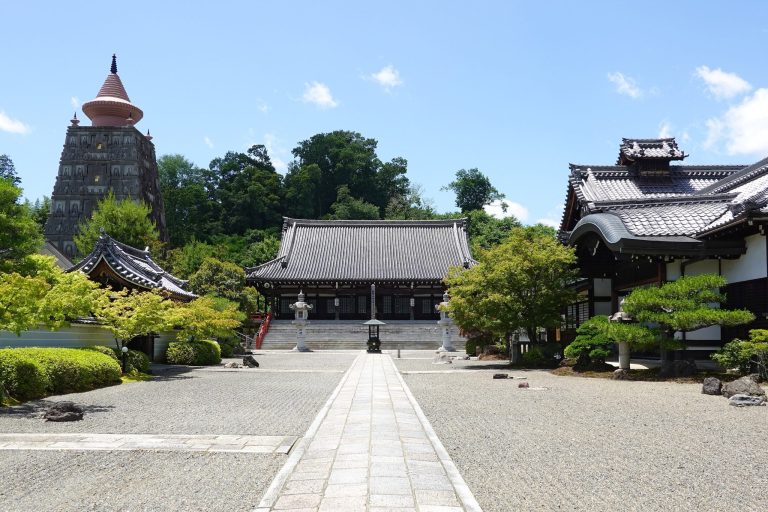
The temporary main hall built after the 1985 relocation houses the hidden Kannon and the temple treasures. It stands on the former Hoto-in site, east of the guardian shrine, and represents the present physical center of Daiun-ji after the buildings on the former grounds were demolished.
Water features and nearby tombs
Chiben Water and Fudo Waterfall
The former grounds retain the ritual water well associated with Yokei, or Chiben. Known as Chiben Water, it is accompanied by Fudo Waterfall. These features remain linked to the temple’s healing tradition and to Yokei’s association with Daiun-ji.
Surviving tombs
Several important tombs stand near the former grounds. They include the tomb associated with the monzeki of Jisso-in, Yokei’s tomb, and the Iwakura Imperial Mausoleum of Princess Shoshi.
Bronze bell
National Treasure bell
The temple’s former bronze bell is preserved away from Daiun-ji at the Sagawa Art Museum. Its inscription gives the date 858, and its earlier transmission from Enryaku-ji’s western pagoda connects the object with the religious institutions and conflicts that shaped the temple’s history.