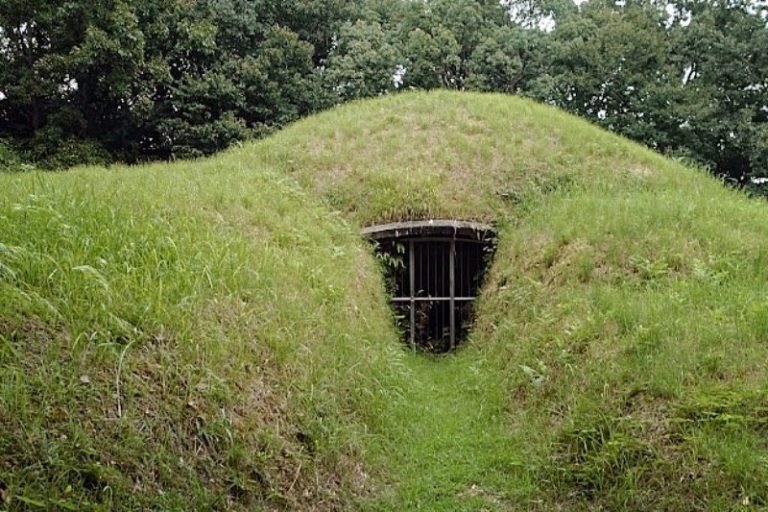
Tachibanazuka Kofun: A Large Kofun-Period Burial Mound in Japan

Site at a Glance
- Rating
- 4
- Popularity
- Very Low
- Country
- Japan
- Primary era
- Medieval
- External website
- Open
- Eras represented
- Medieval
- Civilizations
- Yamato
- Site type
- Burial
- Remains
- Burial Mound
On this page9 sections
History
Tachibanazuka Kofun is a large burial mound in Japan, built during the late sixth century in the Kofun period, an era of elite burial mounds that lasted roughly from the third to the seventh century. It belongs to the TK43 phase, a dating stage identified through the forms and production types of Sue pottery, a high-fired ceramic tradition used in Japan during the Kofun period and later centuries. The tomb is regarded as an important megalithic burial monument of the Buzen region.
Late-sixth-century development
Tachibanazuka Kofun formed part of a local sequence of large burial mounds. It followed a keyhole-shaped mound dating to the middle of the sixth century and came before Ayazuka Kofun, a circular mound dating to the beginning of the seventh century. Ayazuka lies approximately 500 meters to the west, placing the two monuments within the same historical landscape.
The stone chamber was opened in early times. As a result, the original grave goods are unknown, although Sue pottery fragments were recovered from the chamber and from the area extending toward the front ditch. The chamber was reused during the medieval period. Medieval pottery came from a section near the rear wall of the main chamber where paving stones had been removed.
Investigation and protection
A measured plan of the stone chamber was prepared in 1937. Later work in 1995 and 1996 surveyed the mound, measured the chamber, and examined the extent of the site. Further investigations took place in 2011 and 2017 in connection with new facilities.
The mound area became a National Historic Site of Japan on June 26, 1970. This designation is a national form of protection for archaeological, historical, and cultural sites under Japan’s cultural-property system. The designated area was partly expanded and partly released on October 11, 2024. Together with Ayazuka Kofun, Tachibanazuka has one of Japan’s largest multi-chamber horizontal stone chambers, a tomb entered through a side passage cut into the mound.
Remains
Mound and surrounding ditch
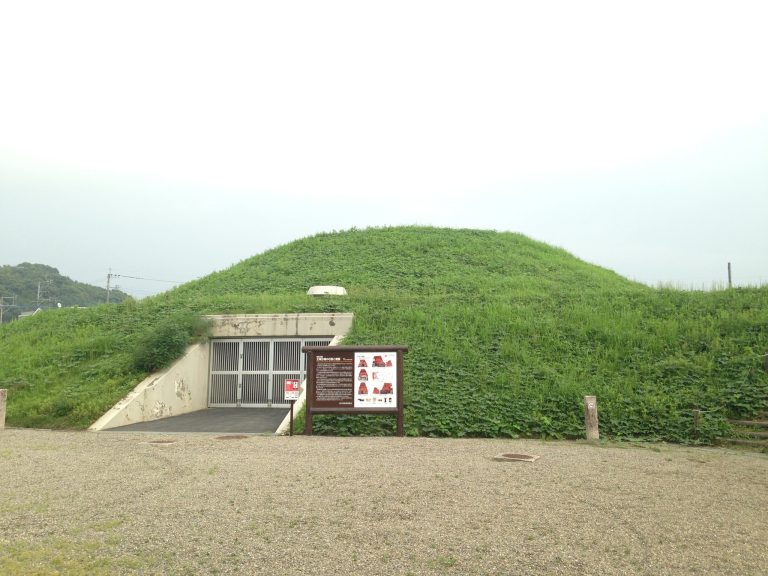
Tachibanazuka Kofun stands on a slight elevation near the center of the Kyoto Plain, within the grounds of Miyako Town Kuroda Elementary School. The mound is a slightly elongated square, measuring 37 meters from north to south and 39 meters from east to west. Before archaeological investigation, it was thought to be a circular mound about 40 meters in diameter.
A ditch surrounds the mound. It measures 6.5 meters wide on the east, 9.95 meters on the north, and 7 meters on the south. Including the ditch, the site measures approximately 53.5 meters north to south and 52 meters east to west. The surrounding land has since been substantially altered, with the school building to the west, the school swimming pool to the south, and the Taiyo no Mori Certified Childcare Center to the northeast.
Horizontal stone chamber
Chamber layout
The mound contains a large horizontal stone chamber built from massive granite blocks. Its entrance opens toward the southeast, with side extensions on both sides of the entrance. The multi-chamber design separates the main chamber, antechamber, and entrance passage. The reconstructed total length is approximately 17.5 meters, while the surviving measurable length is 16.3 meters. Traces of stone removal in front of the chamber mean that the reconstructed figure is partly estimated.
Main chamber and antechamber
The main chamber measures 3.2 meters in length, 4 meters in width, and 3.8 meters in height. The antechamber measures 3.2 meters long, 2.2 meters wide, and 3.1 meters high. Paving stones survive in the antechamber, while partial paving remains in the main chamber and entrance passage. The rear part of the main chamber contains a section where paving stones were removed, the area associated with medieval pottery.
Pottery and archaeological evidence
Recovered Sue pottery fragments include lids, jars, small vessels with spouts, high-footed cups, pedestal supports, stands, and large storage jars. Their forms place the burial mound around the end of the sixth century, during the TK43 phase. The pottery found toward the front ditch extends the evidence beyond the chamber itself and helps relate the burial structure to the surrounding mound area.