Tairyū-ji Temple: A Shingon Buddhist Pilgrimage Temple in Japan


Site at a Glance
- Rating
- 4.5
- Popularity
- Low
- Country
- Japan
- Primary era
- Early Modern
- External website
- Open
- Eras represented
- Early Modern, Modern
- Civilizations
- Japanese, Tokugawa
- Site type
- Religious
- Remains
- Temple
On this page13 sections
History
Tairyū-ji Temple is a Koyasan Shingon Buddhist temple in Anan, Japan, traditionally established in 793 during the Heian period through imperial prayer. Its formal name is Shashinzan Jōjūin Tairyū-ji, and it is traditionally the 21st temple of the Shikoku 88-temple pilgrimage, a Buddhist route associated with Kūkai around the island of Shikoku. It is also the 10th temple of the Awa Chichibu Kannon pilgrimage and is known as the “Koya of the West.”
Kūkai and the Temple’s Foundation
Tairyū-ji is closely associated with the ascetic practice of Kūkai, the monk traditionally regarded as the founder of the Shingon school of Japanese Buddhism. At the age of 19, he is said to have practiced the Kokūzō Gumonji method, a ritual discipline intended to cultivate exceptional memory and learning, for 100 days on a rock at Shashin-dake, about 600 meters west of the present precinct.
Kūkai’s work Sangō Shiiki, written when he was 24, refers to practice at Ōtaki Peak, identified with present-day Mount Tairyūji. The mountain title of the temple derives from Shashin-dake. The name Tairyū-ji refers to the Great Dragon, a dragon deity said to have protected Kūkai during his practice.
Tradition attributes the temple’s establishment to an imperial prayer ordered by Emperor Kanmu in 793. Fujiwara no Fumiyama, governor of Awa, is said to have established the buildings, while Kūkai is traditionally credited with carving and enshrining an image of Kokūzō and other sacred figures. Emperor Junna donated temple lands in 825, strengthening the institution’s resources.
Medieval Revival and Early Modern Patronage
In 1095, Chōhan of Tō-ji revived Tairyū-ji on the orders of the retired Emperor Shirakawa. The temple prospered through the devotion of the imperial household and warrior families, extending the religious importance of the mountain sanctuary beyond its association with Kūkai’s early practice.
During the Tenshō era, from 1573 to 1592, forces commanded by Chōsokabe Motochika burned the temple. Tairyū-ji then passed through repeated cycles of revival and deterioration before being rebuilt under the protection of the Hachisuka clan, the rulers of the Tokushima domain during the Edo period.
A document from 1653 to 1655 concerning itinerant pilgrimage sites identifies the temple as the Ōtaki temple of Nasa District in Awa. Chōzen’s pilgrimage diary also records a visit to the Dragon Cave in 1653. A guide published in 1800 describes the Shashin area as closed to women, reflecting restrictions that shaped access to some pilgrimage spaces.
Modern Pilgrimage and Conservation
Tairyū-ji entered a period of hardship after the Second World War, partly because of its mountainous location. The Dragon Cave, associated with Kūkai’s practice and situated about 3 kilometers along the Iwaya pilgrimage route toward Byōdō-ji, was destroyed by a cement factory. A three-story pagoda built at the temple in 1684 was later moved to Kōgan-ji, where it became a designated tangible cultural property of Ehime Prefecture in 2004.
A ropeway began operating in 1992, easing access to the mountain temple. Improved access and the revival of pilgrimage contributed to a renewed period of prosperity. Sections of the pilgrimage routes connected with Tairyū-ji, including the Tairyū-ji, Kamo, Iwaya, and Byōdō-ji routes, have been designated nationally protected historic sites. The temple precinct covers 6 hectares within the designated pilgrimage landscape. Tairyū-ji is also included in the Awa-Muroto Historical and Cultural Route and has been selected among the Tokushima 88 Scenic Views.
Typhoon 6 in July 2011 broke approximately 15 meters from the top of a cedar estimated to be 400 years old. The falling tree penetrated the main hall roof. The roof was repaired several years later, and damage to the Daishidō caused by a subsequent typhoon had been repaired by 2018.
The temple remains a center of pilgrimage and ritual. Its principal image is opened annually on January 12, while the image associated with Kūkai is opened once a year on the twenty-first day of the third lunar month. The temple also observes the Buddha’s Birthday ceremony on the eighth day of the fourth lunar month and holds a publicly attended New Year’s Eve bell ringing.
Remains
Mountain Setting and Pilgrimage Approach
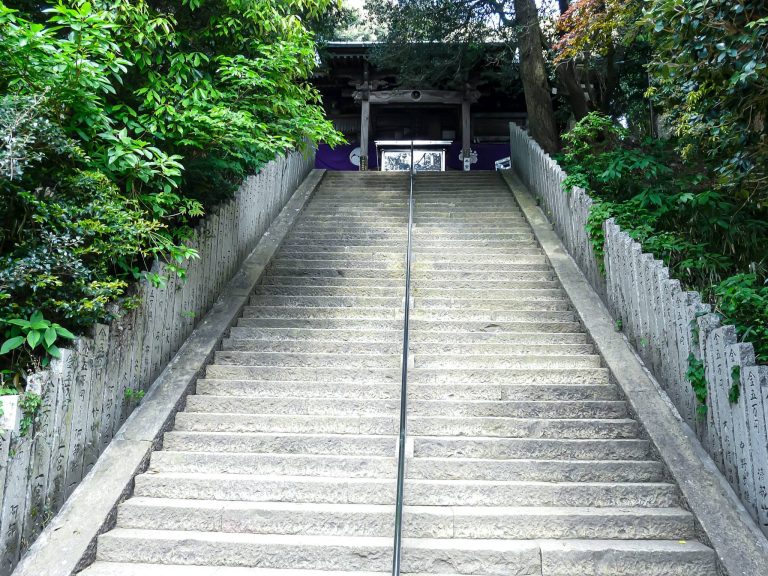
Tairyū-ji stands near the summit of Mount Tairyūji, on the peak called Misen at an elevation of 600.1 meters. The temple precinct lies at 500.6 meters, while the mountain’s other peak, Mount Fudaraku, reaches 618 meters. The buildings occupy a mountain setting organized along a long approach, stone steps, and elevated groups of halls.
The approach from the Niō Gate passes the hexagonal Sutra Repository, the Goma Hall, the main residence, and the pilgrimage-stamp office. The stone stairway then continues through the Bell Tower Gate toward the upper precinct. The Tairyū-ji pilgrimage landscape includes approximately 1.027 kilometers between Wakasugi and the four-way junction before the Niō Gate, 1.34 kilometers of the Kamo route from Isshuku-ji toward the temple, and 2.675 kilometers of the Iwaya route toward the former Dragon Cave. A further 567 meters extends toward Minami-Shashin-dake, and another 2.068 kilometers continues to the Byōdō-ji route junction. The designated first section of the Byōdō-ji route covers 0.66 kilometers from that junction.
Gates, Halls, and Religious Buildings
Entrance and Bell Tower Gates
The Niō Gate, built in 1806, contains guardian figures attributed to the Kamakura period. These figures are described as the largest and oldest guardian figures of their type in Tokushima Prefecture. Farther along the stone steps, the Bell Tower Gate was built in 1903 and forms a passage within the approach to the main hall.
Main Hall and Daishidō
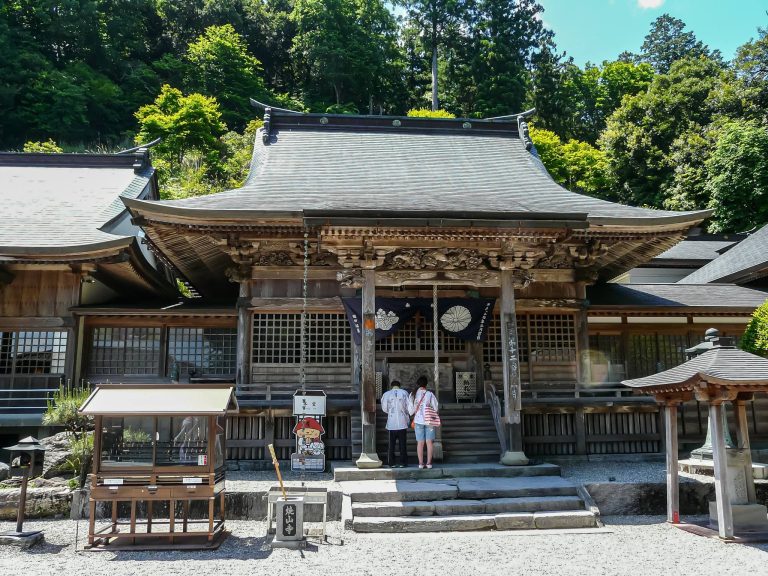
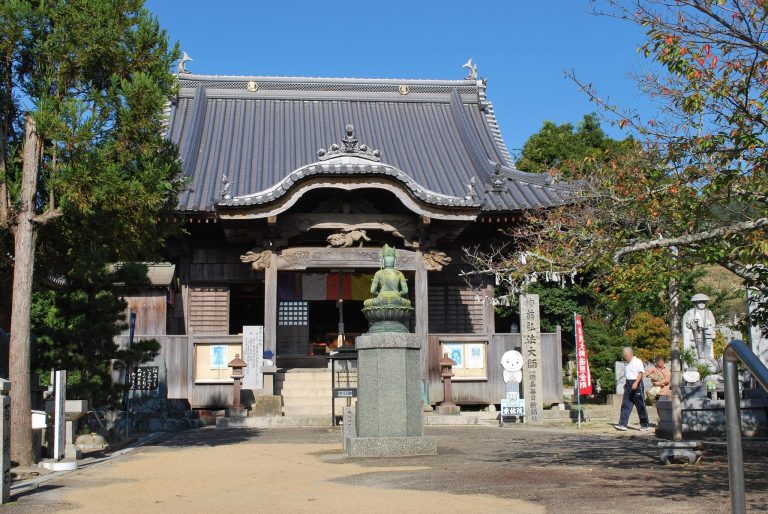
The main hall was built in 1852 at the upper end of the stairs. It houses the principal image, Ākāśagarbha Bodhisattva, also called Kokūzō, a bodhisattva associated in esoteric Buddhism with wisdom, memory, and the vastness of space. The sculpture is a large half-jōroku image that extends to the ceiling. Kūkai is traditionally said to have carved this and other sacred images for the temple and related halls.
The Daishidō, dedicated to Kūkai, was built in 1877 across a bridge from the main hall. Its complex includes a worship hall and an inner hall. The Buddhist-image hall has a ceiling painting of a dragon by Takemura Shōrei, a painter from Kōchi. The Daishidō also preserves a bronze-gilt bell ensemble traditionally associated with Kūkai and dated to either the Tang or Song period, together with carvings that include a depiction of the Seven Sages in the Bamboo Grove from the Song period.
Supporting Halls and Repository
The Gumonji Hall stands behind and to the left of the main hall. It serves as a practice hall for the Kokūzō Gumonji method and is described as foremost among three such places. The Goma Hall, built in 1901, enshrines an image of Fudō Myōō, a wrathful Buddhist deity associated with immovable wisdom and ritual protection. The hexagonal Sutra Repository was built in 1856.
The Treasure Pagoda, built in 1861 on a hill between the main hall and the Daishidō, enshrines five Kokūzō figures: Hōkai Kokūzō, Kongō Kokūzō, Hōkō Kokūzō, Renge Kokūzō, and Gyōyō Kokūzō. The main residence was built in 1895. The precinct also contains the Restoration Hall, which enshrines Chōhan, the fourth abbot associated with the temple in the late Heian period, and Ryōzan, its twenty-second abbot in the early Edo period.
Markers, Trees, and Former Structures
Pilgrimage Markers
Stone pilgrimage markers called chōishi line the route associated with the passage from Isshuku-ji to the Niō Gate. Eleven markers were initially confirmed and designated as Tokushima Prefecture cultural properties in 1967. Later discoveries brought the known total to 18.
Other Precinct Features
A guardian shrine for five deities stands within the precinct, along with a sōrintō, a Buddhist finial or memorial pillar modeled on the vertical elements of a pagoda, dated to 1816. At the foot of the steps to the main hall is a stone monument bearing Santōka Taneda’s verse, “Entering deeper and deeper, still the blue mountains.” Several hundred-year-old Japanese umbrella pines and Hinoki cypress trees surround the complex.
The former Dragon Cave was a natural cave along the Iwaya route and was associated with Kūkai’s ascetic practice. The former three-story pagoda, built in 1684, was also part of the temple’s earlier architectural history before its relocation to Kōgan-ji. The main hall, Daishidō, worship hall, Goma Hall, Treasure Pagoda, Sutra Repository, main residence, Niō Gate, and Bell Tower Gate were registered as tangible cultural properties in 2013.