Gokoku-ji Temple: A Shingon Buddhist Head Temple in Tokyo


Site at a Glance
- Rating
- 4.4
- Popularity
- Medium
- Country
- Japan
- Primary era
- Early Modern
- External website
- Open
- Eras represented
- Early Modern, Modern
- Civilizations
- Japanese, Tokugawa
- Site type
- Religious
- Remains
- Temple
On this page19 sections
History
Gokoku-ji Temple is a major head temple of the Buzan School of Shingon Buddhism in Tokyo, Japan, founded in 1681 during the Edo period. Its formal name is Shinreisan Shitchi-in Daisho Gokoku-ji, and its principal religious figure is Nyoirin Kannon, a form of the Buddhist bodhisattva associated with compassion. The temple was established as a prayer temple for Keisho-in, the mother of Tokugawa Tsunayoshi, the fifth shogun of Japan’s Tokugawa shogunate.
Foundation under the Tokugawa shogunate
In 1681, Tsunayoshi granted the shogunate’s herb-garden site at Otsuka to Ryoken, abbot of Daisho Gokoku-ji in Takasaki, and ordered the new temple’s construction. Ryoken became its founding abbot. Keisho-in’s personal amber image of Nyoirin Kannon was revered as the temple’s principal image and treated as an absolutely secret image. The Kannon image placed in the main hall was donated by the mother of Hotta Masatora.
During the Edo period, Gokoku-ji became a popular temporary lodging temple for traveling public unveilings of Buddhist images. In this role it ranked after Senso-ji and Ekoin. It also became the thirteenth station of the Edo Thirty-Three Kannon pilgrimage, linking the temple to a circuit of devotional sites centered on Kannon worship.
Gojii-in and the Shingi branch
The neighboring Gojii-in was the Edo branch temple of Chisoku-in Chūzen-ji in Tsukuba. It served as the clerical registrar institution for the Shingi branch of Shingon Buddhism, an esoteric school of Japanese Buddhism, and was therefore one of that branch’s highest-ranking temples. After a fire destroyed its temple in Kanda in 1717, the former grounds were converted into a firebreak, and Gojii-in moved to the eastern side of Gokoku-ji. Its abbot also served as Gokoku-ji’s abbot.
Gojii-in was abolished during the Meiji-period separation of Buddhism and Shinto, a government policy that formally divided the two religious traditions. The former Gojii-in grounds were subsequently recognized as part of Gokoku-ji. This change enlarged the temple’s connected institutional and physical setting even as the new Meiji government transformed the land around it.
Meiji land changes and the cemetery
Gokoku-ji had been a shogunal prayer temple without a parishioner base, so it lost its financial support after the Meiji Restoration and faced severe economic difficulties. The temple’s former grounds covered 50,000 tsubo, a traditional Japanese area measure. After the stillbirth and death of Emperor Meiji’s first son, Prince Wakamiizu Teruhiko, in 1873, 25,000 tsubo on the eastern side became the imperial Toshimagaoka Cemetery. Another 5,000 tsubo on the western side became an army cemetery. The temple was left with roughly 20,000 tsubo, and the army cemetery was later organized within the Gokoku-ji cemetery.
Hamuro Mitsuko, the prince’s mother, also died in 1873 but was buried within Gokoku-ji rather than in the imperial cemetery. After the early Meiji government authorized new graves for senior officials, cemeteries for Sanjo Sanetomi, Yamagata Aritomo, and Okuma Shigenobu were established within the grounds. The cemetery later became associated with many other prominent figures, including the architect Josiah Conder, entrepreneur and art collector Okura Kihachiro, business executive Dan Takuma, Kodansha founder Seiji Noma, businessman and tea master Masuda Takashi, politician and Bank of Japan governor Ikeda Shigeaki, martial artist and yoga teacher Nakamura Tempu, Kyokushin karate founder Oyama Masutatsu, composer Dan Ikuma, and Hashimoto Natsuko.
Rebuilding and twentieth-century development
Fires in 1883 and during the 1920s destroyed much of the temple complex. Historic buildings were later transferred to Gokoku-ji, helping to renew its architectural fabric. The temple itself survived the American air raids of the Pacific War without being bombed.
From the Taisho period into the early Showa period, businessman and tea master Takahashi Yoshio, also known as Hoan, served as a leading representative of the temple’s parishioners and directed the development of the grounds. He arranged the transfer of Matsudaira Fumai’s grave to Gokoku-ji after it had been damaged in the Great Kanto Earthquake and faced relocation to Matsue because of land readjustment. Takahashi also obtained Gekkō-den from businessman Hara Rokuro and arranged its move from Onjo-ji in Shiga Prefecture to the area west of the main hall. The resulting development included five tea houses, a treasure pagoda, and the Furo-mon gate, after which the temple hosted large tea gatherings.
Remains
The surviving complex follows a deliberately planned approach road that was historically lined with shops. The route leads through successive gates and open areas toward the principal halls, while the cemetery occupies part of the grounds and contains the graves associated with Gokoku-ji’s modern history. The buildings combine Edo-period religious architecture with historic structures transferred to the site and additions made during its twentieth-century development.
Gates and approach
Niomon
Entry to the temple is through the Niomon, or Gate of the Two Guardian Kings. A pair of Niō guardian figures stands on either side of the passage, giving the entrance its religious and protective character.
Furo-mon
At the upper end of the stairway stands the Chumon, also called the Furo-mon or Gate of Immortality. Built in 1938, it was modeled on the worship hall of Yuki Shrine at Kurama-dera in Kyoto.
Somon
The Somon leads to the abbot’s residence. Its form resembles a gate used at a daimyo residence, and it was intended for important guests.
Halls and religious structures
Main hall
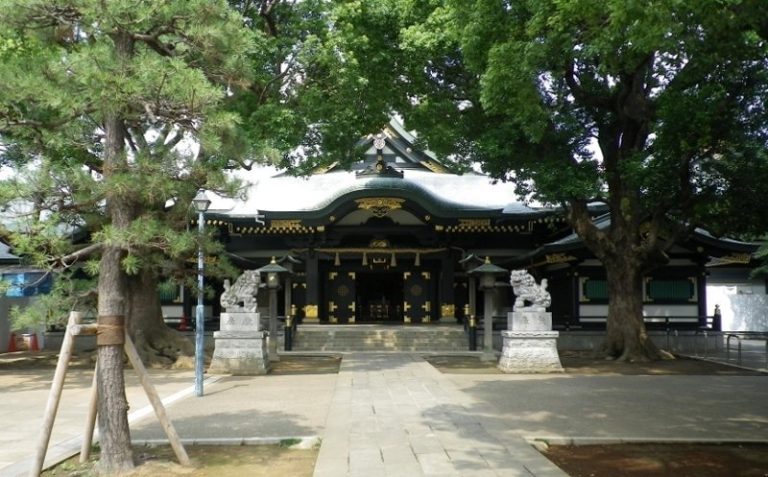
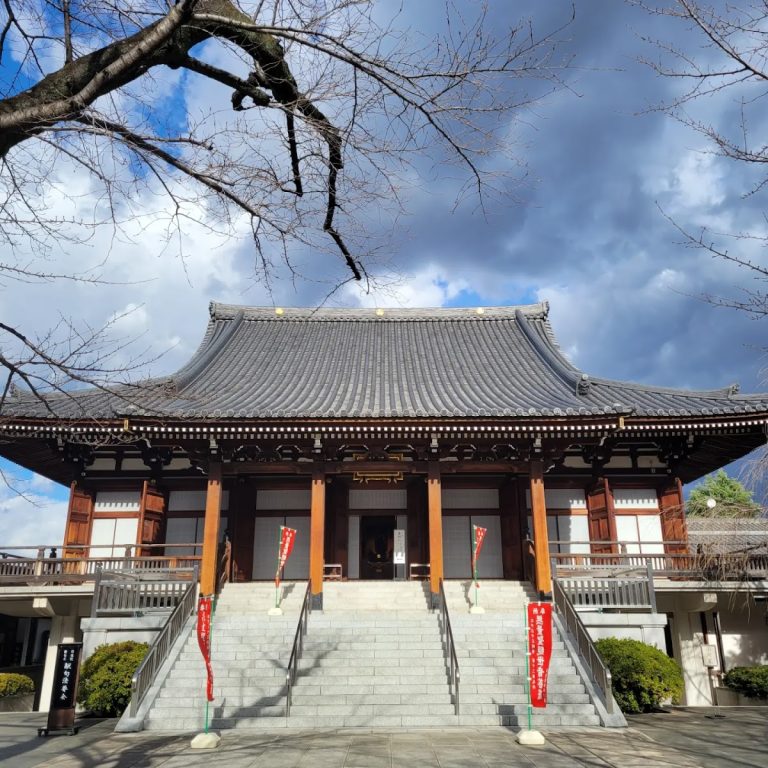
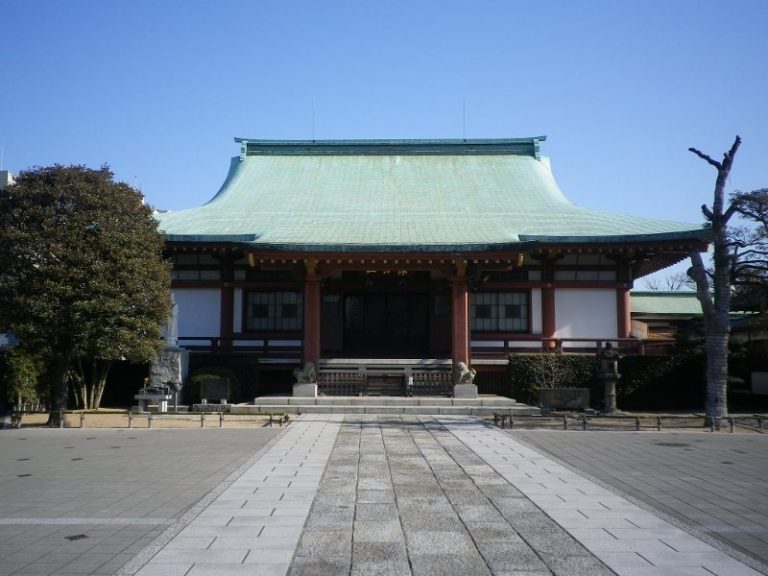
The main hall was originally the Kannon Hall and was built in 1697. After the former main hall was destroyed in the fire of the 1920s, this older hall was moved into its present position. It combines Japanese and Zen-style elements beneath a simple hipped roof covered with copper sheeting. The hall houses the Kannon image donated by the mother of Hotta Masatora.
Daishido
The Daishido, or Great Master Hall, dates from 1701. It is the temple’s originally relocated Yakushido, a hall dedicated to Yakushi, the Buddha associated with healing. The building had formerly been used to store a complete set of sutras and belongs stylistically to the Genroku period, the late seventeenth and early eighteenth centuries.
Bell tower
The bell tower stands to the right of the approach on an unusually high base. It contains a temple bell dating from 1682, close to the foundation of Gokoku-ji.
Tahoto
To the left behind the Furo-mon is the Tahoto, a Japanese Buddhist pagoda form with a square lower section and a circular upper structure. It was donated in 1938 and modeled on the Tahoto at Ishiyama-dera.
Transferred architecture and cultural materials
Gekkō-den
Gekkō-den, or the Moonlight Pavilion, stands west of the main hall. Dating from the early Azuchi-Momoyama period, the late sixteenth century, it was originally a guest house on the grounds of Mii-dera in Shiga Prefecture. It was moved to Tokyo in 1888 and transferred to Gokoku-ji in 1928. The pavilion is an early surviving example of shoin-zukuri, an architectural tradition developed around formal reception and study spaces in elite residences and religious institutions, and it has a tiled roof.
Tea houses and Otowa Fuji
The grounds contain five tea houses used for private tea ceremonies, together with the Tahoto and Furo-mon created during the twentieth-century development of the complex. They also include Otowa Fuji, a Fujizuka, or artificial mound representing Mount Fuji.
Associated works of art
Gokoku-ji’s associated cultural materials include the silk painting Victorious Banner Mandala, a gilt-bronze five-pronged ritual bell, and a silk-and-ink painting of a fisherman by Zhang Lu of Ming China. They also include a dyed and embroidered crepe-silk kimono decorated with plum trees and bamboo, the Collection of Temple Origin Narratives, and Kannon Riding a Dragon, an oil painting by Harada Naojiro made on hemp in 1890. The Kannon painting has been deposited with the National Museum of Modern Art, Tokyo.