Jiuchang Temple: An Ikoma Family Mortuary Temple in Japan


Site at a Glance
- Rating
- 4.5
- Popularity
- Very Low
- Country
- Japan
- Primary era
- Early Modern
- External website
- Open
- Eras represented
- Early Modern
- Civilizations
- Unclassified
- Site type
- Religious
- Remains
- Monastery
On this page9 sections
History
Jiuchang Temple was a Soto Zen Buddhist temple in Konan, Aichi, Japan, traditionally founded in 1384 as a family mortuary temple for the Ikoma lineage. Soto Zen is a major Japanese school of Zen Buddhism that emphasizes seated meditation and monastic discipline. The temple was also known as Zenki Temple and Ryutoku Temple.
Foundation and early names
The traditional account places the temple’s establishment in 1384, when a local notable founded it as Zenki Temple. It was renamed Ryutoku Temple in 1387. Another tradition leaves the foundation date uncertain and connects the temple with the Ikoma family’s migration from Yamato. Under that account, an Ikoma family member established a temple near the family cemetery sometime between 1469 and 1501.
Jiuchang Temple belonged to the Soto Zen tradition and served as the Ikoma family’s mortuary temple, a Buddhist institution responsible for memorial rites and ancestral graves. Its history was therefore closely tied to the family cemetery and to the commemoration of successive Ikoma family members.
Yoshino and the temple’s renaming
After Ikoma Yoshino, a consort of Oda Nobunaga, died in 1566, she was buried at the temple under the Dharma name Ku-an Keisho Daizenjoni. A Dharma name is a Buddhist religious name used in memorial contexts. Oda Nobunaga, the sixteenth-century military leader who played a major role in Japan’s political unification, donated an income of 660 koku to support memorial rites. A koku was a historical measure of rice-based income, traditionally approximating the annual rice consumption of one person. Following Yoshino’s burial, the temple was renamed Jiuchang Temple.
Religious changes and the Arhat paintings
During the Tensho period, a late sixteenth-century Japanese era, the temple’s affiliation with the Kanzan branch declined. The Kanzan branch was a lineage within Japan’s Zen institutional tradition. The Ikoma family later invited a monk from a temple in the town around Kiyosu Castle to serve at Jiuchang Temple, restoring its connection with Soto Zen.
In 1825, the Buddhist monastic precepts master Gocho stayed at the temple and delivered a Buddhist lecture. He found that four of the sixteen hanging scrolls depicting the Arhats were missing. Arhats are Buddhist disciples believed to have attained spiritual liberation, and groups of sixteen were a common subject in Buddhist painting. The scrolls had been transmitted at Jiuchang Temple since the Kamakura period, which lasted from 1185 to 1333. Gocho painted four replacement figures and completed the sixteen-scroll set. Jiuchang Temple later donated the completed set to Sojiji in Tsurumi, and all sixteen scrolls are now designated Important Cultural Properties.
Closure and dismantling
In 2021, the religious corporation decided to dissolve because the temple buildings had deteriorated, the temple had few parishioners, and maintenance had become difficult. The buildings were also considered unable to meet modern earthquake-resistance requirements. Dismantling began in May 2022, and the corporation’s registration was closed in August 2023.
Officials temporarily halted the dismantling after processing marks were identified on some timbers that might have dated from the Tensho period. Because such marks could not establish the age of the wood on their own, further scientific investigation was considered necessary. The city ultimately abandoned plans to preserve the main hall because of the cost of maintaining it. The land was sold to the city and was expected to be redeveloped as Jiuchang Temple Park in fiscal 2023. The Ikoma graves were to remain, while a small hall was planned near the former site for the former principal image and memorial tablets dedicated to Yoshino and other members of the family.
Remains
The former temple grounds comprised the main hall and other temple buildings, with the Ikoma family cemetery occupying the area west of the main hall. The temple buildings were dismantled from May 2022, while the cemetery and its stone monuments were to remain on the grounds. Objects recovered during the dismantling, including potentially old timbers, roof tiles, and a hanging plaque attributed to the Chinese monk and calligrapher Toko Shin’etsu, were transferred to the city for preservation and display at the Konan History and Folklore Museum.
Former temple buildings
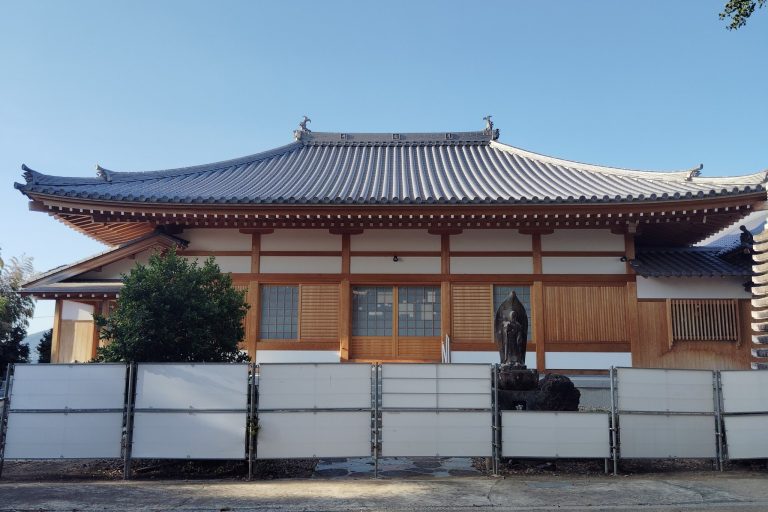
The final surviving main hall was completed in 1925. The date of the residential quarters is unknown, although the structure was considered to belong to the Edo period, which lasted from 1603 to 1868. Both the main hall and the other temple buildings were dismantled beginning in May 2022. Some removed timbers carried processing marks thought possibly to date from the Tensho period, but the marks alone did not establish that the timbers themselves came from that era.
Ikoma family cemetery
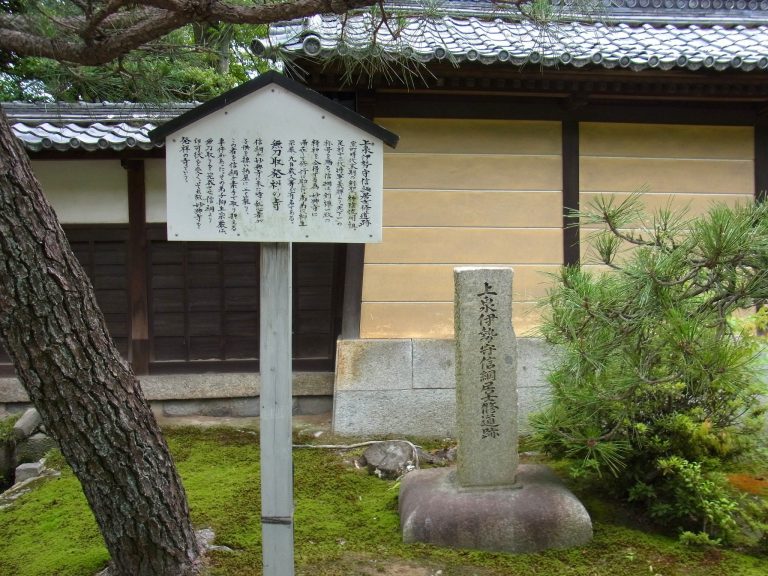
The Ikoma family stone monument group stands west of the former main hall. It includes Yoshino’s grave and the graves of successive members of the Ikoma family. The group was designated a Konan municipal historic site on 30 October 2013 and was to remain after the temple’s closure.
Paintings and preserved objects
The sixteen Arhat paintings began as hanging scrolls transmitted at Jiuchang Temple from the Kamakura period. Four missing figures were repainted in 1825, completing the set. The scrolls were later donated to Sojiji rather than remaining at the former temple, and the entire set is designated Important Cultural Properties. The potentially old timbers, roof tiles, and the hanging plaque attributed to Toko Shin’etsu were preserved and displayed at the Konan History and Folklore Museum.