Ryūkō-ji Temple: A Nichiren Buddhist Sacred Site in Japan


Site at a Glance
- Rating
- 4.2
- Popularity
- Medium
- Country
- Japan
- Primary era
- Medieval
- External website
- Open
- Eras represented
- Medieval
- Civilizations
- Ashikaga shogunate
- Site type
- Religious
- Remains
- Temple
On this page8 sections
History
Ryūkō-ji Temple is a Nichiren Buddhist head temple and sacred-site temple in Fujisawa, Japan, associated with the persecution of the thirteenth-century reformer Nichiren. Its formal name is Jakkō-zan Ryūkō-ji, and its foundation is traced to 1337 at the former Tatsunokuchi Execution Grounds in Katase.
Nichiren and the Tatsunokuchi Persecution
Nichiren placed the Lotus Sutra at the center of Buddhist practice. In the Risshō Ankoku-ron, a treatise arguing that political and social stability depended on adherence to the correct Buddhist teaching, he attributed natural disasters and social disorder to the government and other Buddhist schools failing to follow that teaching. On July 16, 1260, he presented the work to Hōjō Tokiyori, a leading regent of the Kamakura shogunate. The government treated his criticism as rebellion and ordered Taira no Yoritsuna, a senior government retainer, to persecute him.
On September 12, 1271, Nichiren was taken to the Tatsunokuchi Execution Grounds to be beheaded. He was held in a prison cave, and his execution was reportedly stopped near September 13 when a powerful luminous object appeared from the direction of Enoshima and blinded the executioner. Nichiren Buddhism calls this episode the Tatsunokuchi Persecution and regards it as one of the four major persecutions suffered by Nichiren.
A religious tradition also associates the journey with Sashiki no Ama, a laywoman connected with Nichiren. She is said to have offered him black-sesame rice cakes placed on a pot lid as he was taken toward the execution grounds.
Foundation and Temple Administration
In 1337, Nippō, one of Nichiren’s disciples, established a hall known as the Leather-Mat Hall at the site of the Tatsunokuchi Persecution. He enshrined a leather mat said to have been placed beneath Nichiren’s neck at the intended execution, together with a statue of Nichiren made by Nippō. This foundation is regarded as the beginning of Ryūkō-ji.
From the construction of the Leather-Mat Hall until 1886, the temple was maintained through a rotating system administered by eight Nichiren temples in Katase and Koshigoe. The eight, known collectively as the Eight Rotating Temples of Ryūkō-ji, shared responsibility for protecting the sacred site. Honren-ji and Jōritsu-ji were in Katase, while Kangyō-ji, Honjō-ji, Myōten-ji, Honryū-ji, Hōgen-ji, and Tōzen-ji were in Koshigoe and the former Tsumura area. All used the mountain name Ryūkō-zan, an honorific name traditionally used by many Japanese Buddhist temples, and represented major Nichiren Buddhist lineages.
In 1601, Shimamura Uneme, a local notable of Koshigoe and Tsu and a committed Nichiren Buddhist, donated temple lands. This enabled the complex to be organized more fully. A resident head priest was established in 1886, ending the rotating administration.
Modern Religious Status and Preservation
The former head-temple and branch-temple system of the Nichiren school was dissolved in 1941. The temples that had belonged to it are consequently described as former head temples and former branch temples. Government religious policies reduced Ryūkō-ji during the Meiji period, while repairs after the Second World War contributed to the preservation of the site.
Ryūkō-ji is affiliated with the Nichiren Shū, a major school of Nichiren Buddhism, and is one of the five head temples of the Ikegami lineage. It is also designated as a sacred site associated with Nichiren. Four buildings were registered as nationally registered tangible cultural properties in 2021.
Remains
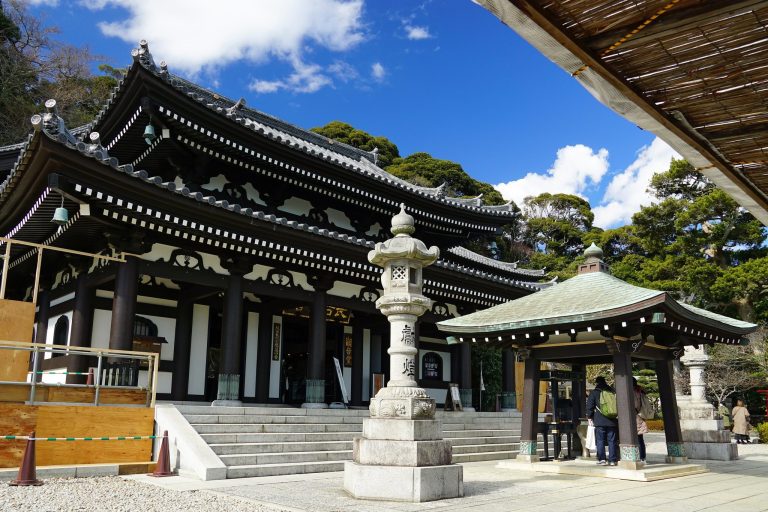
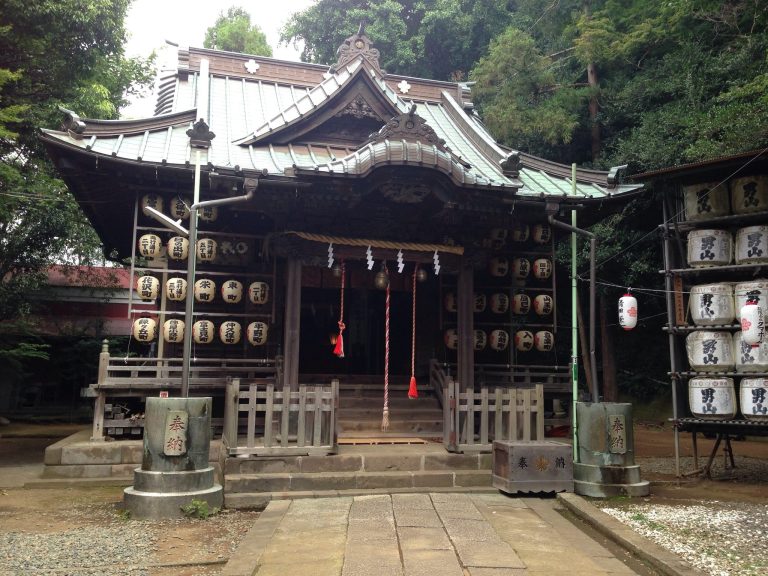
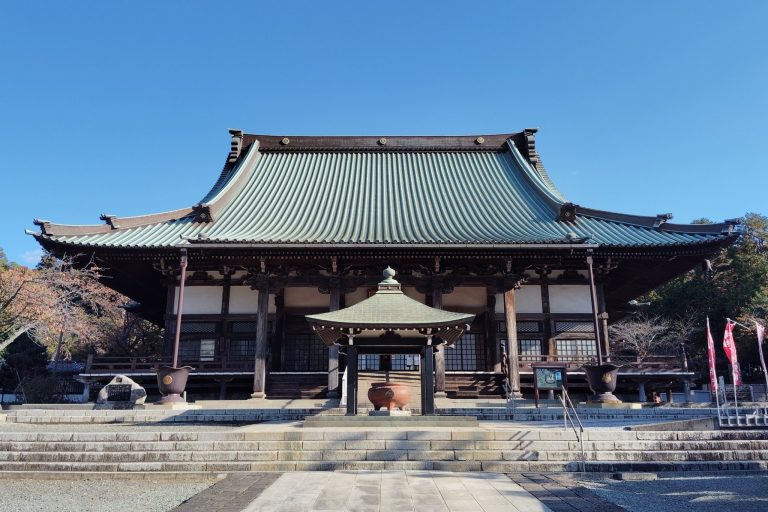
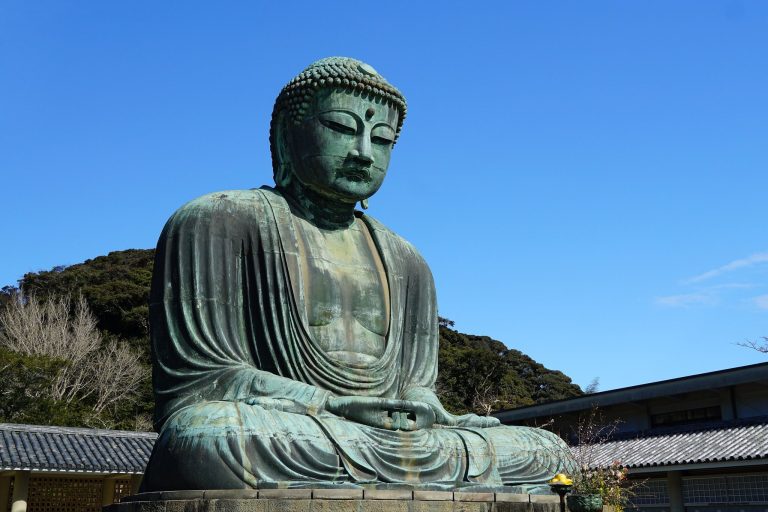
The temple occupies the former Tatsunokuchi Execution Grounds. Its principal buildings include a main hall, a five-story pagoda, a stupa, and the Shichimendō. The grounds also retain the cave in which Nichiren was confined, a marker for the execution ground, and both an outer gate and an inner gate. A statue of Nichiren stands in the courtyard in front of the main hall.
Principal Buildings
The main hall is the principal worship building within the complex. The five-story pagoda is a tower-shaped Buddhist structure associated with relics or commemorative worship, while the stupa is a Buddhist reliquary monument. The Shichimendō forms another principal building group within the temple grounds. The principal object of worship is the Sanbōson, the Three Treasures of Buddhism: the Buddha, the Buddhist teaching, and the Buddhist community.
Features Associated with Nichiren
The prison cave, execution-ground marker, outer gate, and inner gate preserve the physical setting associated with the Tatsunokuchi Persecution. Together with the courtyard statue of Nichiren, these features connect the surviving temple layout with the event commemorated at the site.
The Leather-Mat Hall
The Leather-Mat Hall is the earliest structure associated with Ryūkō-ji’s foundation. It enshrined the leather mat said to have covered the ground beneath Nichiren’s neck during the intended execution, along with a statue of Nichiren made by Nippō. The hall therefore preserves the foundation tradition through both a revered object and an image of the temple’s associated religious founder.