Ichio Miyazuka Kofun: A Keyhole-Shaped Burial Mound in Japan
Site at a Glance
- Rating
- 4.2
- Popularity
- Very Low
- Country
- Japan
- Primary era
- Medieval
- External website
- Open
- Eras represented
- Medieval
- Civilizations
- Yamato
- Site type
- Burial
- Remains
- Burial Mound
On this page10 sections
History
Ichio Miyazuka Kofun is a keyhole-shaped burial mound in Japan, built during the late Kofun period, probably in the first half of the sixth century and possibly around its middle. The Kofun period, conventionally dated from about the third to the seventh century, was marked by large elite tombs and regional chiefly societies. Ichio Miyazuka Kofun followed the nearby Ichiohakayama Kofun as the burial place of a later local chieftain.
The Kose and the Late Kofun Period
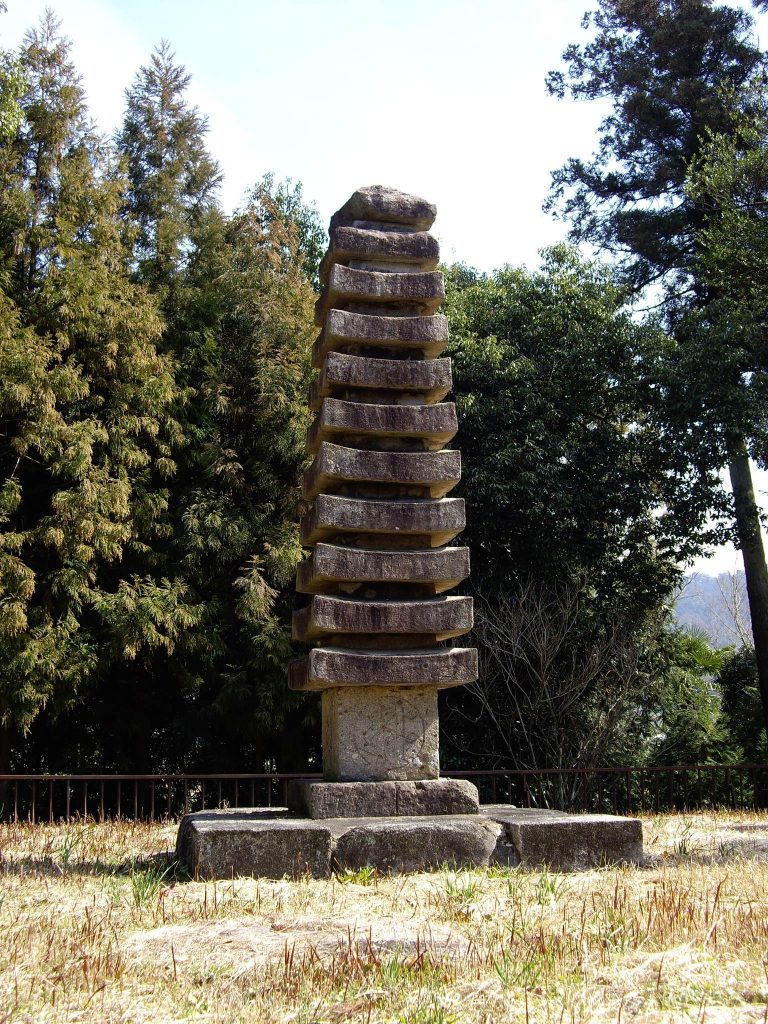
The tomb has been associated with the Kose clan, a prominent late-Kofun-period family linked with political authority, regional rule, diplomacy, and military affairs involving the Korean Peninsula. Important contemporary sites, including Mizudoro Kofun and the remains of the Kose Temple pagoda, are distributed around the mound. These nearby remains provide the wider setting for interpreting Ichio Miyazuka Kofun as a tomb connected with the Kose sphere of influence.
Investigation and Protection
Part of the tomb was excavated around 1893, producing grave goods. Modern archaeological work began with mound surveying and measurements of the stone chamber in 1975 and 1978. A cleaning survey of the chamber followed in 1997, with the earlier investigations reported in 1984 and the cleaning work published in 2018. Ichio Miyazuka Kofun and Ichiohakayama Kofun were designated together as a National Historic Site of Japan on March 31, 1981.
Remains
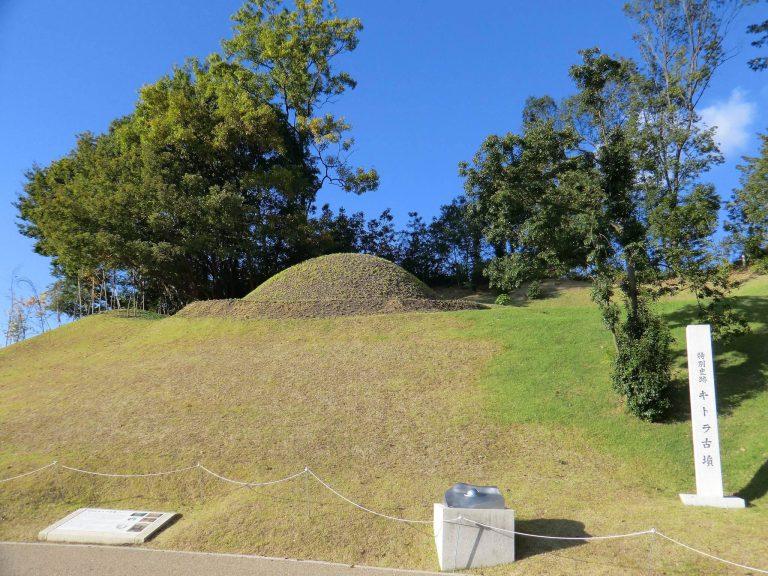
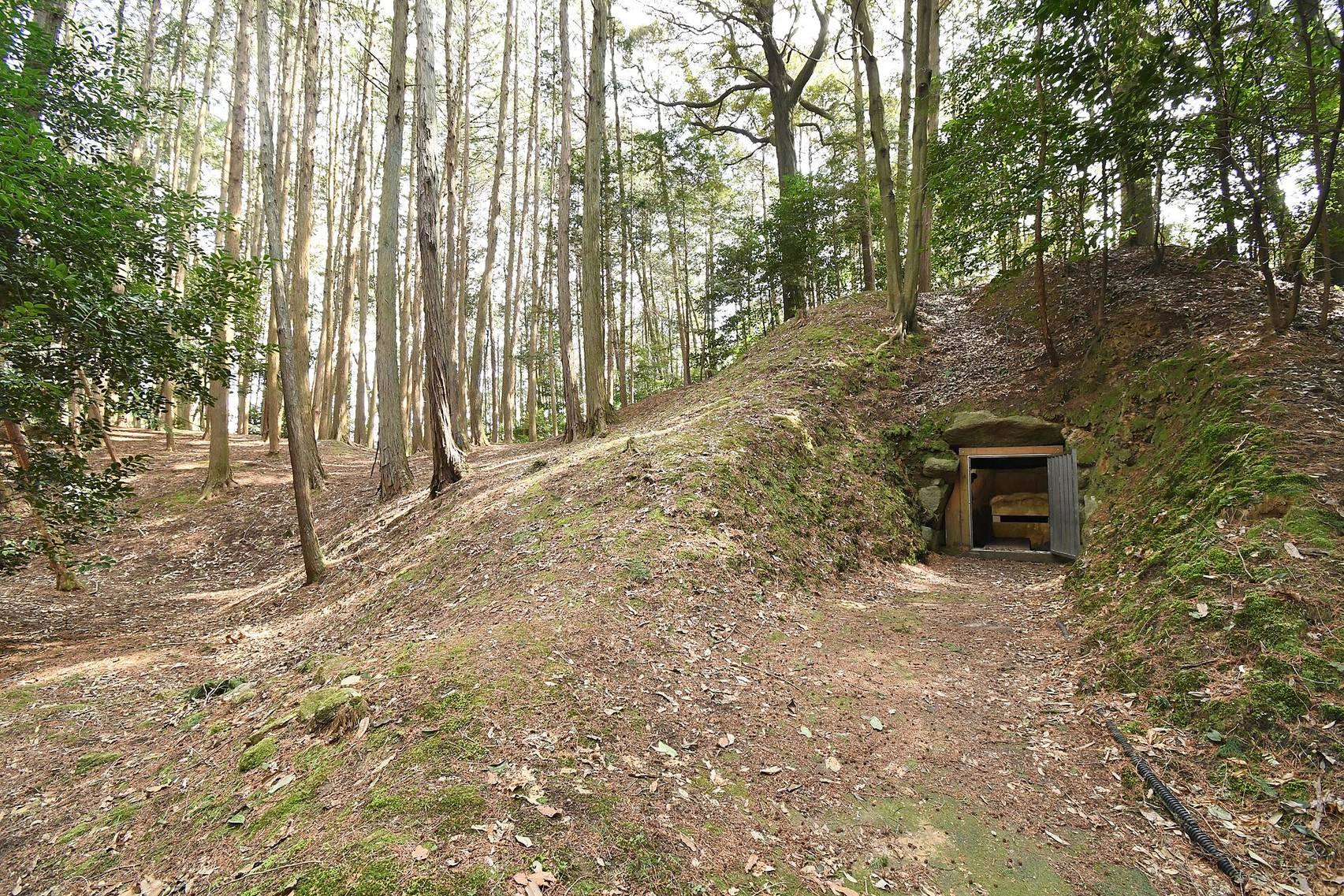
Ichio Miyazuka Kofun stands on an independent hill about 106 metres above sea level at Ichio in Takatori, Nara Prefecture. The hill lies across the Kii route from a ridge extending north from the Ryumon Mountains. A Tenmangu Shrine now occupies the hill, while Ichiohakayama Kofun lies to the northeast. The tomb itself is a two-tiered keyhole-shaped mound, a form that combines a rectangular front with a circular rear. It measures about 47 metres in total length, faces generally northeast, and has a rear section rising roughly 6 metres.
Mound and Stone Chamber
Keyhole-Shaped Mound
The mound consists of a rectangular front section and a circular rear section arranged on a northeast-facing axis. Its two-tiered construction gives the monument a defined stepped profile, with the circular rear portion rising approximately 6 metres above the surrounding mound.
Horizontal Stone Chamber
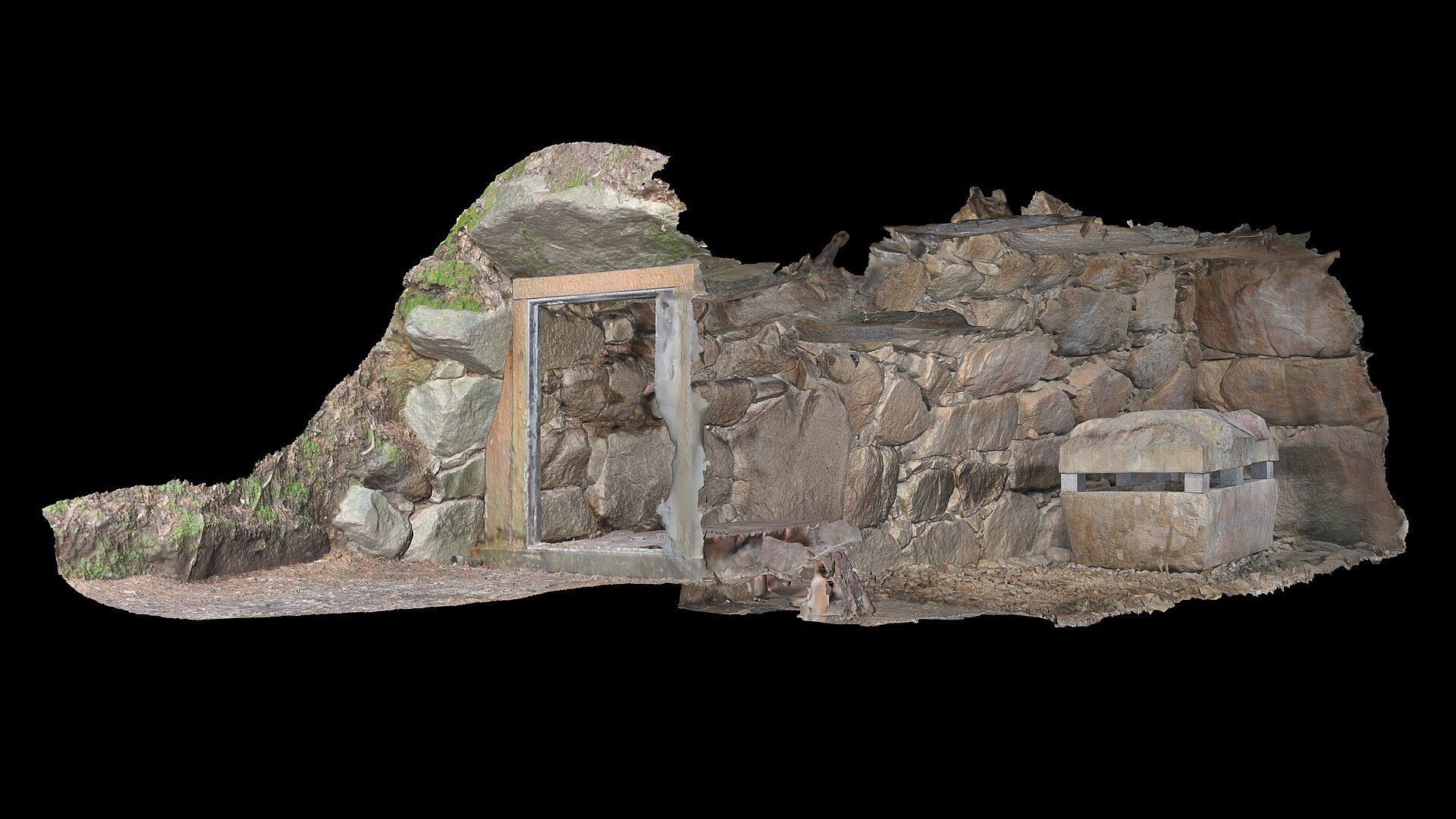
A large double-sleeved horizontal stone chamber occupies the centre of the rear circular section and opens generally toward the north-northwest. This type of chamber is entered through a passage cut into the mound, while the double-sleeved form has side extensions where the burial chamber meets the passage. The entire chamber is 11.6 metres long. Its rectangular burial chamber measures 6.2 metres in length, 2.5 metres in width, and 3 metres in height, and its entrance passage is 5.4 metres long, 1.5 metres wide, and 1.8 metres high.
Natural granite blocks form the chamber. Small gravel covers the floor of the burial chamber, and a stone-lined drainage channel runs along its walls. Four stones cover the burial chamber, while three form the ceiling over the passage.
Burials and Grave Goods
Stone Coffin
A hollowed, house-shaped coffin made from tuff was placed inside the burial chamber. It is badly damaged, but its surviving lid measures 1.86 metres long, 1.21 metres wide, and 0.48 metres high. Six projections for holding ropes are arranged on the lid, with one pair at the front and rear and two pairs along the sides. Red pigment covers the coffin’s exterior.
Later Burial and Objects
Traces of a wooden coffin from a later burial were found in front of the stone coffin. Excavation of the chamber also produced numerous burial objects, including an iron sword decorated with silver and fitted with a dragon-patterned twisted ring head, a gilt-bronze-decorated iron sword with a ring-shaped head, personal ornaments and beads, horse equipment including horse armour, and Sue ware pottery. Sue ware was high-fired gray pottery made in ancient Japan and frequently placed in elite tombs as burial equipment.