Kitsuki Castle: A Hill Castle and Domain Seat in Japan


Site at a Glance
- Rating
- 4
- Popularity
- Medium
- Country
- Japan
- Primary era
- Medieval
- External website
- Open
- Eras represented
- Medieval, Early Modern
- Civilizations
- Ashikaga shogunate, Tokugawa
- Site type
- Military
- Remains
- Castle
On this page10 sections
History
Kitsuki Castle is a Japanese hill castle in Kitsuki, Japan, founded in 1394 by Kitsuki Yorinao on Daizan Hill at the mouth of the Yasaka River. Also known historically as Katsuyama Castle and Gagyū Castle, it controlled the port and became the centre of a castle town. The site was used from the Sengoku period, an era of rivalry among regional warlords from the fifteenth to the late sixteenth century, through the Edo period, when it served as the administrative seat of Kitsuki Domain.
Foundation and Sengoku conflict
The Kitsuki clan belonged to a cadet branch of the Ōtomo clan. The Kamakura shogunate, Japan’s first durable warrior government, had dispatched the family to govern the province. Before Kitsuki Yorinao established the castle on Daizan Hill, the clan’s stronghold stood at Takeno Castle, about 10 kilometres upstream at Takeno in Kamogawa. The relocation brought the stronghold closer to the river mouth and was accompanied by the creation of a castle town focused on control of the port.
During the Sengoku period, Kitsuki Shigenao served as an important retainer of Ōtomo Sōrin. The castle endured a two-month assault by Shimazu forces during the conflict between the Ōtomo and Shimazu clans. The Kitsuki clan retained the stronghold until Toyotomi Hideyoshi’s conquest of Kyūshū.
Toyotomi rule and early reconstruction
After Ōtomo Yoshimune was dispossessed for alleged cowardice during the Japanese invasions of Korea from 1592 to 1598, the Kitsuki clan lost its territory, and its leaders killed themselves. Bungo Province, including Kitsuki, then became territory controlled by Toyotomi Hideyoshi. Maeda Gen’i and Miyabe Keijun administered it before Sugihara Nagafusa received the territory in 1596.
The Keichō Bungo earthquake of 1596 and a storm in 1597 damaged the main tower, or tenshu, and other castle buildings. Sugihara Nagafusa moved his residence to the northern foot of Daizan Hill in 1597. In 1600 the territory passed to Hosokawa Tadaoki, who appointed Ariyoshi Tateyuki as castle governor. Matsui Yasuyuki became governor in 1601.
Lightning struck the tenshu in June 1608, causing a fire. The tower was rebuilt afterward. Documentary evidence indicates that the reconstructed tower had three stacked tiers, with each upper section smaller than the one below, while archaeological investigation in 2017 identified stonework associated with that rebuilding.
Edo-period administration and decline
The 1615 One-Castle-per-Province Order was a policy requiring most castles to be destroyed or abandoned so that each province retained one principal stronghold. In its aftermath, the main enclosure on Daizan Hill was demolished, and the castle’s administrative functions moved to the residence at the hill’s northern foot. This residence later became known as the Daimyo Palace. The castle complex on Daizan had been abandoned by the end of the seventeenth century.
In 1632, Hosokawa Tadatoshi was transferred to Kumamoto, and Ogasawara Tadatomo received Kitsuki and the surrounding territory. Ogasawara moved to Yoshida Domain in Mikawa in 1645, after which Matsudaira Hidechika, lord of Bungo-Takeda Domain, succeeded him. The Matsudaira family governed Kitsuki until the Meiji Restoration of 1868, which ended the Tokugawa political order and began the modern imperial government.
The castle was formally abandoned in 1871. During the Meiji period, its buildings were dismantled, while the former hillside residence was reused as government offices and a school. A shogunal document from 1712 used the spelling “Kitsuki” with different characters for the place name. After consultation with the shogunate, the spelling “Kitsuki” became official for both the town and castle.
Archaeology and heritage recognition
Archaeological investigations began in 2010 in connection with the rebuilding of the former Kitsuki Junior High School. They revealed the remains of the Daimyo Palace beneath the school grounds. The palace area became a prefectural historic site on February 23, 2016. In 2020, the Daizan and Daimyo Palace areas together received designation as a National Historic Site.
Remains
Daizan hill castle
Kitsuki Castle was a connected-compound hill castle built on Daizan Hill, a long and narrow elevation about 200 metres in length and 20 to 30 metres high. Steep slopes and cliffs formed its landward defenses, while the Takayama River lay to the north, the Yasaka River to the east, and Morie Bay beyond the hill. The Daizan complex was divided into four sections by dry moats. Earthworks and a dry moat survive as the principal archaeological features of this district.
Main enclosure tower
The platform of the former main enclosure’s tenshu now supports a three-story reinforced-concrete replica built in 1970. It is an independently standing, watchtower-style structure with three stories and three floors. The building contains a museum and an observation area and is considered the smallest castle in Japan. Its design maintains a period appearance by concealing electrical cables and other modern intrusions.
The historical tower rebuilt after the 1608 fire was a three-tiered stacked-tower structure, although the form of the original tower remains uncertain. The 2017 archaeological investigation identified stone walls connected with the post-1608 reconstruction, providing physical evidence for the later tower’s construction.
Daimyo Palace district
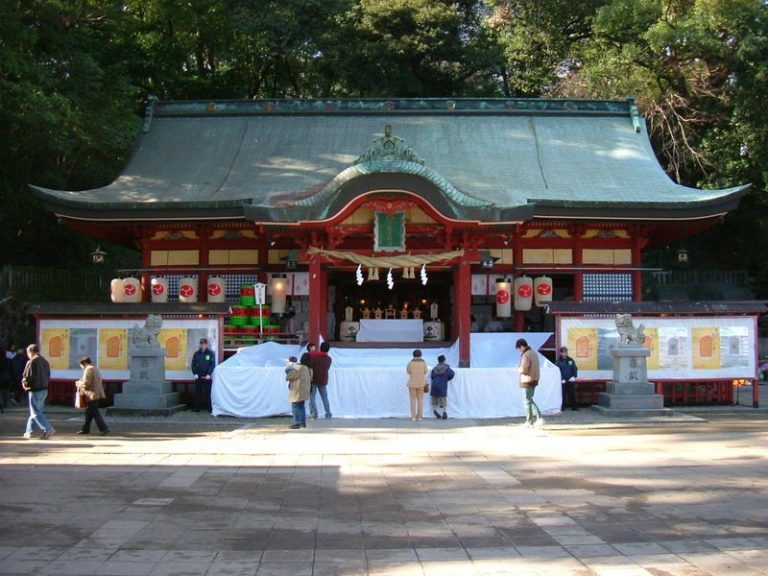
The Daimyo Palace district extends around Kitsuki Shrine, the former Kitsuki Junior High School, and the former Kitsuki City Library at the foot of Daizan Hill. Its surviving remains include a moat, stone walls, and a garden. Together, these features represent the lower administrative and residential area that continued the castle’s functions after the main enclosure on Daizan was demolished.
Related surviving structures
An old Funagata residence survives in the former Jonai-Johana district and is used as a private house. In the castle park, a monument commemorates the founders of Hosei University. It carries reliefs of Kanamaru Tetsu and Ito Osamu, both from Kitsuki Domain and both involved in establishing the Tokyo Law Society, the predecessor of Hosei University.