Katsunuma Clan Residence Ruins: A Sengoku-Period Fortified Residence in Japan


Site at a Glance
- Rating
- 3.9
- Popularity
- Very Low
- Country
- Japan
- Primary era
- Medieval
- Eras represented
- Medieval, Early Modern
- Civilizations
- Takeda
- Site type
- Military
- Remains
- Castle
On this page8 sections
History
Origins and Strategic Role
The Katsunuma clan residence ruins in Japan are the remains of a fortified residence built during the Sengoku period, an era of political fragmentation and warfare conventionally dated to the fifteenth and sixteenth centuries. The site stood in the former Katsunuma area of present-day Kōshū, Yamanashi, on the eastern edge of the Kōfu Basin. It belonged to the Katsunuma clan, a cadet branch, or junior line, of the Takeda warrior house that ruled Kai Province.
The clan was founded by Katsunuma Nobutomo, the brother of Takeda Nobutora, and served as Takeda kin-retainers. The family was entrusted with governing eastern Kai while watching the neighboring territory controlled by the Oyamada clan. The residence stood beside the old Kōshū Kaidō, a highway linking Kai with the Kantō region, including Musashi and Sagami. This position allowed the occupants to observe movement across eastern Kai and helped connect the residence with wider regional routes.
Destruction and Archaeological Recognition
The Katsunuma clan was annihilated in 1560 by Takeda Shingen during Shingen’s struggle to take control of Kai from his father, Takeda Nobutora. The event brought the clan’s independent history to an end and forms the central destructive phase associated with the residence.
The ruins came to light in 1973, when the site was examined as a possible location for a prefectural wine promotion center. The inner enclosure was subsequently preserved in full, and seven excavation investigations carried out through 1977 clarified most of the compound’s layout. Excavation also revealed surrounding streets and urban divisions, providing evidence for the settlement pattern around the residence. Local place-names including Kaga-yashiki and Oku-yashiki continued in the vicinity.
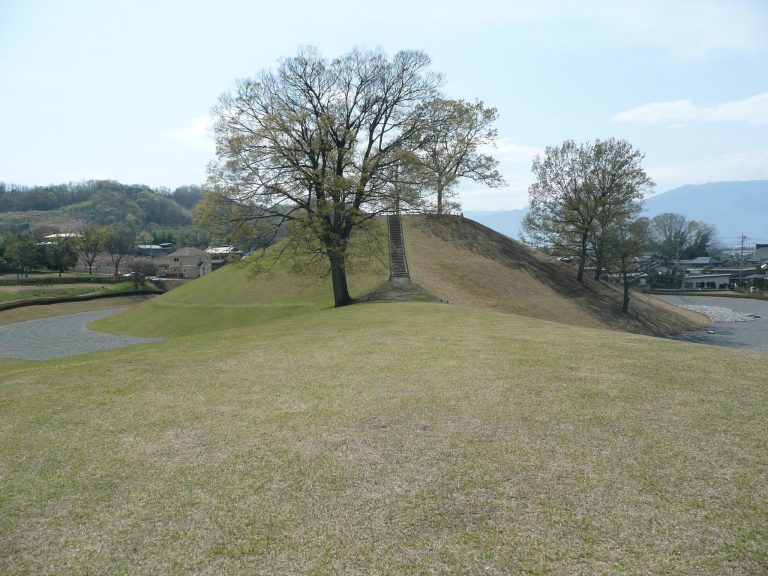
The site was designated a National Historic Site of Japan on 28 May 1981. This status identifies a nationally protected archaeological or historical place of cultural importance. The residence is now maintained as a public park. Finds from the compound show that meat was consumed in a medieval warrior residence and that marine products reached landlocked Kai during the fifteenth century.
A 2009 examination of pottery from a small smithing facility found gold particles and heavy elements adhering to the vessels. Comparisons with material from the Kurokawa and Nakayama gold mines showed relatively little lead and especially high bismuth, a pattern shared with Kurokawa. Gold ore from the nearby Kurokawa mine may therefore have been refined and worked at the residence. Across the Higawa River, the Fukuji site produced twenty Sengoku-period gold pieces, including hirumogane and goishigane, along with many buried coins, placing the residence within a wider landscape of metalworking and exchange.
Remains
Enclosures and Defensive Works
The residence occupies a steep river-terrace edge on the right bank of the Higawa River, at an elevation of 418 meters. A river terrace is a relatively level surface formed above a river’s present channel, while its steep edge can provide both elevation and a defensible boundary. The compound followed a flatland fortified-residence plan made up of linked enclosures. The main enclosure measured about 90 meters from east to west and 60 meters from north to south.
An inner moat survives along the northern and eastern sides of the main enclosure. At the point where a dog’s humerus was found in its lowest layer, the moat measured approximately 5 meters wide and 1.6 meters deep. The gate used the earthworks to form a U-shaped arrangement. Two phases, earlier and later, were identified, and foundation stones indicate that the entrance supported a superstructure.
Buildings, Workshops, and Water Management
Twenty-three buildings with stone foundations have been identified within the compound. Their remains are accompanied by an open area in a part of the site where building remains were not found, as well as garden stones that indicate garden-related features.
The residence also contained a small smithing facility and a reservoir. Another workshop was a floor-level building with a small metalworking installation, a surrounding ditch, and a water basin. Pits inside the workshop were filled with burnt soil. A waterway edged with stones measured approximately 30 or 45 centimeters across and joined a water basin interpreted as a well. Pottery from the smithing facility carried gold particles and heavy elements on its surface, indicating possible gold refining or processing. The precise function of the separate smithing installation in the outer enclosure remains uncertain.
Ceramics, Domestic Objects, and Ritual Equipment
The excavated pottery includes soot-marked Haji vessels, an unglazed earthenware made in ancient and medieval Japan and interpreted here as lantern or lamp vessels. Other ceramics include Seto-Mino ash-glazed plates, Tenmoku bowls with a dark glaze, and Chinese celadon, white porcelain, and blue-and-white porcelain.
Household objects include lacquered bowls decorated with double-tortoiseshell and bird-and-flower designs. Some bowls are thin and small and may have been intended for women. A small folding tray used as a dining stand was made of cypress with cherry side boards fastened to it. It had no legs, and each piece measured about 30 centimeters. Square-section chopsticks tapered toward both ends, while other recovered implements included a grating board, rice paddle, and toothpicks.
Additional finds include iron gunshot, sword fittings, a metal hammer, tweezers, a tea-grinding mill, agricultural tools, and an inkstone. Religious equipment included plates associated with six-vessel ritual stands, linking the residence’s material remains to both household and ceremonial activities.
Animal and Marine Remains
Animal remains dating to the fifteenth century include deer, wild boar, dog, and horse, together with fish and birds. Deer bones predominate. The surviving skeletal pattern points to one young animal, while cut marks on vertebrae and ribs indicate that carcasses were butchered for meat. Chicken remains were also recovered.
Fish remains include small fish from the horse-mackerel family, sea bream, frigate tuna, and kawakawa. Tuna-family remains were also found and are regarded as later intrusions. These marine species provide physical evidence for the movement of sea products into medieval Kai, far from the coast.