Sefa-utaki: A Sacred Ryukyuan Religious Site in Japan


Site at a Glance
- Rating
- 4.3
- Popularity
- Medium
- Country
- Japan
- Primary era
- Early Modern
- External website
- Open
- Eras represented
- Medieval, Early Modern
- Civilizations
- Ryukyu Kingdom
- Site type
- Religious
- Remains
- Sanctuary
On this page14 sections
History
Sefa-utaki is a sacred place of the Ryukyuan religion in Japan, situated on the Chinen Peninsula of Okinawa. Traditionally regarded as sacred from the earliest period of Ryukyuan history, it became one of the kingdom’s principal centers for worship, royal ancestor veneration, ceremonies, pilgrimage, and rituals dedicated to the highest deity of the Ryukyuan religion.
Origins and sacred tradition
Ryukyuan foundation mythology associates Sefa-utaki with Amamiku, the creator deity who descended from a celestial palace to form the islands and later returned to heaven to obtain seeds of the five cereals. Amamiku is traditionally linked with Chinen and Kudaka Island. Sefa-utaki is regarded either as the place where she first landed on Okinawa or as the sacred site she created after leaving Kudaka.
The site was used for religious rites during the fifteenth and sixteenth centuries. Under King Shō Shin of the Second Shō Dynasty, whose reign was associated with the consolidation of royal institutions, Sefa-utaki developed into a major royal sacred center. Pilgrimage to it formed part of the Agariumai, a royal circuit connecting sacred places associated with the religious traditions of the Ryūkyū Kingdom.
Royal administration and restricted access
During the Ryūkyū Kingdom, an utaki, meaning a sacred place often centered on natural features rather than a conventional temple, was reserved at Sefa-utaki for the nobility and clergy. Men were generally prohibited from entering utaki, while commoners could not pass beyond the Ujoguchi entrance. Even the king had to alter his sleeves or wear clothing conforming to women’s dress before entering farther into the sanctuary.
The site was administered by the Kikoe-ōgimi, the highest priestess of the Ryūkyū Kingdom and the chief religious authority for state rituals. Priestesses purified themselves at Urookaa before continuing to the other sacred areas.
Transformation and protection
During Japan’s assimilation of Okinawa, Sefa-utaki was shifted into service as a Shinto shrine. It is now open to the public, although the interior of Sangui and the associated worship point directed toward Kudaka Island remain closed.
Sefa-utaki became part of the UNESCO World Heritage property Gusuku Sites and Related Properties of the Kingdom of Ryukyu in 2000 and was designated a National Historic Site of Japan in 2018. Its protected area covers 55 hectares. The woodland survived the severe destruction that affected many Okinawan cultural properties during the fighting and bombardment of the Second World War, and it continues to preserve rare orchids and ferns.
Remains
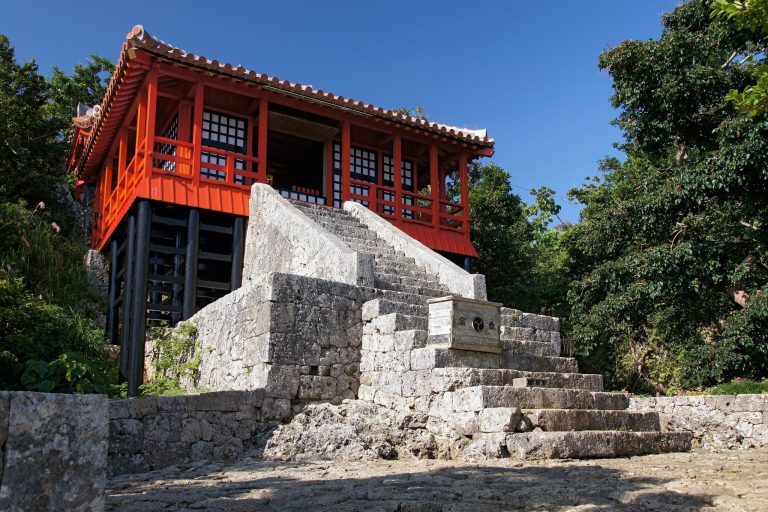
Sefa-utaki is a naturally formed sacred landscape on a wooded high promontory above the sea. Large rock formations, caves, and overhanging ledges open toward the east and south. Paved paths connect several worship areas, while traces of the former inner and outer precincts remain visible within the natural setting. The buildings once associated with the sanctuary have been destroyed, leaving the rocks, caves, springs, paths, and named sacred places as the principal physical elements of the site.
Purification and ceremonial areas
Urookaa
Urookaa lies to the right of the entrance and contains a spring used for ritual purification. Water dripping from a stalactite was regarded as sacred and reserved for ceremonies. Priestesses purified themselves here before proceeding to the other sacred areas.
Ujoguchi
Ujoguchi is the entrance to the sacred complex. During the Ryūkyū Kingdom, it marked the point beyond which commoners could not proceed, reflecting the restricted ceremonial access that shaped the use of Sefa-utaki.
Ufugui
Ufugui is a large open area where ceremonies were performed. Its sacred name corresponds to the name of a facility at Shuri Castle, the royal palace and political center of the Ryūkyū Kingdom.
Yuinchi
Yuinchi was associated with preparing the king’s meal and pronouncing divinations. It was also regarded as the dwelling place of the fire deity. The name refers to a place of abundant harvests and fishing catches and was also used for a kitchen at Shuri Castle.
Sangui and the view toward Kudaka
Sangui
Sangui, the innermost and most prestigious sacred space, is formed by two enormous rocks whose arrangement creates a triangular cleft or passage beneath them. The sea and Kudaka Island can be seen from this position. Sangui was originally an open area enclosed by rock walls on three sides, but part of its rock wall collapsed during the early modern period, changing the form of the space.
Kudaka Island
Kudaka Island lies opposite Sefa-utaki, about 5 kilometres from the Chinen Peninsula, and is visible from Sangui. The island has a circumference of approximately 7.75 kilometres and was a major sacred destination associated with the origins of the Ryūkyū Kingdom. Before ceremonies, sand regarded as sacred was carried from Kudaka and scattered at Sefa-utaki.
Excavated materials
Excavations at Sefa-utaki recovered Chinese Longquan celadon, gold, jade and glass magatama beads, and ancient coins. Magatama are curved, comma-shaped beads that served as ornaments and ritual objects in the cultures of the Japanese archipelago and the Ryukyu Islands. These finds are collectively designated as Important Cultural Properties under the title “Okinawa Prefecture Sefa Utaki Excavated Artifacts.”
Nearby sites