Sanbutsu-ji Temple: A Mountain Shugendo Sanctuary in Japan


Site at a Glance
- Rating
- 4.4
- Popularity
- Low
- Country
- Japan
- Primary era
- Medieval
- External website
- Open
- Eras represented
- Medieval, Early Modern
- Civilizations
- Ashikaga shogunate, Kamakura shogunate, Tokugawa
- Site type
- Religious
- Remains
- Sanctuary
On this page16 sections
History
Sanbutsu-ji Temple is a Buddhist temple of the Tendai school in Japan, located on Mount Mitoku in Misasa, Tottori Prefecture. Tradition places its beginning in 706, when the Buddhist ascetic En no Gyōja established a Shugendo practice ground and enshrined three mountain deities. Shugendo is a Japanese tradition of mountain asceticism that combines Buddhist practice with older local religious beliefs. In earlier periods, the whole mountain was regarded as the temple precinct, making Sanbutsu-ji a religious institution closely associated with demanding mountain practice.
Traditional foundation and early development
En no Gyōja, also known as En no Ozunu, is traditionally regarded as the founder of Shugendo and is associated with religious activity in the mountains of early Japan. A gilt-bronze Buddha from the Asuka period has been cited as evidence of an early foundation at Sanbutsu-ji, although the image has since left the temple.
Tradition further states that Jikaku Daishi Ennin installed images of Shaka Nyorai, Amida Nyorai, and Dainichi Nyorai in 849 and gave the institution the name Jodo-in Mitoku-san Sanbutsu-ji. Shaka Nyorai is the historical Buddha, Amida Nyorai is the Buddha of the Pure Land tradition, and Dainichi Nyorai is the cosmic Buddha central to esoteric Buddhism. Tendai, the school to which Sanbutsu-ji belongs, developed a broad religious practice combining study, meditation, ritual, and devotion to Buddhas and local sacred beings.
The temple’s history is difficult to trace until the late Heian period, a period of Japanese history extending from the late eighth to the late twelfth century. A document found inside the principal Zao Gongen image at Nageire-do bears the date 1168. The building’s architectural form and tree-ring analysis place its construction in the late Heian period, around the beginning of the twelfth century. By then, Mount Mitoku appears to have become an established mountain sanctuary for Shugendo practice.
Medieval references and early modern patronage
Medieval records generally called the mountain Mitoku, while the institutional name Sanbutsu-ji began appearing in written sources around the middle of the Edo period. The earliest surviving documentary reference to the mountain occurs in the 1184 diary Gyokuyo, which mentions a person claiming to be a child of retired Emperor Go-Shirakawa.
The temple acquired land through donations during the early modern period. In 1599, 100 koku of land in the nearby village of Sakamoto was given to Sanbutsu-ji. In 1633, Ikeda Mitsunaka, lord of the Tottori domain, donated another 100 koku. These temple lands remained in its possession until the end of the Edo period.
Sanbutsu-ji continued to receive support from the lords of the Tottori domain. Ikeda Naritoshi rebuilt the main hall in 1839, adding a late-Edo-period building to the temple’s long sequence of religious structures.
Modern recognition and continuing ritual
Sanbutsu-ji was designated a national Historic Site and Place of Scenic Beauty in 1934. In 2015, it became one of the first 18 sites recognized under Japan Heritage through the theme “The Land of Purification of the Six Roots and Healing of the Six Senses: Japan’s Most Dangerous National Treasure and World-Class Radon Springs.”
The temple’s New Year’s Eve bell ritual reflects the continuing religious use of the mountain precinct. Temple personnel and local volunteers climb to the upper area at night and strike the bell 108 times. Ordinary participation was generally prohibited because winter snow and the nighttime ascent made the climb dangerous. In 2013, a limited event for experienced adults formed part of observances for the traditional 1,300th anniversary of the foundation.
Remains
The temple precinct extends across Mount Mitoku and is divided in practice between a lower area reached by ordinary stone steps and paths and an upper area approached by the single steep route known as the Gyōja path. The upper precinct occupies rugged terrain where falling accidents have occurred. Buildings and religious images are distributed along this route, which leads toward Nageire-do, the inner sanctuary set within a nearly vertical cliff. The varied construction dates, materials, and positions of the surviving structures reflect the temple’s development from the late Heian period through the Edo period.
Lower precinct
Main hall
The main hall is a late-Edo-period building rebuilt in 1839. Its principal image is a secret standing Amida Nyorai dating from the late Heian period. The sculpture is approximately 147.5 centimeters high and was carved from a single block of wood. Its interior is hollowed, and its eyes are carved rather than separately inserted. Shallow, gentle carving, a large head, rounded face, narrow eyes, and a slightly raised mouth give the image a distinctive expression. Long storage in a highly humid shrine left it unable to stand independently until restoration in 2002.
Temple lodges and bridge
The lower precinct also contains the guest lodges Kaijo-in, Shozen-in, and Rinkō-in, together with the Shikuiri Bridge and the treasure hall. The treasure hall displays the principal Zao Gongen image that was formerly enshrined at Nageire-do, linking the lower buildings with the mountain sanctuary above.
Structures along the mountain route
Monju-do and Jizo-do
Monju-do and Jizo-do stand in the mountain along the route to Nageire-do. Both are late-Muromachi-period buildings, dating from the period of Japanese history that preceded the Momoyama and Edo periods. Their irimoya roofs, a hipped form with gabled ends, are covered with thin wooden shingles. Monju-do is slightly larger than Jizo-do. It was once attributed to the Momoyama period, but an ink inscription found inside the building gives the date 1567 and indicates an earlier construction.
Bell tower and surrounding buildings
The bell tower stands between Jizo-do and the sutra repository and Kannon Hall. It retains timbers from the Kamakura period. The sutra repository is a late-Heian-period structure that reuses a small Kasuga-style shrine originally associated with a guardian deity. Kannon Hall and Moto-yui-kake-do date from the early Edo period, while Fudo-do dates from the late Edo period.
Nogiwa Inari shrine
The upper precinct includes a stone image of En no Gyōja and the Nogiwa Inari shrine, also known as the Eleven-Headed Kannon Hall. The shrine is a mid-Edo-period structure and forms part of the group of protected buildings positioned within the mountain precinct.
Nageire-do and its images
Cliff sanctuary
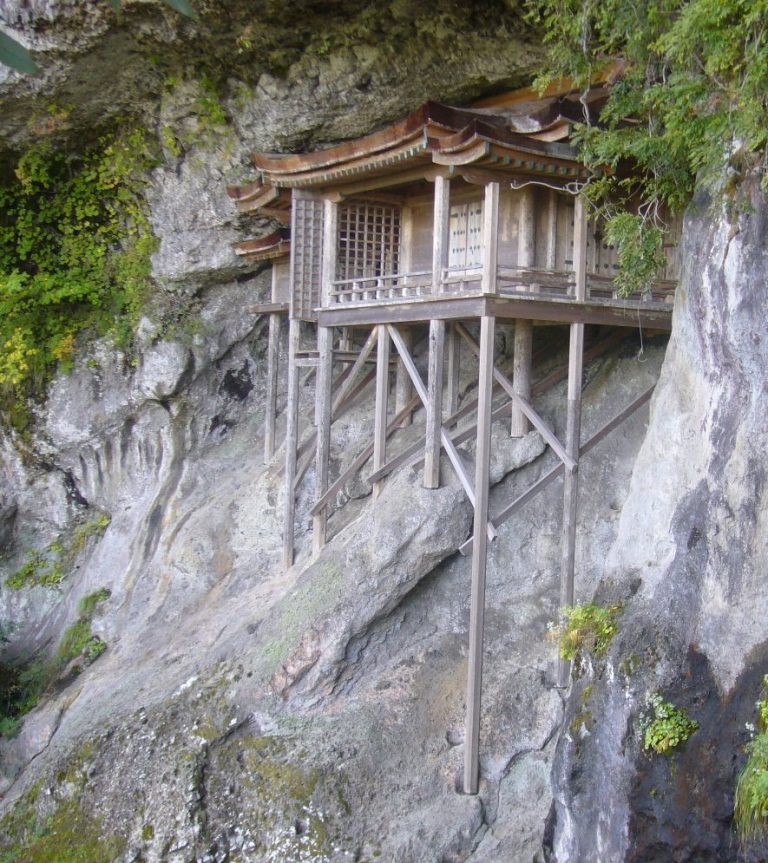
Nageire-do stands about 470 meters above sea level in a recess of an almost vertical cliff. Tall projecting timbers support the building through the kakezukuri technique, which anchors a structure to a steep slope or cliff where a level foundation is unsuitable. Nageire-do is an exceptionally unusual example of a building inserted into a cliff face. Its architectural form and tree-ring evidence place its construction in the late Heian period, around the beginning of the twelfth century.
Nageire-do, Aizen-do, an associated ridgepole tablet, and 43 old timbers together form a National Treasure designation. Aizen-do belongs to the protected group in the upper precinct, while Monju-do, Jizo-do, the sutra repository, Kannon Hall, Moto-yui-kake-do, Fudo-do, the Nogiwa Inari shrine, and the bell tower also have cultural-property or prefectural protection.
Zao Gongen principal image
The principal Zao Gongen image from Nageire-do is a wooden standing statue with one leg raised high and flame-like hair rising from its head. Zao Gongen is a powerful mountain deity of Shugendo, represented through a combination of Buddhist and local religious traditions. The statue’s posture follows the established form of Zao Gongen imagery, while its restrained angry expression and calm late-Heian sculptural style give it a distinctive character.
An internal document bears the date 1168 and attributes the image to the sculptor Kokei. Tree-ring analysis identified wood felled in 1165. Seven wooden standing Zao Gongen images served as attendants beside the principal statue. Their forms and styles vary, and each is more simply executed than the central image. Six were designated together as cultural property in 1920. A seventh, formerly installed as a front image, was added in 2017 after tree-ring analysis dated its wood to 1002.
Eleven-Headed Kannon image
A wooden Eleven-Headed Kannon image from the late Heian period was formerly housed in Kannon Hall. Although its eleven heads are no longer present, the original conception of the figure remains identifiable. Its formal designation describes it as a standing Sacred Kannon image.