Ōdate Castle: A Medieval Mountain Castle in Fukushima, Japan


Site at a Glance
- Rating
- 3.6
- Popularity
- Very Low
- Country
- Japan
- Primary era
- Medieval
- Eras represented
- Medieval
- Civilizations
- Ashikaga shogunate
- Site type
- Military
- Remains
- Castle
On this page7 sections
History
Ōdate Castle was a medieval Japanese mountain castle in Iwaki, Fukushima, Japan, associated with the Iwaki clan and traditionally founded in the late fourteenth or early fifteenth century. Its precise founder and construction date are uncertain, although tradition attributes its creation to Shirato Takahiro, also known as Iwaki Tsunetomo, a member of a collateral branch of the Iwaki clan. The Iwaki were a warrior house that controlled territory in southern coastal Mutsu, broadly corresponding to eastern Fukushima.
Foundation and Iwaki Residence
The name Ōdate appears in a document dated November 28, 1447, confirming that the place-name was in use by that time. The commonly cited date of 1483 may instead relate to an enlargement or to the transfer of the Iwaki clan’s principal residence to the site. The change may have occurred during the tenure of Iwaki Takatada, after he suppressed the Kakitsu internal conflict, when his grandson Iwaki Tsunetaka moved from Shirato in 1483, or during the tenure of Tsunetaka’s father, Iwaki Chikataka. The exact moment when Ōdate became the residence and base of the Iwaki clan’s leaders remains uncertain.
From the early sixteenth century, after the name Taira emerged in the surrounding area, Ōdate was probably also known as Taira Castle or Taira Ōdate. The name Iino-daira Castle became common from around the late 1980s, partly to distinguish the medieval site from the Edo-period Iwaki-daira Castle. In medieval usage, however, Taira and Iino were separate place-names. Iino-daira Castle could also refer to a wider medieval castle complex that included Ōdate, Takatsuki Castle, and Iino Hachiman Shrine.
Transfer of Power and Abandonment
After the Battle of Sekigahara, the Iwaki clan was dispossessed and its lands were confiscated. Torii Tadamasa entered the domain in 1602 with an income of 100,000 koku, a historical measure of domain income conventionally based on the rice needed to support one person for a year, and became the castle’s new lord.
On the orders of the Tokugawa shogunate, Japan’s military government, Torii Tadamasa built Iwaki-daira Castle east of Ōdate over twelve years. Once the new castle was completed, he moved his residence there. Ōdate Castle was then abandoned, with its abandonment dated to 1603. The place-name is also said to have produced the name Ōdate clan, identified either with a family within the Mutsu-Ishikawa lineage or with a family within the Iwaki clan.
The ruins were designated a historic site by Iwaki City on May 1, 2017.
Remains
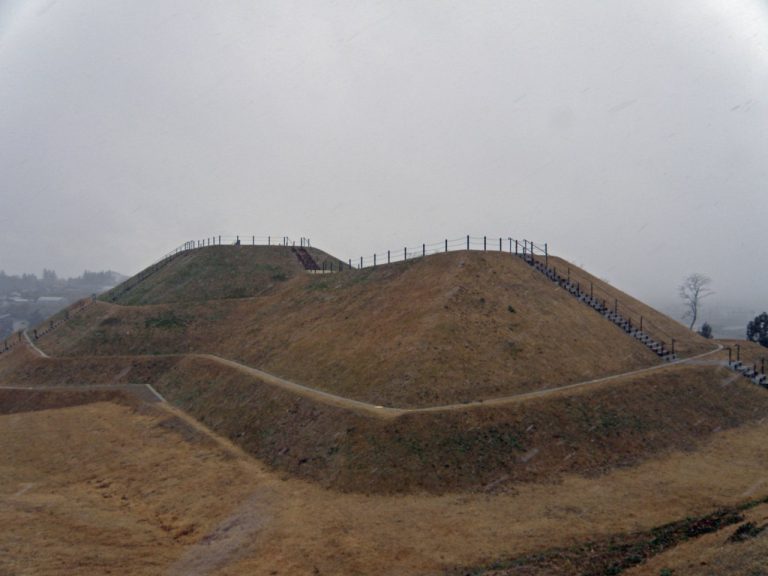
Ōdate survives as an archaeological mountain-castle site rather than as a group of standing castle buildings. Its remains occupy a wider area across parts of present-day Uchigō-Midai-sakai, Yoshima-Shimo-yoshima, and Taira. The surviving defensive landscape includes enclosed areas, earthen banks, ditches cut across ridges, wells, and traces of buildings.
Enclosures and Defensive Works
Principal Enclosure
The principal enclosure stood on a mountain within the castle area. Its remains are associated with an entrance approached through a cut passage, while the site is connected with Yudonosan Shrine. The enclosure earthworks form part of the surviving evidence for the castle’s organization on the mountain.
Wider Castle Area
The broader castle zone extended across several present-day districts and contained multiple kuruwa, enclosed and usually fortified sections of a Japanese castle. Earthen ramparts formed defensive banks, while cross-ridge ditches were cut across the ridge or slope to hinder movement. Wells and building traces add evidence of activity within the fortified area. In the broader medieval complex associated with the name Iino-daira, the castle zone also incorporated Takatsuki Castle and Iino Hachiman Shrine.