Buddhas of Bamiyan: Monumental Buddhist Reliefs in Afghanistan
Site at a Glance
- Popularity
- Very Low
- Country
- Afghanistan
- Primary era
- Medieval
- Eras represented
- Classical, Medieval
- Civilizations
- Kushan
- Site type
- Religious
- Remains
- Sanctuary
On this page14 sections
History
The Buddhas of Bamiyan are monumental Buddhist reliefs in Afghanistan’s Bamiyan Valley, carved during the sixth and early seventh centuries in a major Buddhist center shaped by the Silk Road. The Eastern Buddha was made around 544–595 CE and the Western Buddha around 591–644 CE. They were probably created under Hephthalite rule, although their association with the Kushans has also been proposed because of the region’s earlier Buddhist traditions.
Bamiyan as a Buddhist Center
Bamiyan had been a Buddhist religious center since at least the second century CE, initially under the Kushans, a dynasty that supported Buddhist institutions, trade, and artistic production across much of Central and South Asia. Its position on the Silk Road, a network of routes linking China, Central Asia, South Asia, the Iranian world, and the Mediterranean, connected its monasteries and artists with varied cultural traditions.
The Chinese Buddhist pilgrim Faxian visited Bamiyan around 400 CE. He described a royal Buddhist assembly attended by more than 1,000 monks and mentioned a relic identified as a tooth of the Buddha. On 30 April 630, the monk and scholar Xuanzang visited the valley and found more than ten monasteries and over 1,000 monks. He described the standing Buddhas as decorated with gold and jewels and also recorded a larger reclining Buddha.
The Korean monk Hyecho visited in 727 and described Bamiyan as an independent and powerful Buddhist kingdom, despite the presence of Arab armies north and south of the valley. He also mentioned three important Buddhist relics kept in a monastery southeast of Bamiyan. Annual celebrations drew pilgrims and offerings to the Buddhas, which became prominent cultural landmarks in the region.
Religious and Political Change
Buddhist activity continued after Islam reached the region. Bamiyan remained Buddhist until the Abbasid conquest around 770 CE, experienced a Buddhist revival from about 870 to 977, and then came under Turkic Ghaznavid rule in 977. Murals beside the figures show that Buddhist artistic activity continued into the period of the final Islamic conquest.
The Buddhas survived Genghis Khan’s campaign of 1221, although the assault devastated Bamiyan and killed or displaced much of its population. Later damage was attributed to artillery used under the Mughal emperor Aurangzeb in the seventeenth century, artillery associated with Nader Shah Afshar in the eighteenth century, and actions during the Hazara revolt under Afghan ruler Abdur Rahman Khan in the nineteenth century. The Afghan civil wars of the 1990s caused further damage.
Destruction in 2001
Taliban forces captured the Bamiyan Valley in 1998. Abdul Wahed, the local Taliban commander, drilled holes into the figures to prepare explosives, but Mullah Muhammad Omar and the local administration stopped that operation at the time. The smaller Buddha’s head was nevertheless damaged with dynamite. Rockets were fired at the larger figure, and burning tires damaged its head.
In 1999, Omar temporarily ordered the statues preserved and discussed their possible value for international tourism. Early in 2000, local Taliban authorities sought United Nations assistance with drainage around the niches. On 26 February 2001, however, Omar ordered the destruction of all human images and statues in Afghanistan. Taliban representatives justified the policy through religious rulings against figures being worshipped or respected, and also presented it as a response to the contrast between proposed restoration funding and Afghanistan’s humanitarian needs.
The destruction began on 2 March 2001 and continued for several weeks. Anti-aircraft guns and artillery were followed by anti-tank mines, explosives inserted into holes drilled into the cliff, and rockets. By mid-March, both Buddhas had been destroyed, leaving their niches and fragments. International condemnation came from UNESCO, the Organisation of the Islamic Conference, Pakistan, Saudi Arabia, the United Arab Emirates, India, Japan, Sri Lanka, China, and other governments and organizations. Appeals proposed preservation, relocation, concealment, or restoration, but the Taliban rejected them.
International Protection and Conservation
In 2003, UNESCO, the United Nations Educational, Scientific and Cultural Organization, inscribed the Buddhas and the surrounding Cultural Landscape and Archaeological Remains of the Bamyan Valley as a World Heritage Site under criteria i, ii, iii, iv, and vi. The property covers 105 hectares and has a 225.25-hectare buffer zone. It has remained on the List of World Heritage in Danger since 2003.
International recovery and stabilization work began after 2002. Fragments were documented, sorted, sheltered, and stored, while engineers and conservators assessed the stability of the cliff and niches. In 2009, ICOMOS erected scaffolding in the Western niche for conservation and stabilization. A 2013 attempt to rebuild the smaller Buddha’s foot with iron rods, bricks, and concrete was halted on UNESCO’s orders because it lacked approval and did not follow the policy of using original material.
A UNESCO expert meeting in Paris in 2011 recommended safeguarding the site, studying reconstruction of the Eastern Buddha, and leaving the larger Western niche empty as a monument to the destruction. Proposals for partial anastylosis, a conservation method that reassembles original fragments with limited modern support, have continued, with estimates that about half of the original pieces might be reassembled. UNESCO, ICOMOS, international research institutions, and local stone carvers have taken part in conservation and training. Preservation work was interrupted after the Taliban returned to power in 2021, and UNESCO restoration work resumed in February 2023 after new Italian government funding was approved.
On 7 June 2015, a three-dimensional light projection representing the larger Buddha was displayed in the Western niche. The projector was later donated to Afghanistan’s culture ministry.
Remains
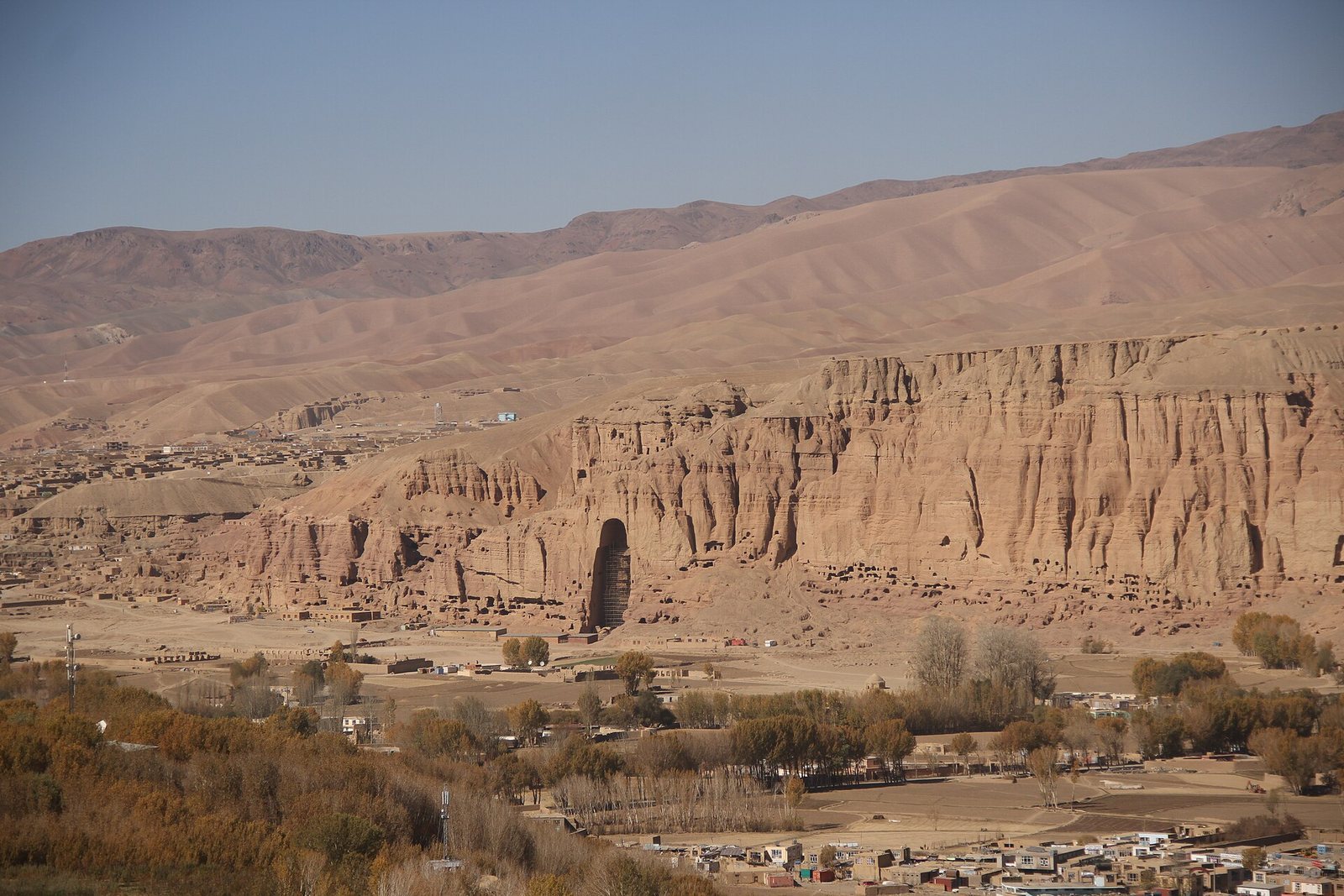
The site consists of two enormous standing reliefs cut into a near-vertical sandstone cliff at about 2,500 metres above sea level, approximately 130 kilometres northwest of Kabul. The figures were carved into the rock with their backs still attached to the cliff, rather than being made as freestanding statues. Each stood within a large niche connected to stairways, galleries, caves, and passages cut through the surrounding rock.
Monumental Niches
Eastern Buddha
The Eastern Buddha measured about 38 metres high, while its niche reached approximately 38 metres. Its body was hewn from sandstone, and details were modeled in mud mixed with straw, covered with stucco, and reinforced in places by wooden armatures. The lower arms used the same mud-and-straw material over wooden supports. The painted surface used several colours, although much of the coating had disappeared before 2001. The figure was traditionally called Shah Mama, or “Queen Mother,” and was often interpreted as female, though that identification remains uncertain.
Western Buddha
The Western Buddha measured about 55 metres high and occupied a niche approximately 58 metres tall. It was constructed with the same combination of carved sandstone, mud mixed with straw, stucco, and wooden supports. Its surface was painted carmine red. The figure was popularly called Salsal, a name associated with the meaning “the light shines through the universe,” and was traditionally interpreted as male. The niche and the recognizable outline of the figure survive, together with fragments of stone, clay, plaster, and other structural materials.
Caves and Painted Chambers
Cliff Caves and Passages
Monks’ caves and connecting passages surround the niches and remain accessible within the site. The wider cliff complex contains more than 900 caves, including rectangular, square, and hexagonal rooms. Some ceilings have small domes or lantern-like forms associated with Macedonian artistic traditions, supported in places by carved stone beams. Many of these features are heavily damaged. The destruction of the Buddhas revealed 50 additional caves, and wall paintings were identified in 12 of them.
Eastern Murals
The surviving murals associated with the Eastern Buddha are concentrated particularly on the ceiling above the figure’s head. Their principal composition shows a solar deity riding a golden, two-wheeled chariot drawn by four horses, with winged attendants and flying wind deities. Kings, dignitaries, Buddhas, and Bodhisattvas, Buddhist figures who seek enlightenment while delaying final liberation to assist others, appear in rows beside the central image.
The solar deity wears a Tokharistan-style caftan and boots, carries a lance, and has been related to Mithra as revered in Sogdian tradition. An adjacent figure is probably the King of Bamyan, shown with a crenellated crown, crescent, korymbos, a rounded topknot or hair ornament, tunic, and Sasanian-style headband. Other figures wear belted jackets with folded lapels and distinctive crowns. Their appearance has been compared with Hephthalite representations from Tokharistan and with figures at Balalyk Tepe.
Western Murals
Murals around the Western Buddha included celestial beings, Bodhisattvas, and male devotees, some wearing double-lapel caftans. The paintings in the caves and niches date broadly from the fifth to the ninth centuries CE, with the main period of activity extending from the sixth to the eighth centuries. They combine Buddhist and Gupta traditions with influences associated with Sasanian, Byzantine, Tokharistan, and wider Silk Road art.
The paintings included Buddhist figures, royal donors, celestial beings, palm leaves, mythical creatures, and people in Central Asian dress. Their pigments included vermilion, a red mercury sulfide, and lead white, a lead carbonate. Analyses also identified natural resins, gums, probable animal-skin glue or egg binders, and drying oils probably derived from walnuts or poppies. Because drying oils lay beneath paint layers rather than only on the surface, some Bamiyan murals have been interpreted as among the earliest known surviving oil paintings, possibly predating European examples by as much as six centuries.
Fragments and Archaeological Evidence
Fragments from the destroyed reliefs include pieces of stone, clay, plaster, and other structural material. They have been documented, sorted, sheltered, and stored for possible partial reconstruction. The niches retain recognizable outlines and some features of the monumental figures, while the surrounding site preserves smaller Buddhist sculptures, monastic caves, painted chambers, and passages associated with the reliefs.