Shortugai: A Harappan Trading Colony in Afghanistan
Site at a Glance
- Rating
- 4.3
- Popularity
- Very Low
- Country
- Afghanistan
- Primary era
- Bronze Age
- Eras represented
- Bronze Age
- Civilizations
- Indus Valley
- Site type
- City
On this page6 sections
History
Shortugai is an Indus Valley, or Harappan, trading colony in Afghanistan, established around 2000 BC during the Bronze Age near the Oxus River and Afghanistan’s lapis lazuli mines. It is regarded as the northernmost settlement of the Indus Valley Civilisation, an urban Bronze Age society centered in the Indus River basin and extending into neighboring regions. Its position and material culture connected the settlement to long-distance exchange across Central Asia.
A Northern Harappan Trading Settlement
Shortugai became a major trading center during the Indus Valley period. Lapis lazuli formed an important part of its commercial connections, while tin, camels, and other Afghan commodities may also have passed through the settlement. Metalworking and other crafts supported this activity. Artisans worked copper, lead, and gold, and practiced stone-cutting.
Agriculture complemented trade and craft production. Residents cultivated lentils, sesame, grapes, wheat, and rye, while zebu cattle and buffalo were kept at the settlement. The irrigation system has received more than one interpretation. One view holds that Indus settlers introduced the technology, while another relates it to the Namazga culture, a prehistoric archaeological culture associated particularly with southern Turkmenistan.
Discovery and Archaeological Interpretation
Shortugai was discovered in 1976 and investigated by a French expedition between 1977 and 1979. Square seals carrying animal motifs and script, together with Harappan pottery, brick measurements, and other cultural features, identify the settlement as part of the Indus Valley tradition rather than simply a place that exchanged goods with it. The excavations also revealed the breadth of its economic life, including farming, craft production, and trade.
Remains
Settlement Layout and Water Management
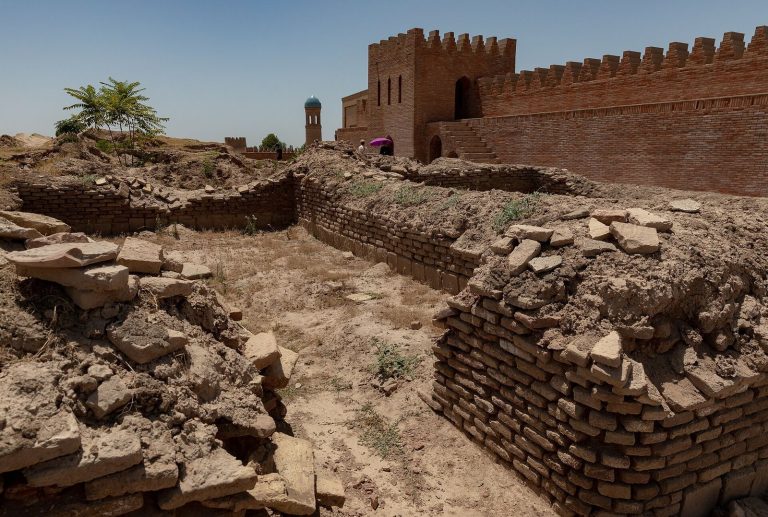
The archaeological site covers about 4 hectares and is divided into Site A and Site B, each measuring approximately 2 hectares and containing several mounds. One area held the ancient town, while the other contained its citadel, a fortified or elevated part of a settlement distinct from the main town. Remains of irrigation canals survive at Shortugai, including channels interpreted as bringing water from the Kokcha River, about 25 kilometers away. A ploughed field containing flax seeds provides evidence of dryland farming alongside canal irrigation.
Crafts, Objects, and Harappan Construction
Excavated material includes lapis lazuli and carnelian beads, other beads, bronze objects, gold pieces, bronze ornaments, terracotta figurines, and shell bangles. A seal bears a short inscription and a rhinoceros motif, while other square seals carry animal designs and script. Clay representations show cattle with carts or harnesses. Painted pottery in Harappan designs, along with jars, beakers, and other clay vessels, reflects the settlement’s cultural connections. Drill heads occur among the craft materials, and the practice of stone-cutting is further indicated by the surviving evidence. The bricks have measurements characteristic of Harappan construction and match those used at Harappa.