Vatican Obelisk: An Ancient Egyptian Monument in St. Peter’s Square
Site at a Glance
- Rating
- 4.8
- Popularity
- High
- Country
- Vatican City
- Primary era
- Classical
- External website
- Open
- Eras represented
- Bronze Age, Classical, Early Modern, Modern
- Civilizations
- Egyptian, Papal States, Roman
- Site type
- Civic
- Remains
- Obelisk
On this page15 sections
History
The Vatican obelisk is an ancient Egyptian monument in Vatican City, generally thought to have been produced during Egypt’s New Kingdom, approximately 1550 to 1070 BC. Its precise date and original attribution remain uncertain. The monument was carved from red granite at Aswan, and its early history is difficult to reconstruct because it bears no Egyptian hieroglyphs or pharaonic dedication.
Egyptian and Alexandrian origins
The obelisk has sometimes been attributed to Amenemhat II, a ruler of Egypt’s earlier Middle Kingdom, or associated with Heliopolis. Another tradition places it in Alexandria before its Roman installation. These differing proposals reflect the uncertainty surrounding a monument that may have been moved or completed outside Egypt.
After Egypt became subject to Rome around 30 BC, the obelisk was completed and erected in Alexandria’s Forum Iulium, a public complex completed under Augustus and dedicated to Gaius Julius Caesar. Gaius Cornelius Gallus, the first Roman prefect of Egypt under Augustus, ordered or supervised its installation at the centre of the forum. There it expressed Rome’s victory over Egypt. Its central position and a bronze sphere and spike at its summit suggest that it probably served as a gnomon, a vertical object whose shadow indicates the sun’s position. The monument was later rededicated under Tiberius, who ruled Rome after Augustus.
From Alexandria to the Roman circus
In AD 37, during the reign of Caligula, the obelisk was transported from Alexandria to Rome for the Circus of Caligula, later called the Circus of Nero. It was erected around AD 38 at the centre of the circus’s spina, the long barrier around which chariot races took place. The circus stood south of the present St. Peter’s Basilica, and parts of it were later incorporated beneath the Constantinian and present basilicas.
Pliny described a specially built ship that carried the obelisk, its base, and its summit. Approximately 1,000 tonnes of lentils served as ballast. Under Claudius, the ship was sunk at Ostia and used as the foundation for a mole and a structure connected with the harbour lighthouse. Archaeological excavations have identified remains associated with the ship and mole near Fiumicino Airport.
The obelisk continued to stand through fires and earthquakes that brought down many other Roman obelisks. It remained beside the Constantinian and later Old St. Peter’s Basilica, while a necropolis developed around it and rising ground gradually buried part of the monument. A longstanding tradition associated its position with the approximate site of the martyrdom of the Apostle Peter. The obelisk consequently became part of Rome’s pilgrimage circuit and acquired names including the “needle of Rome” and the “needle of Saint Peter.”
The Old Basilica and the sixteenth-century relocation
The Old St. Peter’s Basilica was begun north of the obelisk in AD 324. Its demolition began in 1506 to make way for the present basilica, but the monument remained in its ancient position until the sixteenth century. Medieval legends claimed that its bronze globe contained the ashes of Julius Caesar or Trajan. When the globe was opened, no such remains were found.
Popes Nicholas V and Gregory XIII considered moving the obelisk. Other proposals involved placing it on the shoulders of four colossal statues or crowning it with a statue of Christ. Michelangelo declined involvement in one proposal, while another was abandoned as impractical. Pope Sixtus V ultimately ordered the monument’s transfer from its position south of the basilica to the area before the principal facade.
Approximately 500 mathematicians, architects, engineers, and monks from Italy and Greece entered the competition for the work. Domenico Fontana was selected after presenting a detailed plan and a model of his machinery. He received the commission on 5 October 1585 and later described the operation in his 1590 work Della trasportatione dell’obelisco Vaticano e delle fabriche di Sisto V. Preparations lasted about thirteen months. The route measured roughly 260 metres and crossed a difference in elevation of approximately 8 metres.
The obelisk was detached from its ancient base on 30 April 1586, moved to the new site over the following weeks, and raised on 10 September. About 900 men, 150 horses, and 47 winches took part. This was the first modern movement of one of Rome’s ancient obelisks. The traditional cry “Acqua alle funi,” or “Water to the ropes,” is attributed to the sailor Benedetto Bresca, who supposedly warned that the ropes were loosening. Wetting them caused the ropes to contract and regain tension, although the episode is partly legendary.
Sixtus V inaugurated and blessed the obelisk on 26 September 1586. Its Christian crowning and inscriptions presented the triumph of Christianity over paganism. The pope later commissioned Fontana to raise three other ancient obelisks in Rome. The ancient bronze globe was removed during the transfer and passed through several locations before entering the Palazzo dei Conservatori in 1848. A restoration in 1740 found no relic in the bronze cross, despite the belief that a fragment of the True Cross, traditionally associated with the crucifixion of Jesus, had been placed there in 1589.
The obelisk in St. Peter’s Square
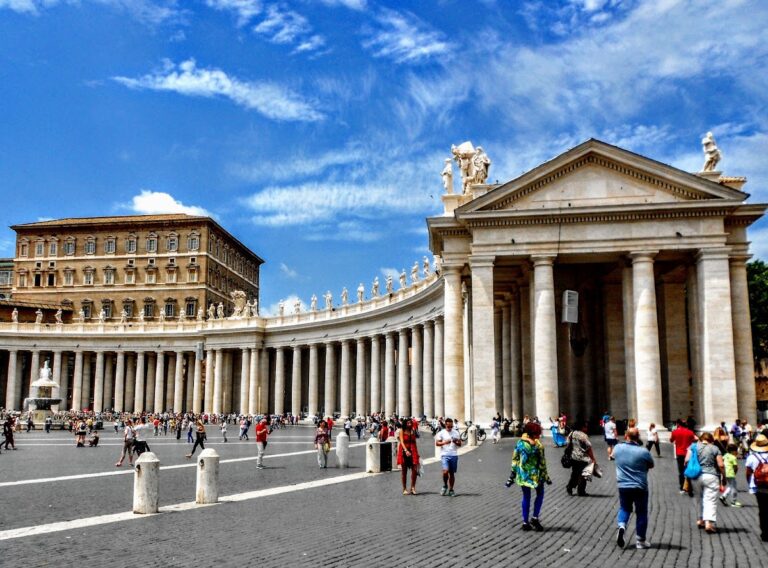
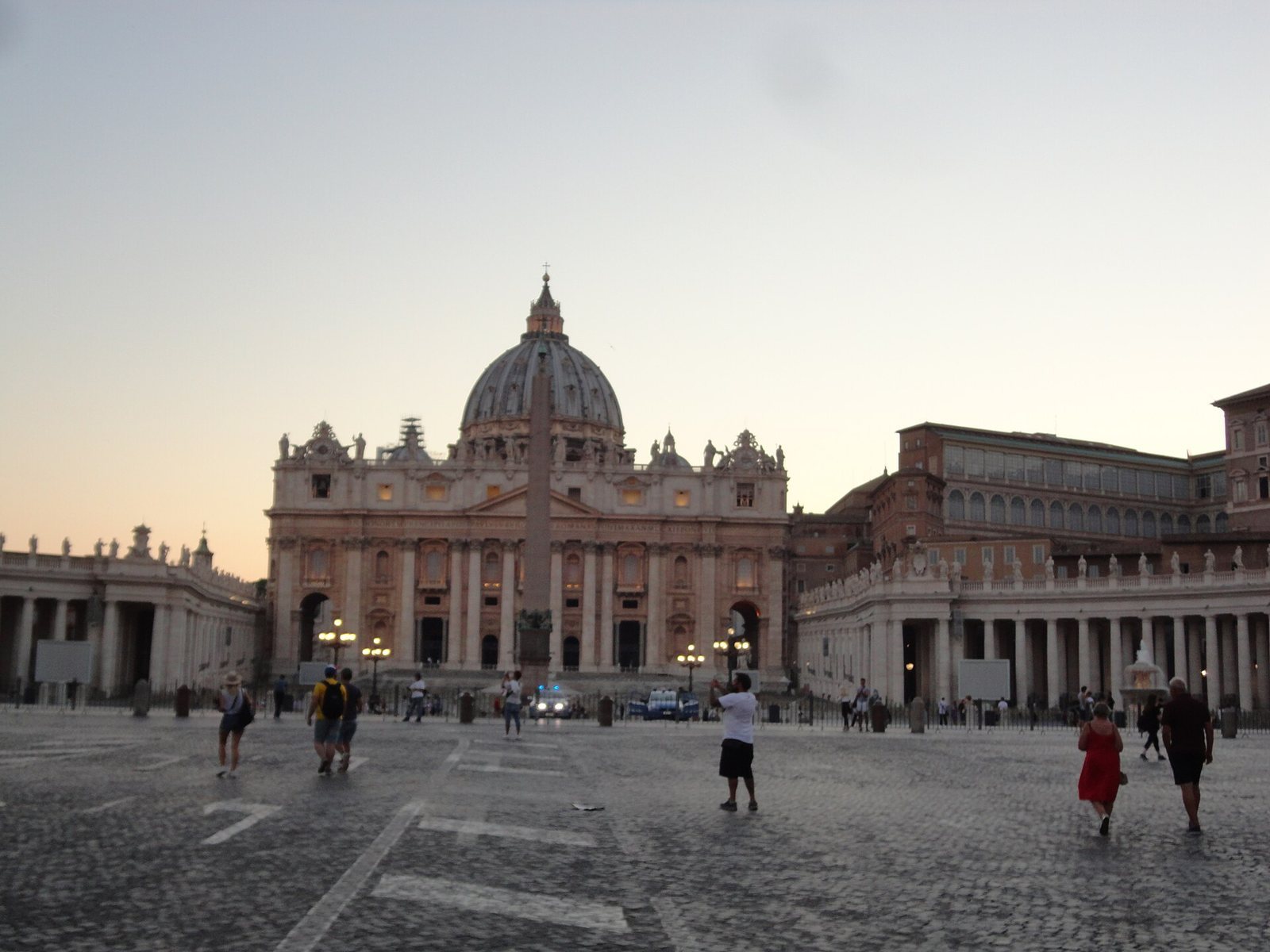
Gian Lorenzo Bernini redesigned St. Peter’s Square from the seventeenth century around the already relocated monument. In 1713, Pope Innocent XIII added bronze crowned eagles and floral decoration to the four sides of its base. In 1817, the astronomer Filippo Gigli designed a wind rose and sundial at the foot of the obelisk. Restoration of the square began in 2009 and included the monument and the surrounding cast-iron lamps dating from 1852. The obelisk has not been moved again since 1586.
Remains
Monumental form and inscriptions
Granite shaft
The Vatican obelisk is a single block of red or syenitic granite quarried at Aswan. Its shaft rises 25.31 metres, while the monument with its base measures approximately 33.31 metres and approaches 40 metres when the cross and base are included. It weighs about 320 to 322 tonnes, making it the second-tallest obelisk in Rome after the Lateran obelisk. It originally stood as a single monument rather than as one of the paired obelisks customary in ancient Egypt.
The shaft carries no surviving Egyptian hieroglyphs or pharaonic titles. It remains uncertain whether inscriptions were erased before the Roman period or whether the monument was never inscribed in Egypt. Two ancient Roman dedications to Augustus and Tiberius occupied its faces. The dedication to Augustus was ordered by Gallus between 30 and 27 BC, but its bronze letters gradually fell away after Gallus became a public enemy. A later dedication was carved in Alexandria after Augustus’s death, during Tiberius’s reign.
Pedestal and summit
The Roman letters were cast in bronze and attached to the stone with soldered dowels rather than carved directly into the shaft. Their arrangement has been reconstructed from surviving dowel holes. Former letter areas and holes remain visible in places, although some surfaces were smoothed and are no longer legible. Four further inscriptions were added to the pedestal after the 1586 relocation. They proclaim that Christ conquers, reigns, and commands, and ask Christ to protect his people from all evil. Fontana placed his own signature beneath the papal dedication.
A bronze cross and papal emblems crown the monument. The emblems consist of a mountain, a star, and a cross, interpreted respectively as references to the mountains of Israel, Mary, and Christ, as well as symbols of papal greatness, power, and splendour. The pedestal is separately estimated to weigh approximately 174 tonnes. The ancient Roman base was left behind when the shaft was transferred to the square.
Ancient and present settings
Roman location
In Alexandria, the obelisk stood at the centre of the Forum Iulium. In Rome, it occupied the centre of the Circus of Caligula’s spina, south of the present basilica. Excavations near the present sacristy have revealed remains of its ancient substructure. The former location is marked by a marble plaque set into the ground between the present basilica and the Teutonic Cemetery.
St. Peter’s Square
The present monument stands at the centre of St. Peter’s Square, where Bernini’s later design developed around it. Its position is approximately 3.8 to 4 metres north of the basilica’s longitudinal axis, although the reason for this offset is unknown. The alignment of the obelisk, the basilica facade, and the dome was later regarded as geometrically significant, even though the monument appears displaced to the right when viewed from the square.
Sixteenth-century transport machinery
The wooden framework
Fontana’s operation used a large wooden framework known as a castello. It had eight posts joined by four beams, with 48 braces secured by iron bolts and clamps. Ropes anchored the structure to the ground, while five additional upper beams supported the pulley system. Reed mats and iron rods with bent ends beneath the monolith protected and stabilized the obelisk during the work.
Movement and raising
Forty capstans, matching pulleys and ropes, and five levers made from beams approximately 13 metres long formed the lifting system. The combined weight of the obelisk and transport materials reached about 348 tonnes. The monument was first lifted clear of its ancient base, lowered onto rollers, and carried across an embankment built to compensate for the change in elevation. The same framework was adapted for the final raising at the new site. That stage lasted from sunrise to sunset and required 52 capstan movements.