Quay with Sphinxes: An Egyptian Monument on Saint Petersburg’s Neva Embankment



Site at a Glance
- Rating
- 4.8
- Popularity
- High
- Country
- Russia
- Primary era
- Bronze Age
- Eras represented
- Bronze Age, Modern
- Civilizations
- Egyptian, Russian
- Site type
- Civic
- Remains
- Statue
On this page14 sections
History
The Quay with Sphinxes is a nineteenth-century river landing in Saint Petersburg, Russia, designed in a Classical style with Egyptianizing features to display two Egyptian sculptures created in the fourteenth century BCE during the reign of Amenhotep III. The sphinxes originally belonged to the pharaoh’s mortuary temple at ancient Thebes, a royal temple intended to maintain a deceased or deified ruler’s cult and memorial rites. Their later installation beside the Neva made them one of Saint Petersburg’s established urban symbols.
Creation at Thebes
The sphinxes were made for Amenhotep III’s mortuary temple on the west bank of the Nile, probably for its peristyle court, a courtyard surrounded by a colonnade. The temple ruins now form part of the archaeological zone of Kom el-Hettan. Amenhotep III was a pharaoh of Egypt’s Eighteenth Dynasty, which ruled during the New Kingdom. The statues preserve his royal identity through their forms and inscriptions, linking the sculptures to the religious and political setting of his reign.
Their attached ritual beards were broken away in antiquity, shortly after Amenhotep III’s death. The sphinxes are regarded as exceptionally accomplished portraits of the pharaoh and may have been made by the same sculptor as a colossal pink-granite head found at Kom el-Hettan in 1957 and now held in the Luxor Museum.
Discovery and European acquisition
The sphinxes were discovered in 1825 near the Colossi of Memnon by Yannis Athanasi, a Greek adventurer and seeker of antiquities excavating for the British consul Henry Salt. Jean-François Champollion examined them during his expedition and praised their preservation and artistic quality in letters written in 1829. He identified the faces as portraits of Amenhotep III.
The discovery took place during the nineteenth-century European and Russian fascination with ancient Egypt known as Egyptomania. In Russia, interest in Egyptian history and imagery was also expressed through the Egyptian Bridge, the Egyptian Gates at Tsarskoye Selo, and an Egyptian museum at the Kunstkamera. Champollion wished to purchase the sphinxes but could not obtain enough money. The sale was delayed, one statue was sent to Alexandria to hasten the transaction, and the sculptures were then sold to France. The July Revolution of 1830 disrupted that sale.
Andrei Muravyov saw one of the sphinxes in Alexandria in 1830 while travelling to holy places after the Russo-Turkish War of 1828–1829. He proposed that Russia acquire them through the ambassador Alexander Ribopierre. Ribopierre passed the proposal to Vice-Chancellor Count Karl Nesselrode, who brought it to Emperor Nicholas I. The emperor referred the matter to the Academy of Arts, whose president, Alexei Olenin, supported the purchase. Russia paid 64,000 rubles for the sculptures, followed by a further 18,000 or 28,000 rubles for their transport to Saint Petersburg.
Arrival and installation
The sphinxes travelled aboard the Buena Speranza. During loading, one statue fell and its headcloth was damaged. The crowns were separate elements rather than parts of the stone monoliths, so they were transported separately. The sculptures reached Saint Petersburg in May 1832.
A granite embankment on Vasilyevsky Island, west of the floating St Isaac’s Bridge, had been planned in 1830. Konstantin Thon designed the quay opposite the Academy of Arts in 1831, initially intending it for Peter Clodt’s sculptures of horse tamers. Their projected cost of 425,000 rubles led to a revision of the design after the sphinxes were acquired. The proportions of the descent to the water were altered to receive the Egyptian statues. Construction began shortly before their arrival and continued for several years. The sphinxes spent their first two years in the Academy of Arts courtyard before being installed beside the Neva in April 1834, when their crowns were probably reassembled. The quay was completed that year.
Auguste de Montferrand proposed placing a colossal statue of Osiris between the sphinxes and offered to make it himself. Osiris was an Egyptian god associated especially with the afterlife, regeneration, and kingship. The proposal was not accepted because the quay’s design had already been approved by imperial decree on 16 December 1831.
Public response and later study
The sculptures initially provoked public dislike, but the quay soon became a favoured urban gathering place and generated new city legends. It also became an established subject for painters, including Maxim Vorobyov, who produced two views of the quay in 1835.
Vasily Struve’s 1912 booklet, The Petersburg Sphinxes, was the first detailed study devoted to the sculptures and their history. Struve translated the inscriptions except those on the sides facing the Neva. Later studies by Yuri Perepyolkin, Evgeny Cherezov, Alexander Vassoevich, and Viktor Solkin examined the remaining texts. The inscriptions preserve the complete fivefold titulary and epithets of Amenhotep III.
Conservation
Concern about the sphinxes’ exposure to climatic fluctuations, pollution, and the damp atmosphere of the Neva embankment began soon after their installation. A proposal to move them to the Hermitage was not adopted. In 2002–2003, Saint Petersburg restoration specialists carried out the first comprehensive scientific restoration and conservation project in the monuments’ history. The work cleaned the sculptures, identified biological and chemical pollutants, and addressed processes that threatened the granite in Russia’s climate. Stanislav and Sergei Shchigorets and Albina Doos directed the project, with an expert commission that included professors from Saint Petersburg State University and supervision by Egyptologist Viktor Solkin. The quay and sphinxes are designated a cultural heritage object of federal significance in Russia.
Remains
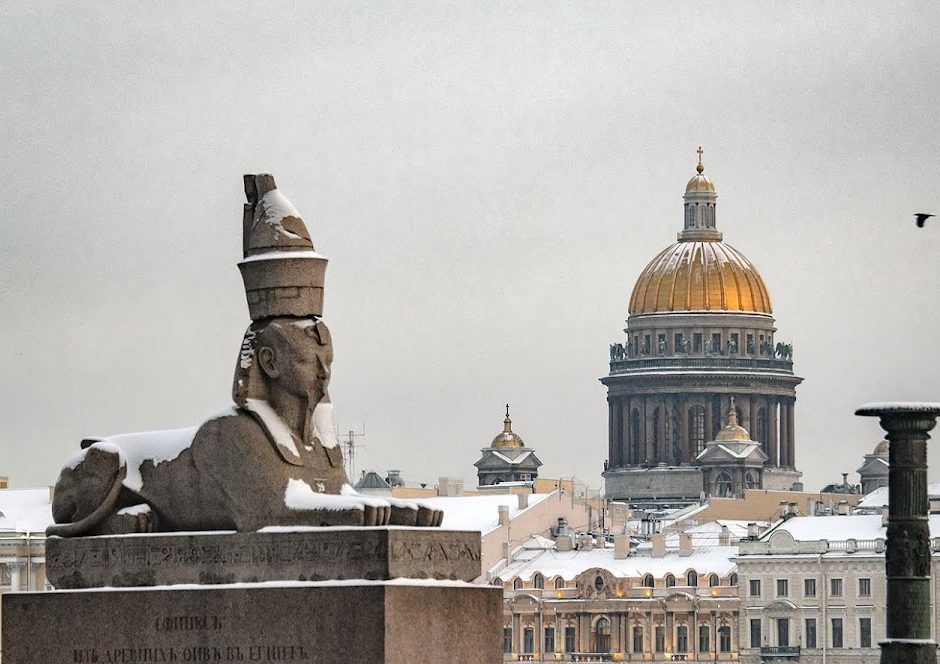
The Quay with Sphinxes is a 42-metre-long granite landing partly recessed into the embankment. Fourteen steps descend to the water, with an intermediate landing six steps below the level of the embankment. The Classical design incorporates Egyptianizing details in granite and bronze, organizing the staircase, benches, lamps, and sphinx pedestals into a single riverfront composition.
Quay structures
Landing and benches
Two semicircular benches line the edges of the intermediate landing. Their ends carry bronze figures of winged lions, or griffins, adding a sculptural element to the landing while framing the descent.
Lamps and descent
Bronze lamp columns with papyrus-like forms flank the beginning of the staircase. Their shapes provide an Egyptianizing visual element within the granite embankment and connect the design of the quay with the imagery of the imported sculptures.
The sphinxes
Eastern sphinx
The eastern sculpture stands on a massive granite pedestal at one side of the staircase. It is carved from pink Aswan granite and represents a human-headed, lion-bodied sphinx weighing approximately 23 tonnes. The figure is 5.24 metres long and 4.50 metres high. Its youthful face is softly modelled, with almond-shaped eyes, carefully rendered eyes and lips, and a restrained smile. The lion body is flexible and graceful, with the heavy tail curled around the right thigh.
The eastern sphinx is relatively well preserved and particularly carefully finished. It has chips on the right side of the headcloth, most of its beard is lost, and part of the rear body and tail has disappeared. The uraeus, the rearing cobra emblem worn on a king’s forehead, has also been lost. Its crown is heavily damaged: the tall portion of the red crown is formed from several pieces, while the front of the white crown is damaged. The front of the pedestal has suffered chips, and a fragment about 60 centimetres long is missing from its rear, although part of the inscription can be reconstructed by comparison.
Western sphinx
The western sphinx has the same human-headed, lion-bodied form and approximate dimensions as its counterpart, but it is made from lower-quality granite and is less well preserved. It may also have been produced earlier. Corrections to sculptural errors remain visible on this statue, while its face is less finely finished. Dark granite particles at the pupils create the impression of a directed gaze.
The western figure has small chips on the right side of its headcloth, a lost beard and uraeus head, and minor damage to the red crown. The front of its pedestal is badly damaged, especially on the right, where weaker granite components deteriorated more severely. Surviving traces of hieroglyphs allow the damaged front inscription to be restored.
Royal imagery and inscriptions
Both sphinxes wear royal headcloths, uraei, and the double crown called the pschent, which symbolized sovereignty over Upper and Lower Egypt. Their broad beaded collars are wesekh collars, and a pleated-cloth covering is represented across the shoulder blades, back, chest, shoulders, and forearms. The ritual beards were attached toward the ears by carved strips.
Hieroglyphic texts appear on the chests, between the forelegs, and around the edges of the pedestals. They preserve much of Amenhotep III’s titulary, including his royal names and epithets, associations with Ra and Amun-Ra, rule over the Two Lands, and claims concerning lawgiving, the pacification of the Two Lands, military victories, exceptional works, offerings, and eternal life. The Academy-facing sides of the pedestals carry the inscription, “Sphinxes from ancient Thebes in Egypt, transported to the city of Saint Peter in 1832.”
The eastern pedestal inscriptions measure 5.85 metres on the embankment side and 5.40 metres on the Neva side. The western texts measure 6.47 metres on the bank side and 6.45 metres on the river side. Drawings made during excavation and transport preserve further evidence about the sculptures’ original setting and movement. Joseph Bonomi the Younger depicted one sphinx being excavated beside fallen peristyle columns, while Nestor L’Hôte recorded another being taken to Alexandria on a platform pulled by several dozen people.