White Tower: An Outer Defensive Tower of Brașov, Romania


Site at a Glance
- Rating
- 4.6
- Popularity
- Medium
- Country
- Romania
- Primary era
- Medieval
- Eras represented
- Medieval, Modern
- Civilizations
- Hungarian
- Site type
- Military
- Remains
- Tower
On this page12 sections
History
The White Tower is an outer defensive fortification of Brașov, Romania, built in the second half of the fifteenth century to strengthen the city’s defenses. It was constructed in the medieval period by the people of Brașov, with dates given as 1460 in some contemporary chronicles and 1494 in the city’s wall chronicle. The tower served as an observation post and a defensive position above the northern edge of the historic center.
Fifteenth-century defenses
The White Tower formed part of Brașov’s external fortifications and worked with the Black Tower on the same side of the citadel. Together, they controlled the approaches from Warthe Hill and helped prevent attackers from reaching the city walls or rolling rocks down the slope toward them. The tower was separated from the wall by the Graft watercourse, creating an independent outer position rather than a structure incorporated directly into the main circuit.
Members of the tinsmiths’ and coppersmiths’ guilds built and guarded the tower. Two men were assigned to watch it even in peacetime. In 1678, too few tinsmith craftsmen remained to carry out this obligation, so the guild bought back its duty.
The Graft connection and siege support
In the early sixteenth century, the Graft Bastion was built below the White Tower. A drawbridge, a movable bridge that could be raised to restrict access, connected the bastion to the tower across the rock in front of it. Two lines of palisades, defensive barriers made from stakes or posts, completed the connection. This arrangement allowed ammunition and food to reach the tower and enabled defenders to be replaced during a siege.
The open slope around the tower was deliberately kept free of trees until the end of the nineteenth century. The clear ground gave guards in the White Tower and Black Tower a wider field of view over the approaches to the city.
Fire, restoration, and later use
On 21 April 1689, the White Tower was damaged by the great fire that nearly destroyed the citadel. The fire followed an attack on Brașov by Habsburg forces. The tower was restored in 1723, and further repairs and restorations followed in 1902 and in 1972 to 1974.
From 1888 to 1960, the Royal Promenade created by Oskar Alesius ran past the tower and offered views across the valley. It was removed when the road to Poiana Brașov was constructed. The tower later became a section of the Brașov County History Museum, which organized exhibitions there until 2015. It was then closed because operating the site was not considered profitable.
Extensive conservation work carried out between 2002 and 2006 addressed damaged masonry and architectural elements while preserving surviving original plaster. The White Tower remains part of Brașov’s external fortifications and is protected as a historic monument under the Romanian monument register code BV-II-m-A-11294.05.
Remains
Setting and structure
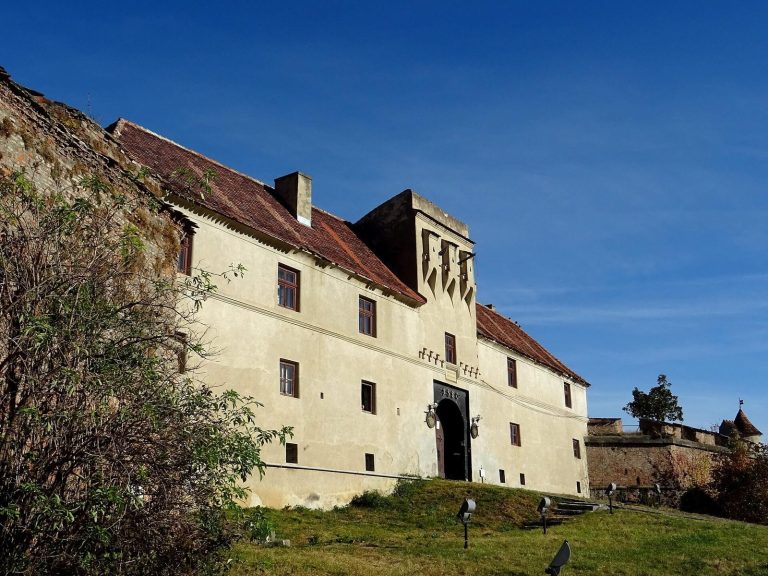
The tower stands on the slope of Dealul Romurilor, also called Straja or Romul, northeast of Brașov’s historic center and above its northern edge. It is approximately 59 to 60 meters from the city walls and about 30 meters above the city level. The White Tower is one of four outer observation and defensive towers built independently of the walls.
Its name comes from the white plaster or paint applied to its exterior. The structure has a closed semicircular, or horseshoe-shaped, plan with a maximum width of 19.2 meters. Its height is approximately 14 to 20 meters, and its limestone walls are four meters thick at the base. Both stone and brick were used in its construction. The southeast side is closed by a straight wall running parallel to the Graft watercourse, while the straight side faces the historic center.
Entrance and internal levels
The entrance is 5.4 meters above ground level and was originally reached only by a movable ladder or staircase. Five levels rise within the tower, linked to its defensive arrangement. Approximately 200 stone steps connect the tower with the historic part of the city.
Courtyard and upper crown
The upper part ends in a crenellated crown. Crenellations are alternating raised sections and openings along the top of a defensive wall. Wooden guard galleries once surrounded the inner courtyard at every level, and the supporting beam sockets remain visible in the masonry. A glass roof now covers the courtyard area as part of the modern restoration.
Defensive features
Loopholes and firearms positions
Numerous loopholes, narrow openings through which defenders could fire weapons, pierce the five levels. The crenellations on the two lower floors are about 70 centimeters high and 40 centimeters wide. Their form was intended for powerful firearms, probably bombards, which were large early guns used to fire heavy projectiles.
Observation posts and balconies
Three stone observation posts project from the structure. They are corbelled, meaning that successive courses of masonry carry them outward from the wall, and each contains openings through which defenders could pour pitch or other liquids. The upper gallery opened onto four enclosed balconies, including three larger balconies facing the hill and a smaller one facing the city. Boiling water or tar could be poured onto attackers from these positions.
Hearth and roof
A stove provided heat for the guards and defenders and could also warm liquids intended for use against attackers. The chimney above the hearth survives. Restoration in the early 2000s completed damaged roof timbers and roof coverings, repaired masonry and crenellations, and exposed the stone surrounds of the doors and windows. The work also included repainting, stairs, and a viewing balcony at the entrance.
An old pine beside the tower was planted during Emperor Franz Joseph I’s visit to Brașov in 1852. Franz Joseph I was the Habsburg emperor of Austria and king of Hungary from 1848 to 1916.