Monastery of St Demetrios Avgou: A Christian Monument in Argolis, Greece


Site at a Glance
- Rating
- 4.9
- Popularity
- Low
- Country
- Greece
- Primary era
- Medieval
- Eras represented
- Medieval, Early Modern
- Civilizations
- Byzantine, Ottoman
- Site type
- Religious
- Remains
- Monastery
On this page4 sections
History
The Monastery of St Demetrios Avgou is a Christian monastery in Greece, in the Argolis region, whose origins extend back to the eleventh century. Regarded as one of the most important Christian monuments in Argolis, it preserves a principal Orthodox monastery church and an adjacent cave connected with the monastic community.
The foundation year and almost the entire subsequent history of the monastery remain unknown. During the regency that governed Greece while Otto, the first king of modern Greece, was a minor, the monastery was dissolved in a state-led suppression of monasteries. Only a very small number of documents from the period after its dissolution survive.
Remains
Principal church
The surviving complex is centered on a dual-dedication katholikon, the principal church of an Orthodox monastery. Rock forms three sides of the building, while the north wall and part of the west side, including the facade, were constructed outside the rock. The church has a three-apsed sanctuary, a dome, and a cross-vault over its main body. Its exceptionally well-executed brick masonry remains a defining feature.
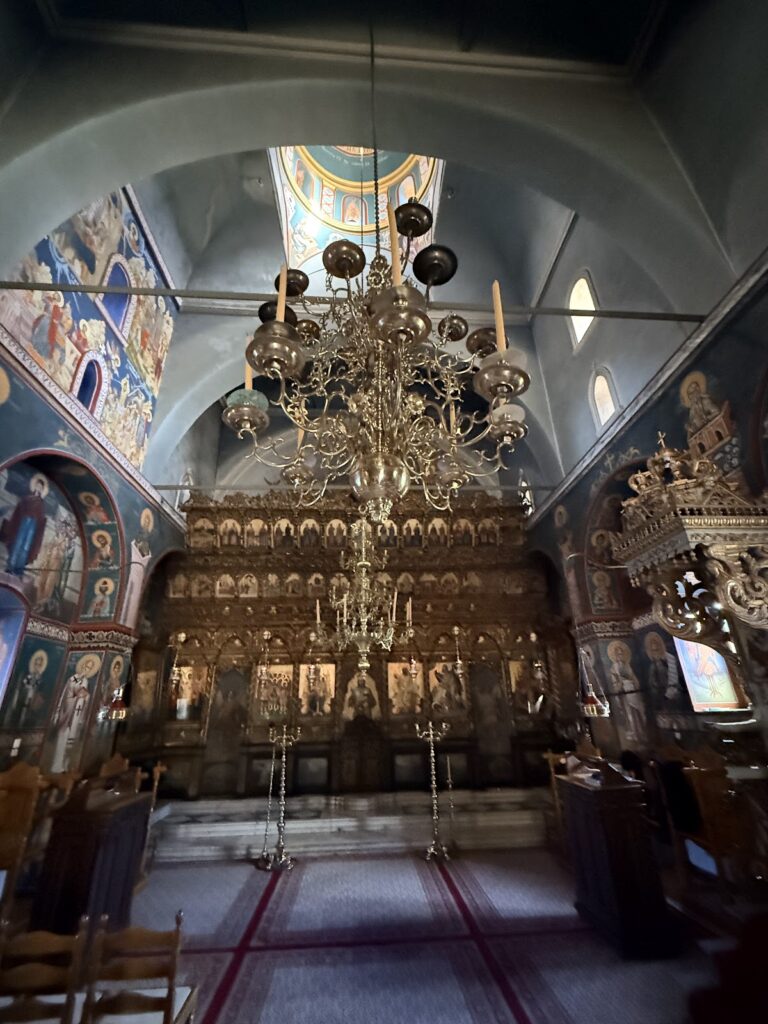
A fire in the nineteenth century destroyed the carved and gilded wooden iconostasis, the screen separating the sanctuary from the main body of an Orthodox church. The fire also caused plaster to fall from the vaults and apses, destroying the frescoes and leaving the masonry exposed.
Adjacent cave
The nearby cave served as an ossuary, a place for storing human bones after burial, and was dedicated to the Transfiguration of the Savior, the Christian feast commemorating the manifestation of Christ’s divine glory. It is one of the two crater-like dolines, roughly circular depressions formed in a limestone landscape, for which the Didyma area of Argolis is known. An eleventh-century fresco shows the Virgin and Child with Saints Anne and Kyriaki, while additional frescoes in the cave date from the seventeenth century.