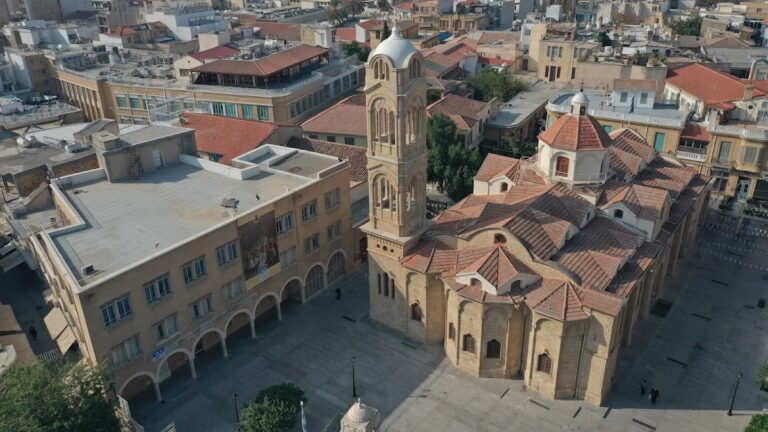
Panagia Chrysaliniotissa Church, Nicosia: An Orthodox Church of Historical Tradition

Site at a Glance
- Rating
- 4.6
- Popularity
- Very Low
- Country
- Cyprus
- Primary era
- Medieval
- Eras represented
- Medieval
- Civilizations
- Kingdom of Cyprus
- Site type
- Religious
- Remains
- Church
On this page7 sections
History
Panagia Chrysaliniotissa Church is an Orthodox church in Cyprus, located within the walled Old City of Nicosia near the Green Line, the ceasefire line dividing the city’s northern and southern sectors. Dated to 1450, it is also regarded as the only surviving church in Nicosia associated with the Middle Byzantine period, conventionally dated here from AD 965 to 1191. The church is dedicated to the Virgin Mary and belongs to the Church of Cyprus.
Foundation and traditions
Tradition attributes the foundation of Panagia Chrysaliniotissa to Queen Elena Paleologina, a Byzantine princess who was the daughter of the Despot of Morea and the wife of John II of Cyprus, a king of the Lusignan dynasty. The Lusignans were the Frankish ruling house of the medieval Kingdom of Cyprus. Elena is also traditionally said to have brought the church’s principal icon from Constantinople.
The church’s name is connected with a tradition that an icon was found in a thicket at the site. Its meaning is interpreted as “Virgin Mary of the Golden Flax.” Panagia Chrysaliniotissa has also been regarded as the first Orthodox church in Nicosia, a distinction rooted in the historical and religious traditions surrounding the building.
Alterations and continuing use
Numerous alterations changed the church over time. These interventions were extensive enough to remove the original structure and form from the surviving building. Panagia Chrysaliniotissa remains an active church, and its religious importance is reflected in the icons and other artefacts associated with it.
Many of the church’s icons are preserved in Nicosia’s Byzantine Museum, a museum devoted to Byzantine art and religious objects. The museum’s collection also includes icons transferred from Faneromeni Church and from Panagia Odigitria Church, which is now known as the Bedesten.
Remains
The surviving church incorporates a building whose original arrangement has been heavily transformed by later work. Its earliest known form was a single-nave, single-domed structure. A single nave is one principal longitudinal worship space, while the building’s cylindrical vault was a continuously curved, barrel-like ceiling. Later interventions altered this arrangement so substantially that the original form can no longer be reconstructed from the present structure alone.
Church structure and devotional objects
Original church form
The original structure consisted of one main worship space covered by a single dome and a cylindrical vault. This combination defined the early architectural arrangement of the church before subsequent alterations changed its fabric and appearance. The building’s present form therefore represents a long process of modification rather than an unchanged survival of the structure dated to 1450.
Icons associated with the church
Panagia Chrysaliniotissa houses the devotional image known as the Panagia Chrysaliniotissa, also called Aliniotissa. An icon is a religious image used in Eastern Christian worship. The church also contains a twin portable icon showing the Virgin Mary looking in two directions. Its paired titles are translated as “Loving or Uniting Virgin” and “Hating or Dividing Virgin,” giving the object a distinctive place among the church’s religious artefacts.
A large group of icons associated with Panagia Chrysaliniotissa is preserved in Nicosia’s Byzantine Museum. Together with the icons kept in the church, these objects form an important part of the site’s surviving religious heritage and preserve connections with the wider Orthodox history of Nicosia.