Khan el-Farangi: A Sixteenth-Century Caravanserai in Acre

Site at a Glance
- Rating
- 4.9
- Popularity
- Very Low
- Country
- Israel
- Primary era
- Early Modern
- Eras represented
- Early Modern
- Civilizations
- Ottoman
- Site type
- Economic
- Remains
- Caravanserai
On this page8 sections
History
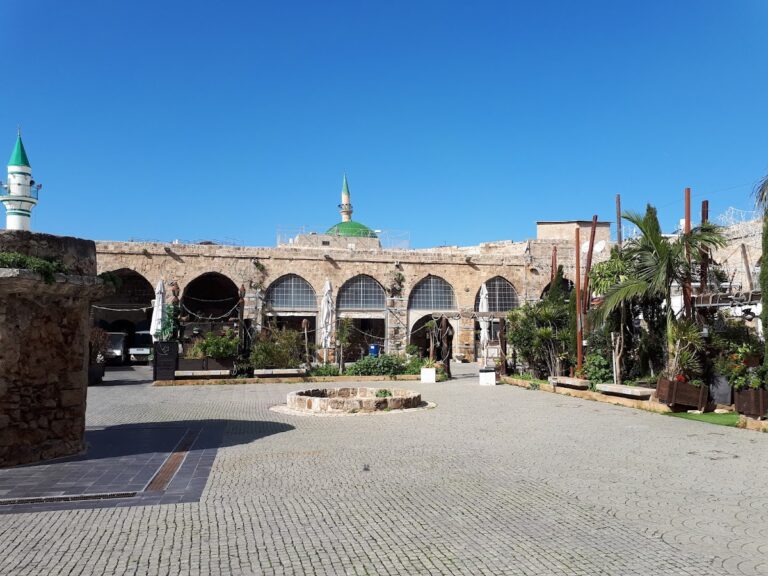
Khan el-Farangi, also known as Khan al-Ifrandj or the “Khan of the French,” is a sixteenth-century Ottoman caravanserai in Acre, Israel. Built in the second half of the sixteenth century in the central market of Acre’s Old City, it occupies the site of the central courtyard of the Venetian merchants’ quarter that existed during the Crusader period, when Acre was a major Latin Christian stronghold and Mediterranean port.
French merchants and the khan
In 1535, Ottoman authorities granted French merchants commercial privileges in several eastern Mediterranean ports, including Acre. French merchants established their residences and commercial headquarters in the khan and came to dominate Acre’s cotton trade. This connection gave the building its name, which it retained even after the French community was expelled.
Franciscan use
During the mid-sixteenth century, Franciscans, a Catholic religious order founded by Francis of Assisi, acquired several rooms in the khan. They first used them as an inn and later as a school. A Franciscan Terra Sancta church, part of the order’s Holy Land institution, was built beside the khan to the north in 1673. The complex is also associated with an eighteenth-century Franciscan monastery.
Governor’s residence and later changes
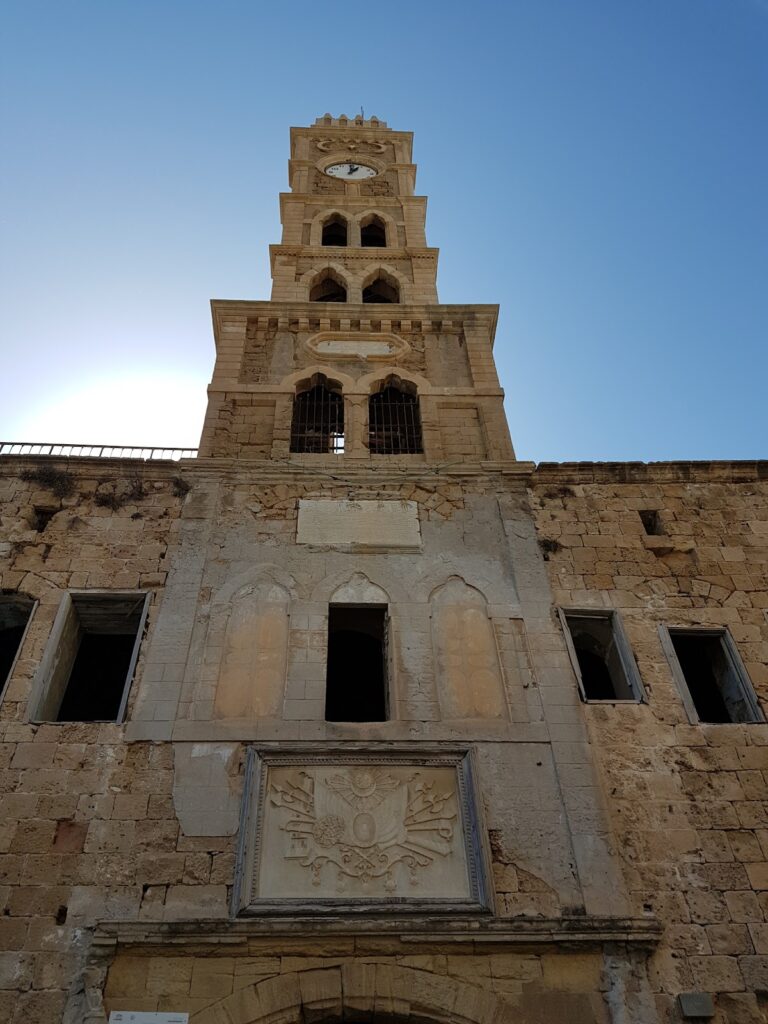
In the early eighteenth century, Acre’s governor moved his residence to the khan. French commercial activity reached its height toward the end of that century, until Ahmad al-Jazzar, the Ottoman governor of Acre, expelled the French merchants in 1791 and took control of the cotton-trade sector. The khan subsequently underwent several reconstructions, with additional floors and wings that substantially obscured its original appearance.
The Franciscan Terra Sancta School now occupies the northern and northeastern wings. Its institutional roots reach back to the beginning of the seventeenth century, while the school was formally established in 1960 and provides education from grades 1 through 8. The continued presence of the school, together with the preservation of the khan, forms part of the site’s modern institutional history. Khan el-Farangi is the oldest caravanserai in Acre to have survived intact.
Remains
Courtyard and entrances
Khan el-Farangi is an open caravanserai arranged around a spacious square courtyard, where merchants formerly unloaded their goods. Buildings were added around the courtyard over time, and successive alterations have largely obscured its original form. The entrance arrangement includes an opening toward the west and a covered passage with a barrel-vaulted ceiling leading from Julius Caesar Street on the south.
Southern facade
The surviving southern facade largely retains its original form. It is a two-storey structure with arcades on the ground floor and a vaulted gateway opening onto the street. This facade preserves the clearest part of the khan’s earlier external appearance amid the later additions.
Terra Sancta School wings
The northern and northeastern wings contain the Terra Sancta School. Two additional storeys were built above the khan for the school, creating a four-storey building in these sections. The school wing was extensively renovated and has a sloping roof covered with red tiles. The site is currently used mainly as a parking area.