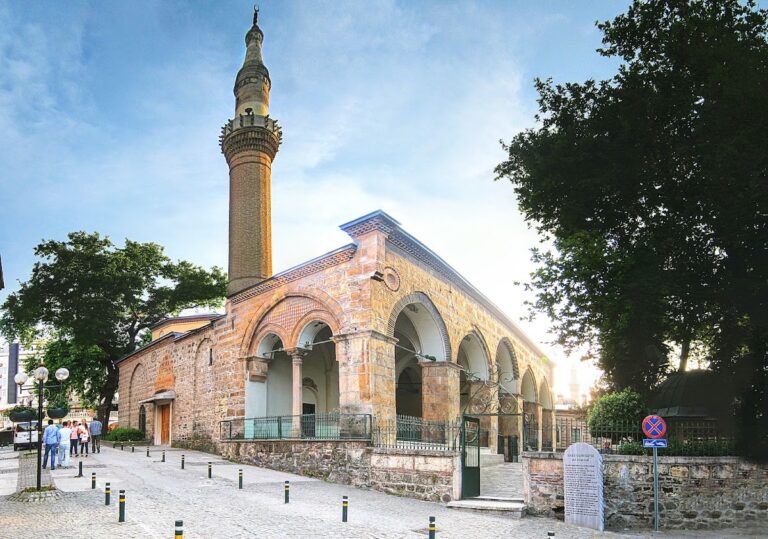
Pirinç Han: An Ottoman Commercial Han in Bursa


Site at a Glance
- Rating
- 4.2
- Popularity
- Medium
- Country
- Turkey
- Primary era
- Early Modern
- Eras represented
- Medieval, Early Modern, Modern
- Civilizations
- Ottoman
- Site type
- Economic
- Remains
- Caravanserai
On this page7 sections
History
Ottoman Foundation
Pirinç Han is an Ottoman commercial lodging complex in Bursa, Türkiye, commissioned by Sultan Bayezid II and built between 1490 and 1508 in the Ottoman period. It was the second han that Bayezid established in Bursa to generate income for his waqf foundations in Istanbul. A waqf was a legally established charitable or religious endowment whose revenues supported designated institutions or services. Pirinç Han was built near Koza Han, which Bayezid had commissioned earlier.
The architects were Yakup Şah bin Sultan Şah and Ali bin Abdullah. Ecebey bin Abdullah served as building superintendent, while Muhiddin was the overseer. The building was initially known by names meaning the New Imperial Han or Imperial Caravanserai. From the beginning of the seventeenth century, it became known as Pirinç Han.
Merchants and Craft Workers
A han was a commercial lodging and storage complex generally arranged around a courtyard for merchants, animals, workshops, and trading businesses. Pirinç Han stood in the Şehreküstü neighborhood, where many Venetian, Russian, and other Western European merchants lived. It became one of the hans most frequented by foreign merchants arriving in Bursa, and fur trading took place there. From the mid-sixteenth century, silk twisters also gathered at the han.
Earthquake Damage and Later Use
The 1855 Bursa earthquake completely destroyed the western and northern arcades and shops. Additions were later built in the courtyard and interior so that the damaged sections could be used again. Between 1903 and 1906, the northeastern corner was cut away during the opening of Hamidiye Avenue, now called Cumhuriyet Avenue.
Until the late 1970s, Pirinç Han housed leatherworking, shoe-manufacturing, silk-twisting, and silk-dyeing workshops. A restoration lasting approximately twenty years ended with the building’s opening as a shopping center in 2002. The work included a new doorway in the western facade. The prayer room and ablution fountain mentioned in historical registers were not reconstructed.
Remains
Courtyard and Rooms
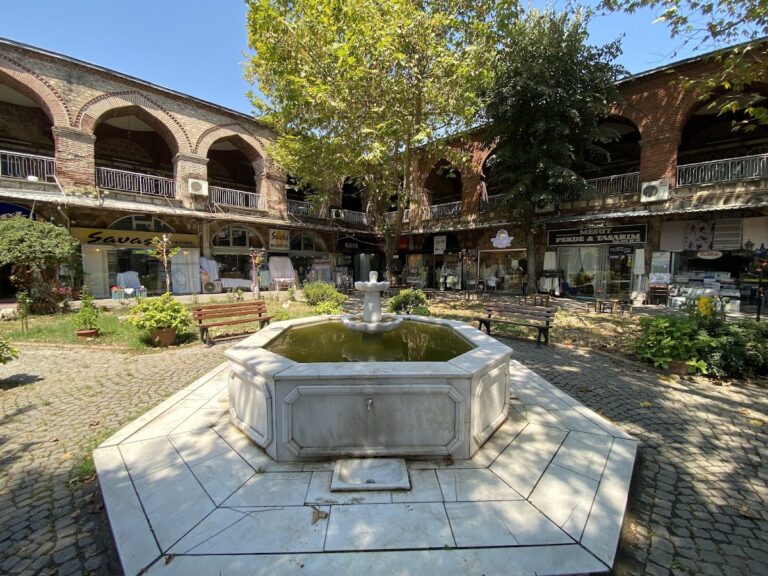
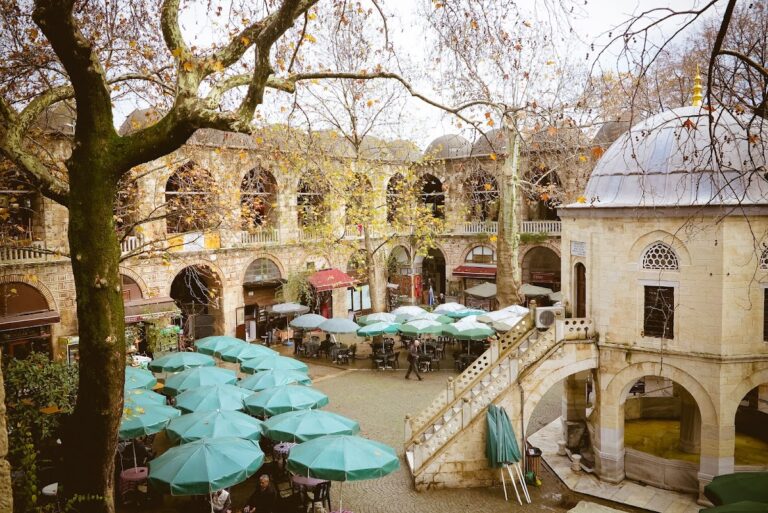
Pirinç Han stands on Cumhuriyet Avenue in Bursa’s central Hanlar District. Its plan is organized around a large square courtyard, with 38 rooms on the lower floor and 48 on the upper floor. Camel stalls and stables formed part of the commercial complex. The entrance is a 2.96-meter-wide, unarched doorway that opens directly onto the courtyard. The lower floor currently contains cafes, while some shops and offices occupy the upper floor.
Construction and Surviving Features
Stone and brick were used together throughout the building. The courtyard arches and their piers are made of cut stone, while brick forms the arches, domes, and vaults. The entrance facade combines cut stone with three courses of brick. Traces of an original sixteen-sided ablution fountain remain visible in the courtyard. The western and northern arcades and shops were destroyed in the 1855 earthquake, and later additions altered the courtyard and interior. The northeastern corner was removed for the opening of Hamidiye Avenue, while the modern restoration added an entrance to the western facade.