St George of the Latins: A Roman Catholic Parish Church in Famagusta, Cyprus


Site at a Glance
- Rating
- 4.4
- Popularity
- Very Low
- Country
- Cyprus
- Primary era
- Medieval
- Eras represented
- Medieval
- Civilizations
- Crusader, Kingdom of Cyprus
- Site type
- Religious
- Remains
- Church
History
St George of the Latins is a ruined Roman Catholic parish church in Famagusta, Cyprus, built by Frankish crusaders during the thirteenth-century Kingdom of Cyprus. Construction began in the first half of the thirteenth century and was probably completed in its final quarter, around 1275. The medieval Kingdom of Cyprus was a Latin Christian state whose rule shaped the church’s construction and use.
The church stood in the northern part of the old city, near the citadel. Its description as “of the Latins” distinguished it from the contemporary Orthodox Church of St George of the Greeks, which lay approximately five minutes to the east. As Famagusta’s first Roman Catholic parish church, it served the city’s Latin Christian community.
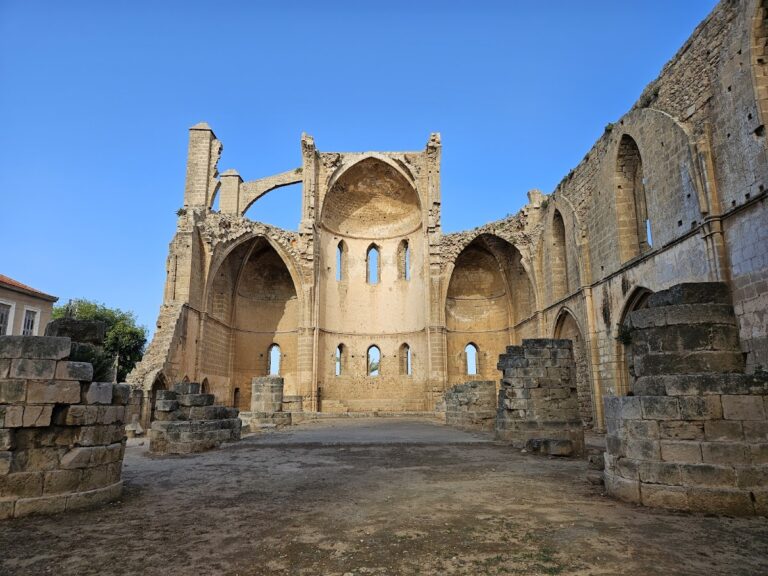
During the Ottoman siege of Famagusta in 1570–1571, bombardment inflicted severe damage on the church and destroyed much of its structure. The building was left in ruins, with only parts of its walls, apse, and portal surviving.
Remains
The surviving church was a single-nave basilica in the late or high Gothic style, a medieval tradition known for pointed forms, ribbed vaults, and elaborate stonework. It had four bays, cross-ribbed vaults supported by intersecting masonry ribs, and a polygonal choir formed with several angled sides rather than a semicircular end. Building materials from the nearby ruins of Salamis were incorporated into its construction.
Walls, Choir, and Portal
Portions of the north and east walls remain, together with part of the fine Gothic apse, the curved or polygonal end of the church’s choir. The south side and the vaults were lost in the bombardment of 1570–1571. The church’s architecture can be compared stylistically with Famagusta’s Cathedral of St Nicholas to the south. Formal inspiration has also been identified from the Sainte-Chapelle in Paris, a thirteenth-century royal Gothic chapel, and from other northern French Gothic buildings.
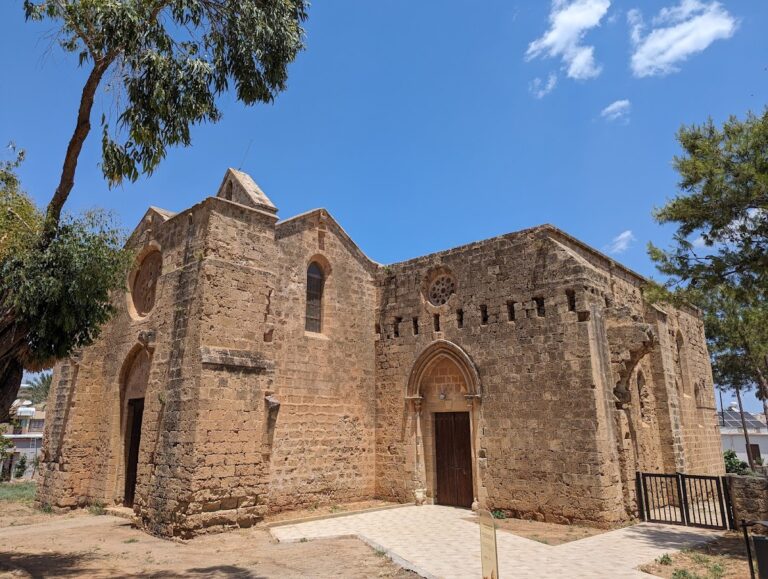
The north portal is the best-preserved entrance described at the site. Its remaining sculptural details include a waterspout shaped as a man holding one hand over his mouth, a lion attacking a lamb, and a bearded man positioned beside the portal. These carved elements survive within the fragmentary remains of the northern side.