St. Barnabas Monastery: An Orthodox Pilgrimage Monastery in Cyprus


Site at a Glance
- Rating
- 4.5
- Popularity
- Medium
- Country
- Cyprus
- Primary era
- Early Modern
- Eras represented
- Classical, Medieval, Early Modern, Modern
- Civilizations
- British, Byzantine, Ottoman, Roman
- Site type
- Religious
- Remains
- Monastery
On this page11 sections
History
St. Barnabas Monastery is a former Orthodox monastery in Cyprus, near Enkomi and about 2 to 3 kilometres west of the ancient city of Salamis, also known as Constantia. Founded in the fifth century, probably around AD 477, it was a Byzantine religious centre associated with Barnabas, an early Christian apostle traditionally linked with the evangelization of Cyprus. The monastery was a stauropegic institution, meaning that it stood directly under the authority of a senior church institution.
Foundation and Byzantine development
Tradition attributes the foundation to Anthemius, Archbishop of Cyprus, after the discovery of Barnabas’s grave. According to the account, Barnabas appeared to Anthemius in dreams and revealed where he had been buried. Anthemius then found the apostle’s remains together with a copy of the Gospel of Matthew. He took the relics to Constantinople, where Byzantine Emperor Zeno, who ruled from AD 474 to 491, granted recognition and privileges. This tradition is connected with the recognition of the Orthodox Church of Cyprus as autocephalous, or self-governing within the wider church.
The first foundation included a basilica and a monastic community. Arab raids in the late seventh century destroyed the basilica, and the complex was subsequently rebuilt. The remains of the early church were incorporated into a later building dated approximately to the ninth century, or around AD 900. After Constantia was abandoned toward the end of the eighth century, the monastery may have served for several centuries as a residence of the archbishops. The continuity of a monastic community during the whole of this period is uncertain, while the church continued to function as a pilgrimage church.
Later history and changing use
In the thirteenth century, Wilbrand of Oldenburg described the settlement around the church as destroyed. In 1735, Vasili Grigorovich Barski recorded the church, its monastic buildings, and its gardens. Archbishop Philotheos directed the work that gave the complex much of its present appearance, particularly the rebuilding carried out in 1756 and 1757.
Later changes included the construction of the east wing in 1916, repairs following earthquake damage in 1941, and the departure of the last monks by 1976. The final monks supported themselves by making and selling icons. After the events of 1974, control of the monastery passed to the Turkish Republic of Northern Cyprus. The circumstances of the monks’ departure are uncertain, but the last monk had left by 1976.
Since 1991, most of the complex has functioned as a museum rather than an active monastery. The church houses an icon museum, while other buildings contain an archaeological museum with material from northern Cyprus. A traditional fair held on June 11 was interrupted after 1974. Evening prayer and liturgy took place at the monastery again on June 21, 2005, for the first time since those events. Barnabas’s relics were eventually transferred to the Basilica of Saint Epiphanius at Constantia, although the monastery retained its association with the apostle’s burial place and pilgrimage tradition.
Remains
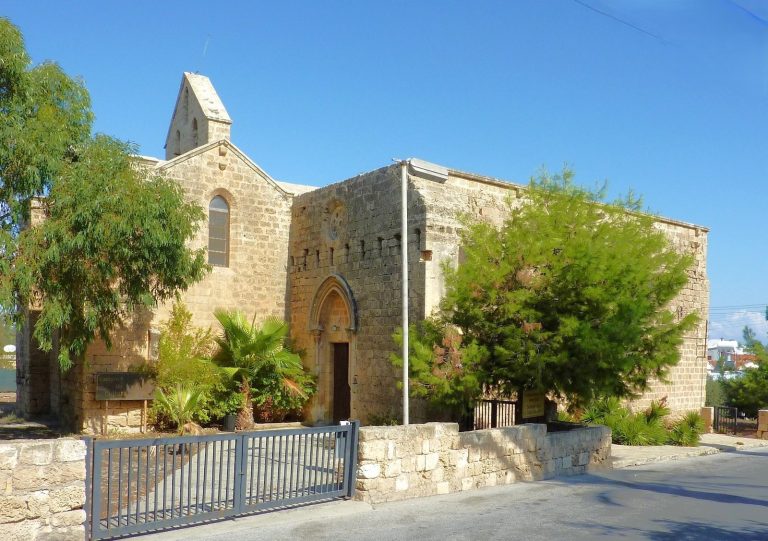
The surviving complex combines a cross-shaped, cross-domed church with monastic rooms, accommodation for visitors and pilgrims, gardens, a separate chapel, and later additions. Its present fabric incorporates elements of earlier construction, while the overall appearance reflects the substantial rebuilding of the eighteenth century.
Church and monastic buildings
Church
The original church was a three-naved basilica with a narthex, or entrance hall, two apses, and a wooden roof. The present church has a cross-shaped plan and two shallow domes set on high drums. It is also described as a three-naved cross-domed church. Earlier basilica remains survive within the later structure. The interior includes an iconostasis, a screen separating the sanctuary from the main worship space, together with a collection of icons. Several twentieth-century frescoes depict the tradition of Barnabas’s burial, the discovery of his remains, and the monastery’s foundation.
Monastic complex
Rooms for the monks were arranged around a courtyard beside the early basilica, with additional accommodation for visitors and pilgrims travelling toward the Holy Land. The complex also included gardens and an aqueduct that supplied water. Its present arrangement includes the church, monastic rooms, visitor accommodation, and a separate chapel east of the main church. The east-wing building was added in 1916, and an entrance and windows were opened in the southern wall. A bell tower was built in 1958, while the mausoleum was renovated in 1953 and earthquake damage to the complex was repaired in 1962.
Chapel and burial crypt
Chapel
The chapel east of the monastery was built in 1954 after an earlier chapel had been demolished. A stone staircase leads downward from the chapel to the rock-cut crypt associated with Barnabas’s burial place.
Crypt and spring
The crypt contains two cavities, including a Roman-period tomb traditionally identified as Barnabas’s burial place. A well beside the right-hand arcosolium, an arched burial recess cut into rock or a wall, produces spring water traditionally credited with healing properties. Pilgrims visited the burial place throughout the monastery’s history. The crypt walls once carried frescoes, of which only very small fragments survive.
Archaeological and icon collections
Part of the monastery houses an archaeological museum containing material from the Neolithic period through the Byzantine period. The collections include Bronze Age objects, finds from the historical Greek periods, Roman-period material, and pottery associated with the ancient Salamis area. Bronze Age pottery is dated approximately to 2300 to 2075 BC and 1900 to 1625 BC. The collection also includes an Archaic-period ceramic object dated approximately to 850 to 750 BC.