Heilig-Kreuz-Kirche: A Medieval Parish Church in Lemwerder, Germany


Site at a Glance
- Rating
- 4.8
- Popularity
- Very Low
- Country
- Germany
- Primary era
- Medieval
- External website
- Open
- Eras represented
- Medieval, Early Modern, Modern
- Civilizations
- Holy Roman Empire
- Site type
- Religious
- Remains
- Church
On this page13 sections
History
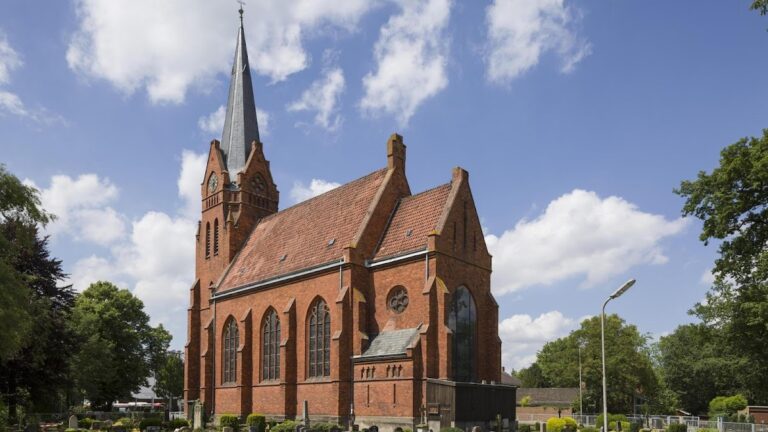
Heilig-Kreuz-Kirche is a medieval Evangelical Lutheran parish church in Germany, serving Bardewisch in the municipality of Lemwerder. The present building was constructed in the first half of the fourteenth century according to a plan influenced by Westphalian models. Its dedication to the Holy Cross, referring to the cross on which Jesus was crucified, has been recorded since the fourteenth century.
Medieval parish and jurisdiction
A church at Bardewisch was first mentioned in 1245, while an associated cemetery was recorded in 1324. These references place the parish within a long-established medieval religious landscape before the construction of the current church. The parish belonged to the ecclesiastical court district of Berne, and the provost of Bremen Cathedral exercised jurisdiction over it.
The church was built as the parish church of Bardewisch during the first half of the fourteenth century. Its design reflects architectural influences from Westphalia, while the arrangement of its roofs and other features also connects it with building traditions found in Flanders and the Netherlands.
Later development and preservation
The church continued in use through later architectural and artistic periods. Changes included the alteration of its windows in the post-Gothic period, the installation of a Rococo altarpiece in 1764, and the addition of paintings for the organ gallery in 1725. The pulpit and altar rail belong to the early Gothic Revival, a nineteenth-century movement that revived medieval Gothic forms.
The church’s large parish bell was cast in Bremen in 1794 by Johann Philipp Bartels. A second bell, known as the Cross Bell, was made in Heidelberg in 1970 by Friedrich Wilhelm Schilling. A comprehensive renovation took place between August 2016 and September 2017. Jan Janssen, Bishop of Oldenburg, reopened the church on the First Sunday of Advent in 2017. The parish remains part of the Wesermarsch church district within the Evangelical Lutheran Church in Oldenburg.
Remains
Heilig-Kreuz-Kirche is a three-aisled brick hall church, a design in which the nave and side aisles have similar heights and form a unified interior space. The nearly square nave has three bays and is covered by nine cross-rib vaults, whose intersecting masonry ribs support the vaulted ceilings. A polygonally closed choir and a compact western tower are attached directly to the church, without an intervening transept.
Church structure and entrances
Nave, aisles, and tower
The nave and both side aisles have separate roofs running lengthwise. This arrangement is rare in Germany but customary in Flanders and the Netherlands. The outer walls of both aisles curve outward, a feature also found in several churches in East Frisia, especially the Romanesque-Gothic church at Eilsum.
Inside the nave, the projecting supports from which the arches and vaults begin are set at a common level, although the vault crowns of the side aisles are lower. The capitals and corbels, which are projecting brackets supporting masonry or vaults, are made of brick. Some are shaped as heads. The large bell chamber extends to the top of the western tower without an intermediate floor. Its bell platform carries an iron frame.
Portals and windows
The two side portals are placed in the western bay, one on the north side and one on the south side. Each was originally topped by a Gothic gable, a pointed decorative feature above a portal, with a round window above it. The other windows were altered during the post-Gothic period.
An opening on the outside that resembles a second southern portal at the western choir bay does not lead into the church interior. It forms part of the building’s external appearance rather than serving as an entrance.
Interior furnishings and paintings
Medieval and eighteenth-century decoration
Late Gothic wall paintings dating from around 1500 survive inside the church. They include an image of Saint Christopher, who is traditionally regarded as a protector of travelers. The paintings are partly heavily overpainted, but they remain evidence of the church’s medieval decorative program.
The Rococo altarpiece was commissioned in 1764 from the Bremen sculptor Johan Krußbecker. Its central painting represents the penitent Mary Magdalene, a prominent New Testament figure often shown in penitential imagery. A baptismal bowl from the second half of the seventeenth century is held by an angel.
Organ gallery and Gothic Revival fittings
Paintings depicting scenes from the life of Jesus were made in 1725 for the organ gallery at the western end of the church. The pulpit and altar rail date from the middle of the nineteenth century and reflect the early Gothic Revival.
Bells and organ
Bell chamber
The 1794 parish bell has a diameter of 107 centimetres and sounds the pitch F-sharp. It was cast in Bremen by Johann Philipp Bartels. The 1970 Cross Bell sounds the pitch B and was cast in Heidelberg by Friedrich Wilhelm Schilling. A clock bell is mounted externally at the top of the tower.
Nineteenth-century organ
The organ was built in 1859 by the Oldenburg organ builder Johann Claussen Schmid and rebuilt in 1957 by Gustav Brönstrup. It has 14 stops distributed across two manuals and a pedal. The upper division includes a double flute with a tone resembling a barrel organ. Six stops remain entirely original, while three others retain parts of their original material.