Old Church Witikon: An Evangelical Reformed Church in Zurich


Site at a Glance
- Rating
- 4.7
- Popularity
- Very Low
- Country
- Switzerland
- Primary era
- Early Modern
- Eras represented
- Medieval, Early Modern, Modern
- Civilizations
- Holy Roman Empire, Swiss
- Site type
- Religious
- Remains
- Church
On this page12 sections
History
Old Church Witikon is an Evangelical Reformed church in Zurich, Switzerland, first documented in 1270. It began as a chapel dedicated to Saint Otmar, an early medieval Christian saint and monastic founder. The church stands within Witikon’s historic core and is associated with a churchyard established before AD 1000, described as the oldest cemetery in Zurich that remains in use.
Medieval origins and the Reformation
The early chapel served the religious life of Witikon before becoming an Evangelical Reformed church. During the sixteenth-century Reformation, the movement that established Protestant churches in parts of Europe, Wilhelm Röibli preached there. His association with the Anabaptists, a radical Reformation movement that rejected infant baptism and emphasized adult baptism, led to his expulsion from the country.
Johann Jakob Wick, who served as pastor of Witikon, gathered illustrated broadsheets and single-leaf prints. His collection, known as the Wickiana, grew into one of the most important sixteenth-century news collections. It comprises two dozen volumes covering subjects such as witchcraft, murder, wartime atrocities, monsters, and unusual natural events.
Expansion and later alterations
The church received its first roof turret in 1612. In 1768, a larger choir was built, changing the interior into a spacious preaching room. Further work followed in 1820, 1889, and 1901. These alterations introduced a new gallery, a new choir window, and a new roof turret.
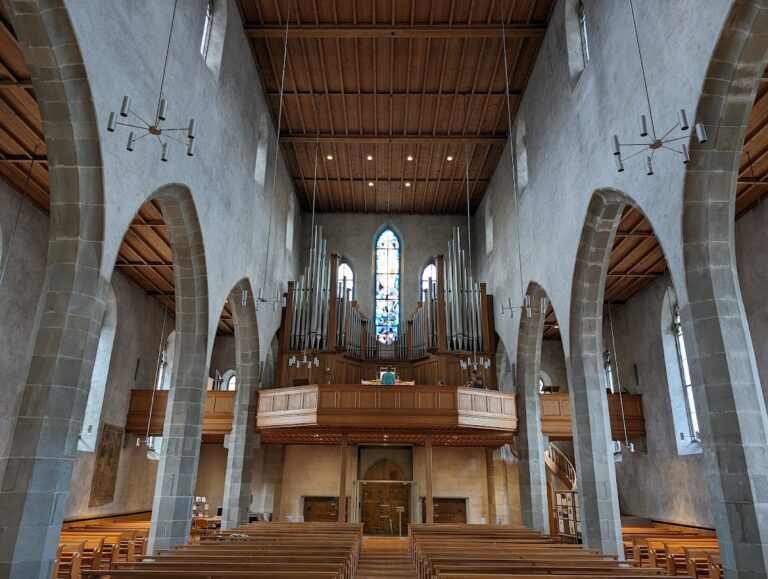
A complete renovation took place in 1926. In 1939 and 1940, the church received a sacristy, new pews, wood wall panelling, and a new gallery parapet. The sacristy is also dated to 1948 in descriptions of the building. The choir was renovated in 1975, when a new organ was installed along its east and north walls.
Witikon in the conflict of 1799
During the fighting of 1799, French troops commanded by General André Masséna used the church hill as a fortress. Masséna was a French Revolutionary and Napoleonic general who commanded forces during the Revolutionary and Napoleonic Wars. Austrian troops surprised the French position and drove them from Witikon after fighting. Two cannonballs from the conflict remain embedded in the church’s exterior wall.
In the twentieth century, a building ban was imposed on the surrounding meadows to preserve the church’s distinctive appearance. The restriction also prevented the historic churchyard from expanding, so a new cemetery was built on Witikonerstrasse.
Remains
Old Church Witikon stands at an elevation of 629 metres on a hilltop in the centre of Witikon’s historic core. It is the highest-altitude church in the city of Zurich. The churchyard occupies a roughly teardrop-shaped area around the building, while the protected meadows preserve the open setting of the hilltop. Legends connect this height with a former Celtic cult site.
Church building and interior
Nave, choir, and sacristy
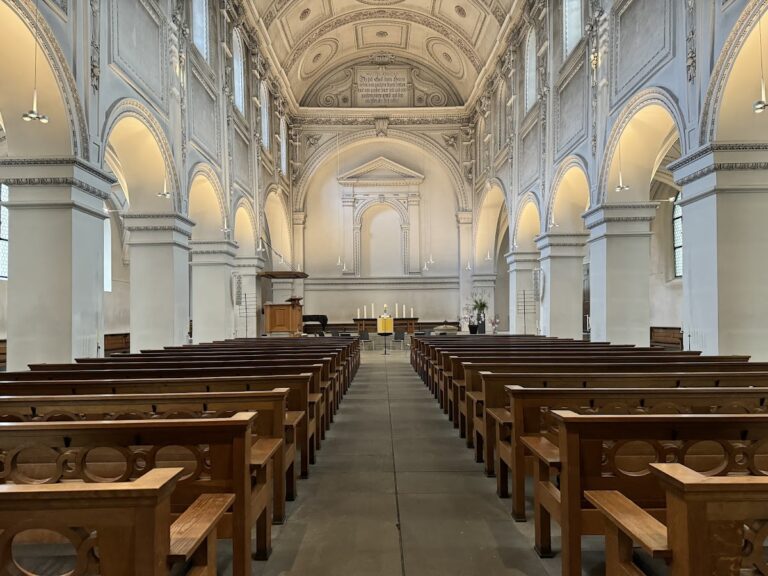
The church has a longitudinally rectangular nave, the main body of the building, and a transversely rectangular choir, the area traditionally reserved for clergy and singers near the altar. A sacristy, a service room for liturgical objects and vestments, stands on the north side. Entrances are placed on the west and south sides. Inside, the plain room is enclosed by a flat wooden ceiling. Its fittings include a western gallery parapet and a baptismal font dated 1715.
Choir windows and fountain
The choir windows were designed by Max Billeter in 1939. In front of the church is a fountain with a round basin and a kneeling figure made by Arnold Gygi in 1938.
Roof turret and organ
Bells
Three bells hang in the roof turret. They form the sequence a’, cis”, e” and were cast in 1879 by Jakob Keller II in Zurich-Unterstrass.
Organ
The present organ was built in 1970 by Neidhart & Lhôte of St-Martin, Neuchâtel. It has 15 sounding stops, an extension, two manuals, and a pedal. The stops control sets of pipes, the manuals are keyboards played by the hands, and the pedal is the keyboard played by the feet. Orgelbau Metzler AG of Dietikon revised the instrument in 1999.
Evidence of the 1799 fighting
Two cannonballs from the fighting between French and Austrian forces in 1799 remain set into the church’s outer wall. They preserve a direct physical reminder of the church hill’s military use during the conflict.